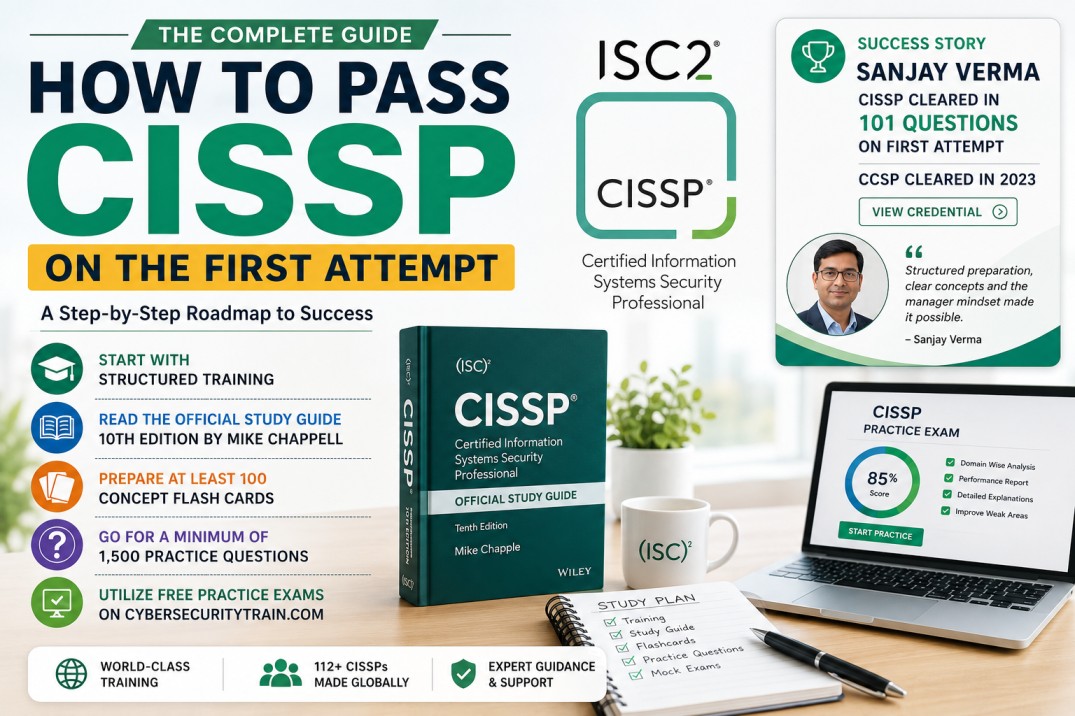
How to Pass CISSP on the First Attempt: A Complete Step-by-Step Study Plan
Learn how Sanjay Verma cleared CISSP on his first attempt in 101 questions, then follow a structured preparation roadmap covering training, the Official Study Guide, 100 concept flashcards, 1,500 practice questions, the CISSP manager mindset, exam scheduling and final revision.
How Sanjay Verma Cleared CISSP on His First Attempt in Just 101 Questions
A practical example of how structured preparation, conceptual clarity, consistent practice and the CISSP manager mindset can support exam readiness.
Mr. Sanjay Verma completed his ISC2 CISSP certification in 2021 on his first attempt. His computer-adaptive examination concluded after 101 questions, which is close to the minimum number of items used in the CISSP adaptive examination format.
CISSP is not simply a test of technical definitions. Candidates must demonstrate judgement across governance, risk, architecture, identity, network security, operations, assessment and software security. Sanjay approached the examination as a security leader rather than as a specialist focused on only one technology.
What Does Passing at 101 Questions Mean?
The CISSP examination uses Computerized Adaptive Testing. The system adapts to the candidate's demonstrated ability and continues until it can make a sufficiently confident pass-or-fail decision under the applicable exam rules.
Completing the examination at 101 questions is an impressive outcome, but it does not prove that almost every answer was correct. ISC2 does not disclose the candidate's exact number of correct answers.
It does indicate that the adaptive examination reached a passing decision very early in the available question range, reflecting strong and consistent performance across the tested domains.
Sanjay prepared to think like a security manager. He considered governance, policy, risk, legal obligations, people, evidence, process, business impact and sustainable controls before choosing technical actions.
After completing CISSP, he continued his professional development and completed the ISC2 CCSP certification in 2023, adding cloud-security specialization to his broader cybersecurity knowledge.
Verify Sanjay Verma’s CISSP Credential
View his publicly issued CISSP digital badge to verify the credential and understand the skills represented by the certification.
Could this become your success story? CISSP success is not built on shortcuts. It requires structured learning, a trusted study guide, concept revision, disciplined practice and the ability to think like a responsible security leader.
How to Pass CISSP on the First Attempt
Preparing for CISSP can feel overwhelming because the syllabus is broad, the questions are judgement-based and the exam expects candidates to think beyond individual security products and tools.
A structured preparation process can make the journey much more manageable. Build your plan around these four essential activities:
Important: No ethical trainer, book, training provider or question bank can guarantee an examination result. However, high-quality training, disciplined preparation and proper guidance can significantly improve a candidate’s readiness and confidence.
What Is CISSP?
CISSP stands for Certified Information Systems Security Professional. It is offered by ISC2 and is designed for experienced cybersecurity professionals who understand security leadership, risk management, architecture, operations and programme management.
CISSP is broad rather than limited to one technology. It covers governance, asset security, architecture, networking, identity, security testing, operations and software security.
CISSP in Simple Words
CISSP validates that you can look at cybersecurity from an organisational perspective—not only as a firewall engineer, SOC analyst, auditor or penetration tester, but as a professional who understands how people, process, technology, risk and business objectives work together.
Who Should Pursue CISSP?
Security Engineers and Architects
Professionals who want to move from individual technologies toward enterprise security design and architecture.
SOC and Incident-Response Professionals
Analysts and managers who want broader knowledge of governance, risk, architecture and security programmes.
GRC and Audit Professionals
Professionals working in risk, compliance, control testing, audit and security governance.
Cybersecurity Managers
Professionals responsible for people, programmes, policies, vendors, risks and business security decisions.
CISSP may not be the right first certification for someone with no cybersecurity or IT background. Beginners should first develop networking, security, operating-system and risk-management fundamentals.
CISSP Prerequisites and Experience Requirements
ISC2 requires candidates seeking the full CISSP certification to demonstrate cumulative professional experience across the CISSP domains. Candidates who pass the examination but do not yet meet the required experience may be eligible for the Associate of ISC2 pathway, subject to current ISC2 rules.
| Requirement | What Candidates Should Know |
|---|---|
| Professional experience | ISC2 currently requires five years of cumulative full-time professional experience. |
| Domain coverage | Experience must cover at least two domains from the current CISSP exam outline. |
| Experience waiver | Qualifying education or approved credentials may satisfy part of the requirement under ISC2 rules. |
| Associate pathway | Candidates who pass before meeting the full experience requirement may pursue the Associate of ISC2 route while building experience. |
| Endorsement | After passing, eligible candidates must complete the ISC2 endorsement process. |
Review the latest details on the official ISC2 CISSP experience-requirements page before registering.
CISSP Exam Format
The English CISSP examination uses Computerized Adaptive Testing. Exam policies can change, so candidates should verify the current format before booking.
| Area | Exam Information |
|---|---|
| Exam duration | Up to three hours under the current English CAT format. |
| Number of items | Approximately 100–150 items. |
| Item types | Multiple-choice and advanced item types. |
| Delivery | Pearson VUE testing centres under ISC2 examination rules. |
| Exam approach | Knowledge, judgement, risk-based decision-making and application across all eight domains. |
Review the official ISC2 before-your-exam guidance and the current CISSP exam outline .
The Eight CISSP Domains
Domain 1: Security and Risk Management
Governance, policies, legal and regulatory topics, ethics, risk, awareness, business continuity and security leadership.
Domain 2: Asset Security
Information classification, ownership, privacy, retention, handling, disposal and data lifecycle protection.
Domain 3: Security Architecture and Engineering
Security models, cryptography, secure design, physical security, vulnerabilities and architecture principles.
Domain 4: Communication and Network Security
Network architecture, protocols, secure communication, segmentation, wireless and network attacks.
Domain 5: Identity and Access Management
Authentication, authorisation, identity lifecycle, access models, federation and privileged access.
Domain 6: Security Assessment and Testing
Audit, assessment, testing strategies, control validation, penetration testing and security metrics.
Domain 7: Security Operations
Incident response, investigations, logging, monitoring, vulnerability management, disaster recovery and operations.
Domain 8: Software Development Security
Secure SDLC, application risks, development models, DevSecOps, testing and software security controls.
The Four Essential Steps to Pass CISSP
1 Start with Structured CISSP Training
Structured training gives you a defined sequence, explains difficult topics and helps you understand how concepts connect across domains.
Without structure, many learners jump between videos, question banks and random notes. This creates fragmented knowledge and weakens retention.
Your training should include:
- Complete coverage of all eight domains
- Concept explanation rather than slide reading
- Scenario-based discussions
- Domain-level assessments
- Manager-mindset guidance
- Revision support and doubt clarification
- Practice-question analysis
- A realistic study timetable
Trainer-selection tip: Learn from a certified and experienced trainer who can connect CISSP concepts with real security programmes, risk decisions and business situations.
2 Read the Official Study Guide, 10th Edition
Use the ISC2 CISSP Certified Information Systems Security Professional Official Study Guide, 10th Edition by Mike Chapple, James Michael Stewart and Darril Gibson.
The book should not be read like a novel. Use an active-reading approach.
Recommended reading method:
- Read the corresponding chapter after each training session.
- Highlight only definitions, decision points and comparisons.
- Write a one-page summary for every major topic.
- Convert difficult concepts into flashcards.
- Attempt chapter questions without checking answers first.
- Record incorrect answers in an error log.
- Revisit weak chapters during final revision.
View the book on the official Wiley website .
3 Prepare at Least 100 Concept Flashcards
Flashcards are valuable because CISSP contains many similar concepts, frameworks, roles, processes and security models. Flashcards support active recall and spaced repetition.
What to include on flashcards:
- Risk appetite versus risk tolerance
- Due care versus due diligence
- Policy versus standard versus procedure
- Authentication versus authorisation
- RTO versus RPO
- Due process and legal concepts
- Symmetric versus asymmetric cryptography
- Data owner versus data custodian
- Preventive, detective and corrective controls
- Recovery strategies
- Security models
- Software-development approaches
A practical target is:
- 12–15 flashcards for each weaker domain
- 5–10 cards for stronger domains
- Daily review of 20–30 cards
- Weekly rewriting of cards that are too vague
4 Complete at Least 1,500 Practice Questions
Practice questions are essential, but the number alone will not make you ready. The real value comes from reviewing why each option is right or wrong.
Recommended question distribution:
| Preparation Stage | Questions | Purpose |
|---|---|---|
| Domain learning | 600 | Build and test domain-level knowledge. |
| Mixed-domain practice | 400 | Learn to switch between topics and recognise the tested concept. |
| Scenario-based practice | 300 | Develop judgement and manager-level thinking. |
| Mock examinations | 200+ | Improve focus, timing and readiness. |
Do Not Memorize Question Banks
Memorising answers creates false confidence. For every incorrect question, identify the concept, why your reasoning failed and what clue in the question should have changed your decision.
Use the Free CISSP Practice Exam
CybersecurityTRAIN.com provides a free CISSP practice examination to help candidates test their understanding, identify weak domains and become more comfortable with scenario-based questions.
Do not use the test only to calculate a score. Review every incorrect or uncertain answer and convert difficult concepts into revision notes or flashcards.
How to Review Practice Questions Correctly
Create an error log with these columns:
| Question Topic | My Answer | Correct Concept | Why I Was Wrong | Action |
|---|---|---|---|---|
| Incident response | Immediately isolate every system | Follow the approved response process and preserve evidence | I selected a technical action before governance and evidence requirements | Review incident-response phases |
| Risk treatment | Security team accepts risk | The authorised business owner accepts residual risk | I confused technical ownership with business accountability | Create a flashcard |
After every 100 questions, review:
- Your weakest domain
- Your most common reasoning mistake
- Concepts you repeatedly confuse
- Questions where you acted before assessing
- Questions where you chose a tool instead of a process
How to Think Like a Manager in CISSP
The phrase “think like a manager” does not mean selecting the least technical answer every time. It means making decisions using governance, risk, business impact, legal obligations, policy, process and long-term security effectiveness.
The CISSP Manager Mindset
- Understand the business objective before selecting a control.
- Identify and assess risk before acting.
- Follow approved policy and process.
- Protect people and human safety first.
- Respect legal, regulatory and contractual obligations.
- Preserve evidence during investigations.
- Recommend risk treatment; authorised business owners accept risk.
- Choose sustainable solutions instead of temporary fixes.
- Use least privilege and defence in depth.
- Address root causes where possible.
Technical Answer vs Manager Answer
| Scenario | Reactive Technical Thinking | CISSP Manager Thinking |
|---|---|---|
| A serious vulnerability is discovered | Patch every system immediately. | Assess exposure, criticality, testing requirements, change process and treatment priority. |
| A security incident occurs | Delete the malicious file. | Follow the incident-response plan, preserve evidence, contain the incident and coordinate stakeholders. |
| A residual risk remains | The security administrator accepts it. | The authorised risk owner makes an informed decision based on business impact. |
| A vendor will process sensitive data | Install additional monitoring software. | Perform due diligence, risk assessment, contract review and control validation before onboarding. |
Read the detailed guide: Demystifying the CISSP Common Body of Knowledge: How to Think Like a Manager .
A Complete 120-Day CISSP Preparation Plan
1 Days 1–15: Orientation and Baseline
- Download the current CISSP exam outline.
- Take a baseline test without overanalysing the score.
- Identify strong and weak domains.
- Set a weekly study schedule.
- Begin structured training.
2 Days 16–55: Complete All Eight Domains
- Attend training domain by domain.
- Read corresponding chapters in the Official Study Guide.
- Create chapter summaries.
- Complete 50–75 questions per domain.
- Start building your 100 flashcards.
3 Days 56–75: First Revision
- Review all eight domain summaries.
- Complete mixed-domain questions.
- Revise incorrect-answer logs.
- Read the manager-mindset guide.
- Focus on concepts you repeatedly confuse.
4 Days 76–95: Scenario Practice
- Practise judgement-based questions.
- Explain why three options are weaker than the best answer.
- Review governance, risk, legal and operations concepts.
- Practise choosing process before tool where appropriate.
5 Days 96–110: Mock Exams
- Attempt full-length timed mock examinations.
- Simulate exam conditions.
- Avoid interruptions and reference materials.
- Review all uncertain answers, not only wrong answers.
- Revisit weak topics in the study guide.
6 Days 111–120: Final Revision
- Review 100 flashcards daily in smaller groups.
- Review processes, frameworks and comparison topics.
- Read your error log.
- Avoid starting new, large resources.
- Prepare exam logistics and identification.
- Reduce study intensity during the final day.
Recommended Weekly Study Schedule
| Day | Activity | Suggested Duration |
|---|---|---|
| Monday | Training lesson and concept notes | 90 minutes |
| Tuesday | Official Study Guide reading | 60–90 minutes |
| Wednesday | Practice questions and error-log review | 60 minutes |
| Thursday | Next lesson and flashcards | 90 minutes |
| Friday | Revision of weak concepts | 60 minutes |
| Saturday | Domain test or mixed-question set | 2 hours |
| Sunday | Weekly review and next-week planning | 60 minutes |
How to Know You Are Ready for the CISSP Exam
Do not use one practice-test score as your only readiness indicator.
- You have completed structured coverage of all eight domains.
- You have read the Official Study Guide or thoroughly covered its concepts.
- You have created and revised at least 100 concept flashcards.
- You have completed at least 1,500 quality practice questions.
- You can explain why incorrect options are weaker.
- Your mock scores are consistently improving across different sources.
- You can identify business, legal, human-safety and risk considerations.
- You are no longer depending on memorised wording.
- You can maintain focus during a full timed mock examination.
Readiness is consistency, not perfection. The goal is not to know every sentence from every book. The goal is to make reliable security decisions across all eight domains.
How to Schedule the CISSP Exam
ISC2 certification examinations are scheduled through the candidate’s ISC2 account and delivered through Pearson VUE.
Step 1: Create or Access Your ISC2 Account
Visit the official ISC2 website and sign in or create an account.
Step 2: Select CISSP
Open the certification or examination area and select the CISSP exam.
Step 3: Purchase or Register
Follow the current ISC2 registration and payment instructions.
Step 4: Open Courses and Exams
After registration, return to your ISC2 dashboard and open the Courses and Exams section.
Step 5: Continue to Pearson VUE
Select Schedule. You will be directed to the relevant Pearson VUE scheduling workflow.
Step 6: Select Test Centre, Date and Time
Choose an available centre and appointment. Verify your name carefully because it must match the identification accepted under the current examination policy.
Official scheduling resources:
CISSP Exam-Day Strategy
Read the Final Sentence Carefully
Identify what the question is asking: first action, best response, primary concern, most effective control or ultimate responsibility.
Identify Your Role
Determine whether you are acting as a manager, security officer, auditor, architect, investigator or technical administrator.
Look for Process and Risk
Before choosing a tool or technical action, consider assessment, policy, approval, evidence, legal obligations and business impact.
Select the Best Answer
More than one option may appear correct. Choose the option that most completely addresses the question from the appropriate role.
Quick Exam Checklist
- Read every qualifier: first, best, most, least and primary.
- Do not add facts that are not stated in the question.
- Do not choose a technical fix before understanding the problem.
- Prioritise human safety where applicable.
- Preserve evidence during investigation scenarios.
- Follow policy and approved process.
- Do not panic when questions feel unfamiliar.
- Focus on one question at a time.
Common Reasons Candidates Struggle
Using Too Many Resources
Jumping between many books and videos creates confusion. Use one primary book, structured training and selected practice resources.
Ignoring Weak Domains
Candidates often over-study their professional speciality and avoid unfamiliar domains.
Memorising Practice Answers
Repeated question banks can create familiarity without real understanding.
Thinking Only Technically
CISSP expects governance, risk and business awareness, not only configuration knowledge.
Booking Too Early
An exam date can create motivation, but booking before completing all domains can create unnecessary pressure.
Ignoring Exam Logistics
Name mismatches, identification issues, travel delays and poor rest can affect exam-day performance.
Final First-Attempt CISSP Checklist
- Complete structured CISSP training.
- Download the current ISC2 exam outline.
- Read the Official Study Guide, 10th Edition.
- Prepare at least 100 concept flashcards.
- Complete at least 1,500 quality practice questions.
- Maintain an incorrect-answer log.
- Read the CISSP manager-mindset guide.
- Take multiple timed mock examinations.
- Revise all eight domains.
- Verify eligibility and endorsement requirements.
- Schedule through the official ISC2 and Pearson VUE process.
- Review exam-day identification and policies.
- Rest properly before the examination.
Success formula: Structured training + Official Study Guide + 100 flashcards + 1,500 practice questions + manager mindset + disciplined revision.
Prepare for CISSP with Proven, Structured Guidance
Passing CISSP requires more than watching videos or memorising practice answers. Candidates need complete domain coverage, conceptual clarity, scenario-based preparation, revision discipline and the ability to think like a security manager.
CybersecurityTRAIN.com reports that its training and mentoring programmes have supported 112 professionals across the globe in becoming CISSP certified.
Our objective is to provide world-class CISSP and CCSP training through experienced, certified professionals who understand both examination strategy and real-world cybersecurity.
Candidates receive guidance on:
- All eight CISSP domains
- The CISSP manager mindset
- Study planning and domain sequencing
- Conceptual and scenario-based questions
- Practice-test analysis
- Weak-domain improvement
- Revision and exam-readiness planning
- CISSP and CCSP career direction
While no ethical training provider can guarantee an exam result, we assure learners of committed guidance, structured preparation, experienced mentorship and high-quality training throughout their CISSP or CCSP journey.
Enquire About CISSP Training Take the Free CISSP Practice Exam Learn How to Think Like a ManagerCall or WhatsApp: +91 98857 89887
Frequently Asked Questions
1. Can I pass CISSP on the first attempt?
Many candidates pass on their first attempt, but no outcome can be guaranteed. Structured preparation, complete domain coverage, practice questions and strong judgement improve readiness.
2. How long should I study for CISSP?
Many working professionals prepare over three to four months. The appropriate duration depends on professional experience, domain familiarity and weekly study time.
3. Which book should I use for CISSP?
A strong primary resource is the ISC2 CISSP Certified Information Systems Security Professional Official Study Guide, 10th Edition by Mike Chapple, James Michael Stewart and Darril Gibson.
4. How many practice questions should I complete?
A target of at least 1,500 well-reviewed questions gives broad exposure, provided you analyse the explanations instead of memorising answers.
5. Are 100 flashcards enough?
One hundred is a useful minimum. Candidates with more weak areas may need additional cards. Quality and regular revision matter more than the exact number.
6. What does “think like a manager” mean?
It means considering governance, risk, business objectives, human safety, legal obligations, policy and sustainable controls before selecting a technical action.
7. Do I need five years of experience before taking the exam?
Candidates may take the exam before meeting the full experience requirement, but certification status and the Associate pathway are governed by current ISC2 rules.
8. Where is the CISSP exam conducted?
ISC2 examinations are delivered through approved Pearson VUE testing centres, subject to current regional availability and examination policies.
9. Should I rely only on free practice questions?
No. Free practice questions are helpful, but they should supplement structured training, the Official Study Guide, revision and varied scenario-based practice.
10. Is CISSP a technical or managerial certification?
CISSP includes technical concepts but expects candidates to understand them within governance, architecture, risk, operations and organisational decision-making.
11. What score should I get in mock exams?
Rather than depending on one score, look for consistent performance across different sources, strong explanations and improvement in weak domains.
12. Where can I take a free CISSP practice exam?
CybersecurityTRAIN.com provides a free CISSP practice test at CybersecurityTRAIN CISSP Practice Test .
13. How can I verify Sanjay Verma’s CISSP credential?
You can view his public CISSP digital badge on Credly .
14. Where can I learn the CISSP manager mindset?
Read the CybersecurityTRAIN guide, “Demystifying the CISSP Common Body of Knowledge: How to Think Like a Manager,” and practise applying its principles to scenario-based questions.