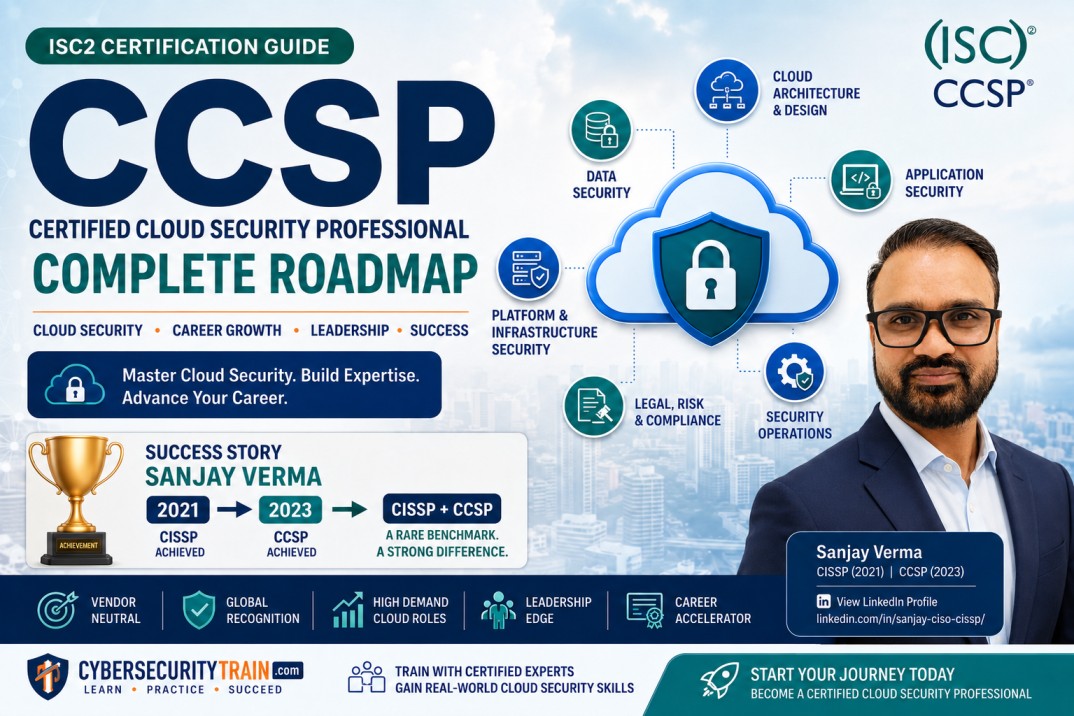
CCSP Certification Roadmap: How to Become a Certified Cloud Security Professional
Want to build serious credibility in cloud security? This complete CCSP roadmap explains the ISC2 Certified Cloud Security Professional certification, exam domains, eligibility, CISSP-to-CCSP path, preparation strategy, career value, job roles, and Sanjay Verma’s CISSP-to-CCSP success story.
Cloud security has become one of the most important areas of cybersecurity. Organizations are moving applications, identities, data, workloads, APIs and business operations to cloud platforms such as AWS, Microsoft Azure, Google Cloud and SaaS environments. This shift has created strong demand for professionals who understand cloud architecture, cloud risks, identity security, data protection, compliance and secure operations.
This is where CCSP, the Certified Cloud Security Professional certification from ISC2, becomes highly valuable. CCSP is designed for professionals who want to prove advanced knowledge in securing cloud data, applications and infrastructure.
Simple career message: If CISSP proves that you understand broad cybersecurity management and architecture, CCSP helps you demonstrate specialized cloud security knowledge.
For experienced cybersecurity professionals, CCSP can become a powerful next milestone after CISSP. For cloud security learners, it provides a structured way to understand cloud security governance, architecture, operations, risk and compliance.
What Is CCSP?
CCSP stands for Certified Cloud Security Professional. It is a globally recognized cloud security certification from ISC2, the same organization behind CISSP.
CCSP validates that a professional has the knowledge and skills required to design, manage and secure data, applications and infrastructure in cloud environments. It covers cloud architecture, cloud data security, infrastructure security, application security, cloud operations, legal risk and compliance.
Beginner-Friendly Explanation
CCSP is not only about AWS or Azure tools. It is about understanding how to secure cloud environments at a professional level across architecture, data, identity, infrastructure, operations, legal, risk and compliance areas.
CCSP in One Line
Why CCSP Is Important for Cloud Security Careers
Cloud security roles require more than basic cloud knowledge. Professionals must understand how to secure cloud identities, protect data, design secure architectures, assess shared responsibility, manage compliance evidence, secure cloud applications and respond to cloud incidents.
CCSP helps professionals build a structured and vendor-neutral understanding of cloud security. This is useful because many organizations operate in multi-cloud, hybrid cloud and SaaS environments.
Cloud Security Authority
CCSP demonstrates that you understand cloud security beyond basic cloud administration.
Vendor-Neutral Knowledge
CCSP is not limited to one cloud provider. It helps professionals think across cloud models and environments.
Strong After CISSP
For CISSP holders, CCSP can be a strong specialization toward cloud security leadership and architecture.
Career Differentiation
CCSP can help experienced professionals stand out in cloud security, governance, architecture and risk roles.
Career advantage: CCSP is especially valuable for professionals who want to move from general cybersecurity into cloud security strategy, architecture, governance, operations and compliance.
Who Should Pursue CCSP?
CCSP is best suited for professionals who already have some experience in IT, cybersecurity, cloud, risk, governance, architecture or operations. It is not usually the best first certification for absolute beginners.
| Background | Why CCSP Can Help | Suggested Preparation Focus |
|---|---|---|
| CISSP Professionals | CCSP adds cloud security specialization to broad cybersecurity expertise. | Cloud architecture, shared responsibility, cloud compliance. |
| Cloud Engineers | Helps move from cloud operations to cloud security architecture. | Cloud security controls, IAM, data protection, operations. |
| SOC Analysts | Supports growth into cloud detection, logging and incident response. | Cloud security operations, logs, threat detection. |
| GRC Professionals | Helps build cloud risk, compliance and governance expertise. | Legal, risk, compliance, cloud control frameworks. |
| Network Security Engineers | Supports transition into cloud infrastructure and Zero Trust security. | Cloud network security, segmentation, secure connectivity. |
| Security Managers | Improves cloud governance and cloud security leadership capability. | Cloud risk, strategy, compliance and architecture oversight. |
Important Note for Beginners
If you are completely new to cybersecurity, start with fundamentals, networking, cloud basics, SOC/GRC concepts, and then move toward CCSP once you have the right experience and maturity.
CCSP Eligibility and Experience Requirements
According to ISC2, CCSP candidates need a minimum of five years of cumulative full-time experience in information technology. Out of this, three years must be in cybersecurity, and one year must be in one or more of the six CCSP domains.
ISC2 also explains that certain education or certificates may satisfy up to one year of experience, and CISSP can waive the CCSP experience requirement. Always check the latest ISC2 requirements before planning your exam.
| Requirement Area | What It Means |
|---|---|
| Total IT Experience | Minimum five years cumulative full-time IT experience. |
| Cybersecurity Experience | Three years must be in cybersecurity. |
| CCSP Domain Experience | One year must be in one or more CCSP exam domains. |
| CISSP Advantage | CISSP can waive the CCSP experience requirement as per ISC2 guidance. |
| Associate Route | Candidates without required experience may still pass the exam and become an Associate of ISC2 while gaining experience, subject to ISC2 rules. |
Always Verify Latest ISC2 Rules
Certification eligibility, exam format and policies can change. Always refer to the official ISC2 CCSP page before booking your exam.
CCSP Exam Domains Explained
The CCSP exam is structured around six cloud security domains. These domains help candidates understand the complete scope of cloud security.
Domain 1: Cloud Concepts, Architecture and Design
Covers cloud computing concepts, cloud models, shared responsibility, reference architectures, secure design and cloud service models.
Domain 2: Cloud Data Security
Covers data lifecycle, encryption, tokenization, data discovery, classification, storage, privacy and data protection controls.
Domain 3: Cloud Platform and Infrastructure Security
Covers cloud infrastructure, virtualization, network security, compute, storage, risk assessment, secure infrastructure and disaster recovery.
Domain 4: Cloud Application Security
Covers secure software development, application security, APIs, DevSecOps, identity integration and application vulnerabilities in cloud environments.
Domain 5: Cloud Security Operations
Covers operational controls, monitoring, incident response, logging, change management, vulnerability management and cloud operations.
Domain 6: Legal, Risk and Compliance
Covers legal requirements, privacy, audit, compliance, contracts, risk management and governance in cloud environments.
Study tip: Do not study CCSP as six separate theory chapters. Connect every domain with real cloud examples: identity, data, workloads, SaaS, encryption, logs, risk and compliance.
CISSP to CCSP: Why This Path Makes Sense
Many senior cybersecurity professionals first complete CISSP and then proceed to CCSP. This is a powerful path because CISSP builds a broad security foundation, while CCSP adds cloud security specialization.
| Certification | Primary Focus | Career Value |
|---|---|---|
| CISSP | Broad cybersecurity management, architecture, governance and security domains. | Useful for security leadership, architecture, management and broad cybersecurity roles. |
| CCSP | Cloud security architecture, data security, platform security, operations and compliance. | Useful for cloud security, cloud governance, cloud architecture and cloud risk roles. |
Why CISSP + CCSP Is Powerful
- CISSP gives strong cybersecurity breadth.
- CCSP gives cloud security depth.
- Together, they show leadership-level security thinking with cloud specialization.
- This combination is useful for cloud security architects, security managers, consultants and GRC leaders.
Success Story: Sanjay Verma’s CISSP-to-CCSP Journey
A practical example of how a cybersecurity professional can build a strong benchmark by combining CISSP with CCSP.
Many cybersecurity professionals complete one certification and stop there. But cloud security is changing the industry. As organizations move toward cloud, SaaS, Zero Trust and hybrid infrastructure, professionals need to keep upgrading their skills.
Sanjay Verma followed this path strategically. He first completed CISSP in 2021, building a strong foundation in cybersecurity governance, architecture, risk, operations and leadership. After that, he proceeded toward cloud security specialization and completed CCSP in 2023.
Why This Journey Matters
Sanjay’s journey shows that cybersecurity career growth should not stop at one milestone. CISSP helped establish broad security credibility, while CCSP strengthened his expertise in cloud security — one of the most important security domains for modern organizations.
There are many professionals in cybersecurity, but the combination of CISSP along with CCSP is still a strong benchmark because it reflects both broad security maturity and cloud security specialization. Sanjay Verma is one of the professionals who built this combination and used it to strengthen his credibility as a cybersecurity and cloud security mentor.
This could be your benchmark too: If you want to grow from cybersecurity fundamentals to CISSP-level maturity and then CCSP-level cloud security specialization, you need the right roadmap, mentorship and disciplined preparation.
What Learners Can Take from Sanjay’s Story
- Do not treat certifications as isolated badges; treat them as career milestones.
- Build broad security knowledge first, then specialize in cloud security.
- CISSP and CCSP together can create strong leadership and cloud credibility.
- Cloud security is not optional anymore for senior cybersecurity professionals.
- Learning from a certified trainer helps you understand the exam mindset and real-world application.
- Your goal should be to understand concepts deeply, not just pass the exam.
Want to Build a Similar Benchmark?
If you want to make this benchmark your own, connect with CybersecurityTRAIN.com for guidance on CISSP, CCSP and cloud security learning paths.
Why You Should Learn from a Certified Trainer
CCSP is not a basic memory-based exam. It requires understanding of cloud security principles, shared responsibility, risk, compliance, architecture, operations and real-world decision-making. A certified trainer can help you avoid common preparation mistakes and understand the exam mindset.
Concept Clarity
A certified trainer can explain difficult cloud security concepts in simple language using real-world examples.
Exam Mindset
CCSP questions often test judgment and best answer selection, not only definitions. Trainer guidance helps you think correctly.
Domain Mapping
A trainer helps you connect cloud architecture, data security, operations, risk and compliance instead of studying in isolation.
Career Direction
The right mentor can guide whether you should pursue CCSP now, after cloud fundamentals, or after CISSP.
Why Certified Trainer Guidance Matters
- You learn the correct exam interpretation.
- You avoid outdated or random study material.
- You understand real-world cloud security scenarios.
- You get clarity on weak domains.
- You learn how to answer management-level and architecture-level questions.
- You build confidence through structured preparation.
Important recommendation: Always get trained by someone who understands the certification, has practical cybersecurity experience and can explain the difference between textbook answers and real exam thinking.
CCSP vs CISSP: Which One Should You Choose?
CISSP and CCSP are both respected ISC2 certifications, but they serve different purposes.
| Area | CISSP | CCSP |
|---|---|---|
| Primary Focus | Broad cybersecurity management and architecture. | Cloud security specialization. |
| Best For | Security managers, architects, consultants, senior cybersecurity professionals. | Cloud security architects, cloud security engineers, cloud GRC professionals. |
| Scope | Wide cybersecurity coverage. | Deep cloud security coverage. |
| Career Direction | Security leadership and broad cybersecurity roles. | Cloud security leadership, architecture, operations and compliance. |
| Best Path | Good first senior-level security certification. | Excellent next step after CISSP or cloud security experience. |
Simple Recommendation
If you want broad cybersecurity leadership, choose CISSP. If you want to specialize in cloud security, choose CCSP. If you want a strong senior benchmark, plan for both in the right sequence.
CCSP Career Roles
CCSP can support many cloud security and cybersecurity leadership roles.
Cloud Security Architect
Designs secure cloud architecture, controls, identity, network segmentation, data protection and compliance strategy.
Cloud Security Engineer
Implements cloud security controls, logging, IAM, encryption, network security and threat detection.
Cloud GRC Analyst
Works on cloud risk assessment, cloud compliance, evidence collection, control testing and audit readiness.
Security Consultant
Advises organizations on cloud governance, security architecture, risk management and compliance programs.
Security Manager
Leads cloud security programs, governance, policy, risk treatment, vendor management and security strategy.
Cloud Security Operations Lead
Manages cloud monitoring, incident response, logging, threat detection and operational security.
120-Day CCSP Preparation Roadmap
CCSP preparation should be structured. Do not jump directly into practice questions without understanding the domains.
1 Days 1–15: Understand Cloud Fundamentals
Study cloud service models, deployment models, shared responsibility, virtualization, containers, cloud architecture and cloud governance basics.
2 Days 16–30: Cloud Concepts, Architecture and Design
Focus on secure cloud architecture, cloud reference models, risk considerations, availability, resiliency and secure design principles.
3 Days 31–45: Cloud Data Security
Learn data lifecycle, encryption, tokenization, masking, key management, data classification, retention and privacy.
4 Days 46–60: Cloud Platform and Infrastructure Security
Study compute, storage, networking, virtualization, secure infrastructure, business continuity and disaster recovery.
5 Days 61–75: Cloud Application Security
Understand secure SDLC, DevSecOps, APIs, application vulnerabilities, identity integration and cloud application risks.
6 Days 76–90: Cloud Security Operations
Focus on logging, monitoring, incident response, change management, vulnerability management, patching and operational controls.
7 Days 91–105: Legal, Risk and Compliance
Study privacy, contracts, audit, compliance, risk management, cloud legal concerns and governance obligations.
8 Days 106–120: Practice, Review and Exam Readiness
Take practice questions, revise weak areas, review official exam outline, practice scenario-based thinking and prepare exam strategy.
Preparation Tip
Every week, revise one cloud scenario: public storage exposure, weak IAM permissions, encryption failure, cloud incident response, legal jurisdiction issue, or shared responsibility confusion.
How to Study CCSP Effectively
CCSP preparation needs a balance of theory, architecture thinking, cloud examples and practice questions.
Use the Official Exam Outline
Always study according to ISC2’s official CCSP exam outline. It helps you avoid wasting time on irrelevant topics.
Connect Concepts with Examples
Do not memorize encryption, IAM or compliance terms. Understand how they apply in AWS, Azure, SaaS and hybrid cloud.
Practice Scenario Questions
CCSP often tests judgment. Practice questions that ask for best control, best approach or risk-based decision.
Revise Weak Domains
Many candidates are strong in technology but weak in legal, risk and compliance. Do not ignore Domain 6.
CCSP Exam Mindset
- Think like a cloud security professional, not only a cloud administrator.
- Understand shared responsibility clearly.
- Prioritize risk-based decisions.
- Choose governance and architecture-level answers when appropriate.
- Do not jump to tools before understanding requirements.
- Think about data protection, legal impact and business risk.
Common CCSP Preparation Mistakes
1. Treating CCSP Like an AWS or Azure Exam
CCSP is not a single-vendor cloud exam. It tests vendor-neutral cloud security concepts and decision-making.
2. Ignoring Legal, Risk and Compliance
Cloud security includes contracts, privacy, jurisdiction, audit and compliance. These areas matter in CCSP.
3. Memorizing Without Architecture Understanding
You must understand cloud architecture, shared responsibility and design principles, not just definitions.
4. Studying Without a Certified Mentor
Without the right guidance, candidates may focus on wrong areas or misunderstand exam-style decision-making.
5. Not Practicing Scenario Questions
CCSP requires practical judgment. Scenario questions help you develop exam confidence.
6. Weak Cloud Data Security Preparation
Data lifecycle, encryption, key management and privacy are extremely important in cloud security.
CCSP Resume Keywords
Use these keywords only if you understand them and can explain them confidently.
Cloud Security Keywords
- Cloud Security
- CCSP
- Cloud Architecture
- Cloud Governance
- Shared Responsibility Model
Technical Keywords
- IAM
- Encryption
- Key Management
- Cloud Logging
- Cloud Infrastructure Security
GRC Keywords
- Cloud Risk Management
- Cloud Compliance
- Legal and Regulatory Requirements
- Cloud Audit
- Data Privacy
CCSP Interview Questions for Beginners and Professionals
| Question | Strong Answer |
|---|---|
| What is CCSP? | CCSP is an ISC2 certification that validates advanced cloud security knowledge across cloud architecture, data security, infrastructure security, application security, operations, legal, risk and compliance. |
| How is CCSP different from CISSP? | CISSP covers broad cybersecurity domains, while CCSP specializes in cloud security. CISSP is broad; CCSP is cloud-focused. |
| What is the shared responsibility model? | It defines security responsibilities between the cloud provider and customer. The provider secures the cloud infrastructure, while the customer secures data, identities, configurations and workloads depending on the service model. |
| Why is data security important in cloud? | Cloud data may move across regions, services and providers. It must be classified, encrypted, monitored, retained and protected according to business and legal requirements. |
| What is cloud governance? | Cloud governance defines policies, roles, responsibilities, risk management, compliance and decision-making for cloud usage. |
| What is cloud security operations? | It includes monitoring, logging, incident response, vulnerability management, patching, change management and operational control of cloud environments. |
| Who should pursue CCSP? | Security professionals, cloud engineers, GRC professionals, architects, consultants and managers who want to specialize in cloud security should consider CCSP. |
| Is CCSP good after CISSP? | Yes. CISSP builds broad cybersecurity credibility, while CCSP adds cloud security specialization. The combination is strong for senior cloud security and leadership roles. |
Useful Official ISC2 Resources
Related CybersecurityTRAIN.com Guides and Courses
Final Thoughts: Is CCSP Worth It?
Yes, CCSP is worth it for professionals who want to build serious credibility in cloud security. It is especially valuable for those already working in cybersecurity, cloud, GRC, architecture, operations or security management.
CCSP helps you think beyond basic cloud administration. It pushes you to understand cloud security at a professional level — including architecture, data protection, infrastructure security, application security, operations, legal, risk and compliance.
Your CCSP Success Formula
- Build strong cloud fundamentals.
- Understand all six CCSP domains.
- Connect concepts with real cloud scenarios.
- Study under certified guidance.
- Practice scenario-based questions.
- Think like a cloud security professional, not just a tool administrator.
- Use CCSP as a career milestone, not just an exam.
Final career message: CCSP is one of the strongest certifications for professionals who want to become recognized in cloud security. If you want to follow a benchmark like Sanjay Verma’s CISSP-to-CCSP journey, start with the right roadmap and learn from certified mentors.
Want to Prepare for CCSP with Certified Guidance?
At CybersecurityTRAIN.com, we help cybersecurity professionals build certification-focused and career-focused skills through structured guidance in CISSP, CCSP, cloud security, GRC, Zscaler, Zero Trust and security leadership.
Sanjay Verma completed CISSP in 2021 and CCSP in 2023. If you want to build a similar professional benchmark, connect with CybersecurityTRAIN for guidance.
Always choose training from a certified trainer who understands both the certification mindset and real-world cybersecurity application.
Visit CybersecurityTRAIN.com Read Cloud Security RoadmapCall or WhatsApp: +91 98857 89887
Frequently Asked Questions
1. What is CCSP?
CCSP stands for Certified Cloud Security Professional. It is an ISC2 certification focused on cloud security architecture, data security, infrastructure security, application security, operations, legal, risk and compliance.
2. Is CCSP good for cloud security careers?
Yes. CCSP is valuable for professionals who want to build credibility in cloud security, cloud governance, cloud architecture, cloud operations and cloud compliance roles.
3. Is CCSP better than CISSP?
Neither is universally better. CISSP is broader and covers multiple cybersecurity domains. CCSP is specialized for cloud security. Many professionals pursue CISSP first and CCSP next.
4. Should I do CISSP before CCSP?
If you already have senior cybersecurity experience, CISSP before CCSP can be a strong path. CISSP builds broad security maturity, while CCSP adds cloud security specialization.
5. What are the CCSP exam domains?
CCSP covers six domains: Cloud Concepts, Architecture and Design; Cloud Data Security; Cloud Platform and Infrastructure Security; Cloud Application Security; Cloud Security Operations; and Legal, Risk and Compliance.
6. Is CCSP suitable for beginners?
CCSP is not usually the best first certification for absolute beginners. It is better for professionals with IT, cybersecurity, cloud, GRC or architecture experience.
7. Does CISSP help with CCSP eligibility?
ISC2 states that CISSP can waive the CCSP experience requirement. Candidates should always verify current ISC2 rules before applying.
8. How long does it take to prepare for CCSP?
Many professionals prepare in 3 to 4 months with structured study, depending on their cloud security background, experience and available study time.
9. Why should I learn CCSP from a certified trainer?
A certified trainer can help you understand the exam mindset, avoid common mistakes, connect domains with real scenarios and prepare in a structured way.
10. Where can I get CCSP guidance?
You can connect with CybersecurityTRAIN.com for guidance on CCSP, CISSP, cloud security and cybersecurity certification roadmaps.