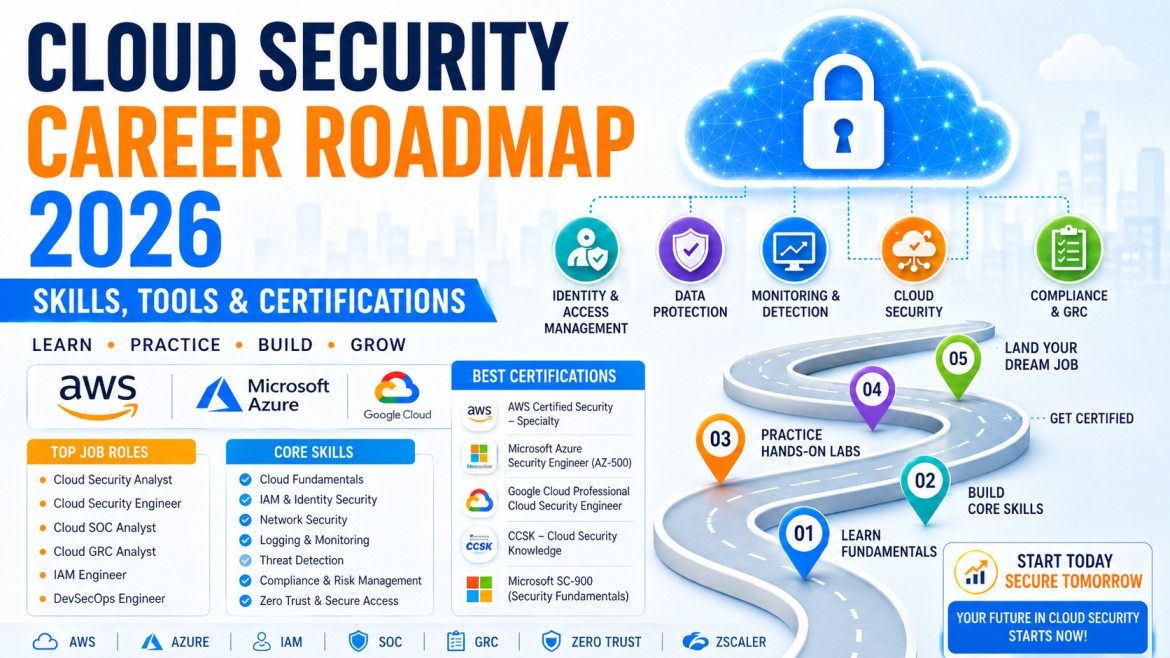
Cloud Security Career Roadmap 2026: Skills, Tools and Certifications
Want to build a career in cloud security? This beginner-friendly roadmap explains cloud security skills, job roles, AWS and Azure security basics, IAM, logging, monitoring, compliance, SOC integration, Zero Trust, Zscaler and cloud security certifications.
Cloud security is one of the most important cybersecurity career paths in 2026. Organizations are moving applications, data, identities, workloads and business processes to cloud platforms such as AWS, Microsoft Azure and Google Cloud. As cloud adoption grows, security teams need professionals who can protect cloud identities, workloads, networks, data, logs, configurations and compliance requirements.
Many beginners think cloud security is only for cloud architects or senior engineers. That is not true. You can enter cloud security from multiple backgrounds, including SOC, network security, IT support, GRC, system administration, DevOps, Zscaler/Zero Trust and cybersecurity fundamentals.
Simple career message: Cloud security is not just one skill. It is a combination of cloud fundamentals, identity security, network security, logging, monitoring, compliance, automation, incident response and risk management.
This article gives you a complete roadmap to start a cloud security career in 2026, especially if you are a student, fresher, SOC analyst, GRC learner, IT professional, network engineer or career switcher.
What Is Cloud Security?
Cloud security is the practice of protecting cloud-based systems, applications, data, identities, networks and workloads from threats, misconfigurations, unauthorized access, data leakage and compliance failures.
In traditional IT, many systems were hosted inside company data centers. In cloud environments, applications and infrastructure may run across AWS, Azure, Google Cloud, SaaS platforms and hybrid environments. This changes how security is designed and operated.
Simple Example
If a company stores customer data in an AWS S3 bucket or Azure Storage account, cloud security ensures that the data is encrypted, access is restricted, logging is enabled, public exposure is prevented, and alerts are generated if risky activity occurs.
Cloud Security Covers:
- Identity and access management
- Cloud network security
- Data protection and encryption
- Logging and monitoring
- Threat detection and incident response
- Vulnerability and posture management
- Compliance and audit readiness
- Secure cloud configuration
- Zero Trust access
- DevSecOps and automation basics
Why Cloud Security Is a Strong Career in 2026
Cloud security is growing because businesses increasingly depend on cloud platforms for daily operations. With more cloud usage comes more risk: misconfigured storage, weak IAM permissions, exposed APIs, insecure workloads, poor logging, secrets leakage and compliance gaps.
Cloud Adoption Is Growing
Organizations use cloud for applications, storage, databases, analytics, DevOps, AI platforms and remote work services.
Identity Has Become the New Perimeter
Cloud access depends heavily on IAM, MFA, roles, policies, privileged access and identity governance.
Misconfiguration Risk Is High
Many cloud incidents happen because of exposed storage, excessive permissions, weak logging or insecure network rules.
Compliance Needs Are Increasing
Organizations must prove that cloud controls meet security, audit, privacy and customer requirements.
Career Advantage
Cloud security connects multiple cybersecurity domains. If you understand SOC, GRC, network security, IAM, Zero Trust and cloud basics, you can position yourself strongly for cloud security roles.
Who Can Start a Cloud Security Career?
Cloud security is not limited to one background. Different professionals can enter cloud security from different starting points.
| Your Background | How You Can Move into Cloud Security | Best Starting Focus |
|---|---|---|
| Student / Fresher | Learn cybersecurity basics, cloud fundamentals, IAM and logging. | Cloud fundamentals + security basics. |
| SOC Analyst | Move into cloud detection, cloud logs, SIEM integration and incident response. | CloudTrail, Azure Activity Logs, Sentinel, GuardDuty. |
| GRC Professional | Move into cloud compliance, cloud risk assessment and control testing. | Cloud controls, ISO 27001, CIS benchmarks, evidence collection. |
| Network Engineer | Move into cloud networking, security groups, firewalls, private connectivity and Zero Trust. | VPC/VNet, routing, security groups, Zscaler. |
| IT Support / System Admin | Move into cloud identity, endpoint integration, access control and monitoring. | IAM, MFA, Azure Entra ID, Microsoft Defender. |
| DevOps Engineer | Move into DevSecOps, secrets management, cloud workload security and automation. | CI/CD security, IaC scanning, container security. |
Important: You do not need to learn everything at once. Start with cloud fundamentals, then choose a direction: SOC-focused cloud security, GRC-focused cloud compliance, or engineering-focused cloud security.
Cloud Security Job Roles
Cloud security has multiple job roles. Some are technical, some are monitoring-focused, and some are compliance-focused.
Cloud Security Analyst
Monitors cloud alerts, reviews logs, investigates suspicious activity and supports cloud security operations.
Cloud Security Engineer
Implements and manages cloud security controls such as IAM, encryption, network security, logging and threat detection.
Cloud GRC Analyst
Works on cloud risk assessment, compliance evidence, audit readiness, control mapping and cloud policy review.
Cloud SOC Analyst
Investigates cloud alerts from AWS, Azure, Google Cloud and SIEM platforms such as Microsoft Sentinel or Splunk.
Cloud IAM Analyst
Focuses on identity, access reviews, privileged access, MFA, conditional access, roles and permissions.
DevSecOps Security Engineer
Secures CI/CD pipelines, infrastructure as code, containers, secrets, repositories and cloud deployments.
Skills Required for Cloud Security
Cloud security skills can be divided into foundation, security, operations and compliance skills.
1. Cloud Fundamentals
- Compute
- Storage
- Networking
- Databases
- Regions and availability zones
- Shared responsibility model
2. Identity and Access
- IAM users, roles and policies
- MFA
- Conditional access
- Privileged access
- Least privilege
- Access reviews
3. Logging and Detection
- CloudTrail
- Azure Activity Logs
- Microsoft Sentinel
- AWS GuardDuty
- Security alerts
- Incident response
4. Compliance and Risk
- Cloud risk assessment
- Cloud control testing
- ISO 27001 cloud controls
- Evidence collection
- CIS benchmarks
- Policy compliance
Core Cloud Security Skill Formula
- Understand cloud basics.
- Secure identities first.
- Protect data and storage.
- Monitor logs and alerts.
- Harden configurations.
- Follow compliance and governance.
- Practice incident response scenarios.
AWS Security Basics for Beginners
AWS is one of the most widely used cloud platforms. If you want to learn cloud security, AWS security basics are a strong starting point.
Important AWS Security Areas
IAM
Manage users, groups, roles, policies, permissions and MFA. IAM is one of the most important AWS security topics.
S3 Security
Protect storage buckets from public exposure, weak permissions and unencrypted sensitive data.
CloudTrail
Records AWS account activity and API calls. Useful for investigation, audit and monitoring.
GuardDuty
A threat detection service that helps identify suspicious activity and potential threats in AWS accounts.
Security Groups
Control inbound and outbound network access for cloud resources such as EC2 instances.
KMS
Used for encryption key management and protecting sensitive data.
Beginner AWS Security Project
Create a sample AWS security checklist covering IAM MFA, least privilege, S3 public access blocking, CloudTrail enabled, GuardDuty enabled and security group review.
Azure Security Basics for Beginners
Microsoft Azure is widely used by enterprises, especially organizations using Microsoft 365, Entra ID, Defender and Sentinel. Azure security skills are very useful for SOC, GRC and cloud security roles.
Important Azure Security Areas
Microsoft Entra ID
Identity platform used for users, groups, roles, conditional access, MFA and identity protection.
Microsoft Defender for Cloud
Helps manage cloud security posture, recommendations, alerts and workload protection.
Microsoft Sentinel
Cloud-native SIEM and SOAR platform used for security monitoring, detection and incident response.
Azure Activity Logs
Provide visibility into operations performed on Azure resources.
Network Security Groups
Control inbound and outbound network traffic to Azure resources.
Key Vault
Used to manage secrets, keys and certificates securely.
Beginner Azure Security Project
Create a sample Azure security checklist covering MFA, conditional access, privileged role review, Defender for Cloud recommendations, Sentinel alerts and Key Vault access review.
IAM: The Most Important Cloud Security Skill
Identity and access management is one of the most important areas in cloud security. Many cloud breaches happen because of weak credentials, excessive permissions, exposed keys, missing MFA or poorly managed privileged access.
IAM Concepts You Must Know
- Users, groups and roles
- Policies and permissions
- Least privilege
- MFA
- Privileged access management
- Conditional access
- Access keys and secrets
- Service accounts and workload identities
- Access review and certification
- Identity logging and monitoring
Interview-ready line: In cloud security, identity is often the new perimeter. If IAM is weak, attackers may gain access even if the network is well protected.
Logging, Monitoring and Detection
Cloud security is not complete without logging and monitoring. If logs are missing, security teams cannot investigate incidents properly.
| Cloud Platform | Important Logs / Tools | Security Use |
|---|---|---|
| AWS | CloudTrail, CloudWatch, GuardDuty, Security Hub, VPC Flow Logs | API activity, threat detection, network visibility and security posture. |
| Azure | Azure Activity Logs, Entra ID logs, Defender for Cloud, Sentinel, NSG Flow Logs | Identity monitoring, cloud alerts, SIEM detection and incident response. |
| Google Cloud | Cloud Audit Logs, Security Command Center, VPC Flow Logs | Audit visibility, posture management and threat detection. |
| SaaS | Microsoft 365 logs, Google Workspace logs, Salesforce logs | User activity monitoring, data access review and suspicious login detection. |
Cloud SOC Example
A SOC analyst receives an alert that an IAM user created a new access key and used it from an unusual country. The analyst checks CloudTrail logs, source IP, user history, permissions, MFA status and recent activity to determine whether the account is compromised.
Cloud Security for SOC Analysts
If you are already learning SOC, cloud security can be a strong next step. SOC teams increasingly investigate alerts from AWS, Azure, Google Cloud and SaaS platforms.
What SOC Analysts Should Learn in Cloud Security
- Cloud login and authentication logs
- Suspicious IAM activity
- Unusual API calls
- CloudTrail and Azure Activity Logs
- GuardDuty and Defender alerts
- Storage exposure alerts
- Impossible travel and risky sign-ins
- Cloud SIEM integration
- Incident escalation and evidence collection
Best SOC-to-Cloud Path
SOC Analyst → Cloud logs → Cloud SIEM detection → IAM investigation → Cloud incident response → Cloud Security Analyst.
Related guide: SOC Analyst Career Roadmap 2026
Cloud Security for GRC Professionals
GRC professionals can also move into cloud security by focusing on cloud governance, compliance, risk assessment, control testing and audit evidence.
What GRC Professionals Should Learn
- Cloud shared responsibility model
- Cloud risk assessment
- Cloud control mapping
- Cloud evidence collection
- IAM access review
- Encryption and logging controls
- Cloud configuration compliance
- Vendor and SaaS risk assessment
- ISO 27001 cloud control relevance
- CIS cloud benchmarks
Best GRC-to-Cloud Path
GRC Analyst → ISO 27001 → Cloud risk assessment → Cloud control testing → Cloud compliance analyst.
Related guide: ISO 27001 Career Roadmap
Cloud Security and Zero Trust / Zscaler
Cloud security is closely connected with Zero Trust. Users access cloud apps from anywhere, and private applications may be hosted across data centers, public cloud and hybrid environments. This is where Zero Trust and platforms like Zscaler become important.
How Zscaler Connects with Cloud Security
- ZIA helps secure internet and SaaS access.
- ZPA helps secure private application access without traditional VPN.
- ZDX helps monitor digital experience across cloud and network paths.
- Zero Trust reduces broad network-level access.
- Cloud security teams need secure access for remote and hybrid users.
Career advantage: If you know cloud security plus Zscaler/Zero Trust, you become more valuable for organizations moving toward SASE and modern secure access architectures.
Related guides:
Best Cloud Security Certifications for 2026
Certifications can help structure your learning and improve your resume. Choose based on your background and target role.
| Certification | Best For | Beginner Suitability | Career Direction |
|---|---|---|---|
| Microsoft SC-900 | Security, compliance and identity fundamentals. | Good for beginners. | Microsoft security, identity and compliance foundation. |
| Microsoft AZ-500 | Azure security engineering. | Intermediate. | Azure Security Engineer, Cloud Security Engineer. |
| Microsoft SC-200 | Security operations and Microsoft Sentinel. | Intermediate. | Cloud SOC Analyst, Security Operations Analyst. |
| AWS Certified Security - Specialty | AWS security professionals. | Not ideal as first cloud cert. | AWS Cloud Security Engineer. |
| Google Professional Cloud Security Engineer | Google Cloud security roles. | Intermediate to advanced. | GCP Cloud Security Engineer. |
| CCSK | Vendor-neutral cloud security knowledge. | Good after cloud basics. | Cloud security, audit, compliance and architecture foundation. |
Certification Tip
If you are a beginner, do not jump directly to advanced cloud security certifications. Start with cloud fundamentals, then learn IAM, logging, networking and basic cloud controls before selecting a certification.
Official Certification Resources
90-Day Cloud Security Roadmap for Beginners
This roadmap is suitable for students, freshers, SOC analysts, GRC learners and IT professionals who can study 1–2 hours per day.
1 Days 1–10: Learn Cloud Fundamentals
Understand compute, storage, networking, databases, cloud regions, availability zones and the shared responsibility model.
2 Days 11–20: Learn IAM and Identity Security
Focus on users, roles, policies, MFA, least privilege, conditional access, privileged access and access keys.
3 Days 21–30: Learn Cloud Network Security
Understand VPC/VNet, subnets, security groups, network security groups, routing, private endpoints and firewall concepts.
4 Days 31–40: Learn Data Protection
Study encryption, key management, storage security, backup, data classification and public exposure prevention.
5 Days 41–55: Learn Logging and Monitoring
Practice CloudTrail, Azure Activity Logs, GuardDuty, Defender for Cloud, Sentinel, Security Hub and alert investigation basics.
6 Days 56–70: Learn Cloud Compliance and Risk
Understand cloud risk assessment, control testing, evidence collection, CIS benchmarks, ISO 27001 mapping and audit readiness.
7 Days 71–80: Learn Zero Trust and Zscaler Basics
Understand secure access, ZIA, ZPA, ZDX, Zero Trust, SaaS security and private application access.
8 Days 81–90: Build Projects and Prepare Resume
Create 3–4 practical projects, update resume keywords, practice interview questions and choose your certification path.
Best Beginner Portfolio Projects
- AWS IAM security checklist
- Azure conditional access and MFA review
- Cloud logging and alert investigation scenario
- Cloud risk register with 8 risks
- S3 or storage security checklist
- Cloud security incident response playbook
Cloud Security Resume Keywords
Use these keywords only if you understand them and can explain them in interviews.
Core Keywords
- Cloud Security
- AWS Security
- Azure Security
- IAM
- Cloud Risk Assessment
SOC Keywords
- CloudTrail
- Azure Activity Logs
- Microsoft Sentinel
- GuardDuty
- Cloud Incident Response
GRC Keywords
- Cloud Compliance
- Control Testing
- CIS Benchmarks
- Evidence Collection
- Shared Responsibility Model
Beginner Cloud Security Interview Questions
| Question | Strong Beginner Answer |
|---|---|
| What is cloud security? | Cloud security is the practice of protecting cloud identities, data, workloads, networks, applications and configurations from threats, unauthorized access and compliance failures. |
| What is the shared responsibility model? | It means cloud providers and customers share security responsibilities. The provider secures the cloud infrastructure, while customers secure their data, identities, configurations and workloads depending on the service model. |
| Why is IAM important in cloud security? | IAM controls who can access cloud resources and what actions they can perform. Weak IAM can lead to unauthorized access, privilege abuse and data exposure. |
| What is least privilege? | Least privilege means users and services should have only the minimum access required to perform their tasks. |
| What cloud logs are useful for investigation? | AWS CloudTrail, Azure Activity Logs, Entra ID logs, GuardDuty alerts, Microsoft Sentinel incidents and VPC/NSG flow logs are useful for investigation. |
| How can GRC connect with cloud security? | GRC connects through cloud risk assessment, control testing, compliance evidence, policy review, audit readiness and cloud configuration governance. |
| What is a common cloud security risk? | Common risks include public storage exposure, excessive IAM permissions, missing MFA, weak logging, insecure network rules and exposed secrets. |
| What is cloud security posture management? | It is the process of continuously checking cloud configurations against security best practices and compliance requirements to identify and fix misconfigurations. |
| How does Zero Trust relate to cloud security? | Zero Trust helps ensure access is based on identity, context and least privilege rather than trusting users only because they are on a network. |
| What should a beginner learn first for cloud security? | Start with cloud fundamentals, IAM, networking, logging, storage security, shared responsibility model and basic security monitoring. |
Useful External Resources
Related CybersecurityTRAIN.com Guides and Courses
Final Thoughts: How to Start a Cloud Security Career in 2026
Cloud security is a powerful career path because it connects security, cloud, identity, networking, compliance and operations. You do not need to become an expert in every cloud platform immediately. Start with fundamentals, then build practical skills around IAM, logging, monitoring, risk and secure configuration.
Your Cloud Security Success Formula
- Learn cloud fundamentals first.
- Master IAM and identity security.
- Understand logging and monitoring.
- Learn cloud network and storage security.
- Practice cloud risk assessment and compliance.
- Connect cloud with SOC, GRC and Zero Trust.
- Build practical projects and explain them confidently.
Final career message: A strong cloud security professional does not only know cloud services. They understand how identities, data, networks, logs, risks, controls and business requirements work together in the cloud.
Want to Build a Cybersecurity Career with SOC, GRC, Cloud and Zscaler Skills?
At CybersecurityTRAIN.com, we help students, freshers and working professionals build practical cybersecurity skills through structured training in SOC, GRC, Zscaler, Zero Trust and career-focused cybersecurity learning.
If you want to enter cybersecurity through SOC, GRC, cloud security or Zero Trust, explore our practical training programs.
Explore SOC Analyst Training Explore GRC with CISM Explore Zscaler TrainingCall or WhatsApp: +91 98857 89887
Frequently Asked Questions
1. What is cloud security?
Cloud security is the practice of protecting cloud identities, data, applications, workloads, networks and configurations from threats, unauthorized access and compliance failures.
2. Is cloud security good for beginners?
Yes. Beginners can start with cloud fundamentals, IAM, networking, logging and security basics, then gradually move into cloud security operations, engineering or compliance roles.
3. Which cloud platform should I learn first?
AWS and Azure are both strong choices. If you are from Microsoft or enterprise IT background, Azure is a good start. If you want broader cloud infrastructure exposure, AWS is also a strong option.
4. Do I need coding for cloud security?
Coding is not always required for beginner roles, but scripting and automation knowledge can help you grow. Start with security fundamentals first.
5. What is the most important cloud security skill?
Identity and access management is one of the most important cloud security skills because cloud access depends heavily on permissions, roles, MFA and privileged access.
6. Can SOC analysts move into cloud security?
Yes. SOC analysts can move into cloud security by learning cloud logs, cloud alerts, SIEM integration, IAM investigations and cloud incident response.
7. Can GRC professionals move into cloud security?
Yes. GRC professionals can move into cloud security by learning cloud risk assessment, cloud compliance, control testing, audit evidence and cloud governance.
8. Which certification is best for cloud security beginners?
Microsoft SC-900 is beginner-friendly for security, compliance and identity fundamentals. CCSK is useful for vendor-neutral cloud security knowledge after basic cloud understanding.
9. Is Zscaler related to cloud security?
Yes. Zscaler is related to cloud security and Zero Trust because it helps secure internet, SaaS and private application access using cloud-delivered security services.
10. How long does it take to learn cloud security?
With consistent study, beginners can build a strong foundation in 90 days. Becoming job-ready depends on practical labs, projects, interview preparation and prior IT/security knowledge.