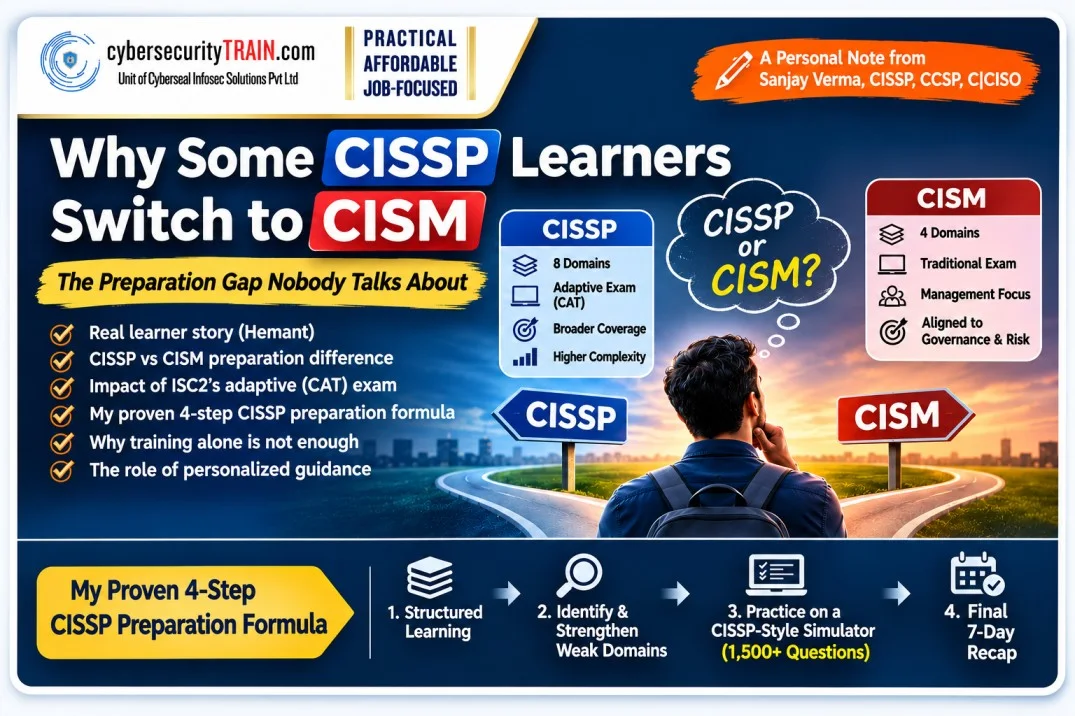
Why Some CISSP Learners Switch to CISM: The Preparation Gap Nobody Talks About
A personal perspective from Sanjay Verma on why CISSP preparation can become overwhelming, how CISSP and CISM preparation differ, and why structured learning, realistic practice and personalized guidance matter.
Why I Wanted to Write This Article
Over the years, I have noticed an interesting pattern among cybersecurity professionals preparing for senior-level certifications.
A learner starts CISSP preparation with tremendous enthusiasm. They join a reputed training institute, attend the classes, collect the books, notes and practice material, and initially everything looks manageable.
Then the training ends.
A few weeks later, reality begins to feel very different.
- The syllabus suddenly looks enormous.
- Practice-test scores fluctuate.
- Questions appear to have two or even three reasonable answers.
- Technical experience does not always translate into correct exam decisions.
- Confidence slowly starts dropping.
And eventually, I hear a question like this:
This is not another article trying to prove whether CISSP is better than CISM. Both are respected certifications, but they test different perspectives.
Hemant's Story: Training Was Not the Problem
Hemant had already completed CISSP training from a reputed cybersecurity training institute. He deliberately selected that provider because it was considered one of the better institutes in India.
The training itself was not necessarily his problem. He attended the sessions, had study material, and had already been introduced to all eight CISSP domains.
But after the formal training ended, something important disappeared:
There was nobody closely watching how he was preparing after the course. Nobody was analysing why he was getting specific questions wrong or whether the real challenge was knowledge, question interpretation, overthinking, time management, a weak domain, or the wrong professional perspective.
Eventually, Hemant contacted me. We worked together continuously for around three months. The first thing I did was not give him another complete CISSP course.
I tried to understand Hemant as a learner: how he retained information, where he hesitated, which domains came naturally, and whether his challenge was knowledge or decision-making.
Once I understood those patterns, the preparation became personal. We created a study approach around his strengths and weaknesses instead of forcing him into a generic timetable.
Three months later, Hemant cleared CISSP.
Why CISSP Learners Sometimes Lose Confidence
CISSP is broad by design. It spans eight domains: Security and Risk Management, Asset Security, Security Architecture and Engineering, Communication and Network Security, Identity and Access Management, Security Assessment and Testing, Security Operations, and Software Development Security.
A network-security professional may be highly comfortable with network architecture but struggle with software security. A SOC analyst may naturally understand incident response but find governance or risk concepts less intuitive. A GRC professional may understand policy and risk but need more work on architecture or networking.
CISSP asks you to move across all of these areas—and then make decisions across them.
CISM Can Look More Manageable From the Outside
CISM is more tightly focused on information security management. Its current structure centers on Governance, Risk Management, Information Security Program, and Incident Management.
For someone already working in governance, risk, leadership or security-program management, these areas may feel more naturally connected.
CISSP and CISM Require Different Preparation Approaches
| Area | CISSP | CISM |
|---|---|---|
| Certification Body | ISC2 | ISACA |
| Primary Orientation | Broad cybersecurity leadership and security knowledge | Information security management |
| Domains | 8 | 4 |
| Question Challenge | Breadth + interpretation + adaptive exam pressure | Management judgment + prioritization |
| Technical Breadth | Broader | More management-focused |
| Governance / Risk | Important | Central |
| Preparation Focus | Consistency across broad domains and scenario reasoning | Governance, risk, business alignment and program decisions |
The CISSP Adaptive Exam Changes the Preparation Game
One of the most important preparation differences is the adaptive CISSP exam experience. A conventional mock test may tempt someone to think, “I scored 75%, so I am ready.” I do not use that logic.
I want to see whether a candidate demonstrates consistent understanding across domains and can still reason correctly when several difficult questions appear together, wording becomes complex, two answers look correct, and time pressure increases.
My Proven CISSP Preparation Formula
Over the years, I have developed a preparation framework that has worked for learners coming from networking, SOC, cloud, infrastructure, governance, security engineering, audit and other backgrounds. Many of these learners eventually cleared CISSP.
I do not claim that one formula guarantees success for everyone. I believe the framework is proven, while the way it is applied should be personalized.
Step 1: Build the Foundation Properly
Start with structured learning through instructor-led training, self-paced learning or disciplined self-study. Use the official CISSP study material or official study guide as the backbone.
Step 2: Identify Weak Domains and Learn From Multiple Sources
Classify your domains into strong, average and weak, then work deliberately on the weak areas.
Use multiple formats when necessary: official material, reference books, videos, technical nuggets, flashcards, diagrams, mind maps, AI tools and practice scenarios.
AI is most useful when you ask it to explain concepts, contrast answer choices, or give real-world examples—not simply to give you an answer.
Step 3: Practice on a Serious CISSP-Style Simulator
You cannot prepare properly for CISSP by reading theory alone. You need to experience complex scenarios, long wording, ambiguous-looking options, technical-versus-managerial decisions, time pressure, domain switching and mental fatigue.
This is why I built my own CISSP practice simulator on CybersecurityTRAIN. The current bank contains 1,500+ CISSP-style practice questions.
How I Use Simulator Scores
If someone scores 70%, I want to know why the other 30% was lost: weak domains, misreading, overthinking, knowledge gaps, judgment mistakes, guesses, time pressure or fatigue.
That analysis is far more valuable than the raw score.
My 90% Readiness Benchmark
I become much more confident about a learner when they can consistently score above 90% on our practice environment and can explain why each answer is correct.
No practice score guarantees CISSP success. If CybersecurityTRAIN publishes a specific historical success figure, it should be supported by documented learner records, sample size and methodology.
Can You Try the Practice Bank?
Yes. A quick practice assessment can be used to experience the question style and difficulty. If you need broader access to the 1,500+ question bank, contact the CybersecurityTRAIN team to check current availability.
Step 4: The Final Seven-Day Recap
The final week is for consolidation, not restarting the entire syllabus. Review weak-domain notes, flashcards, important frameworks, risk concepts, BCP/DR, cryptography, IAM, networking, security operations, software-development security and commonly confused topics.
Revisit incorrect questions, but ask why you chose the wrong answer rather than memorizing the right one.
My Four-Step Formula in One View
| Stage | What I Recommend | Objective |
|---|---|---|
| 1. Structured Learning | Training or self-study + Official Study Guide | Build the complete CISSP foundation |
| 2. Weak-Domain Improvement | Books, videos, nuggets, flashcards, AI and multiple explanations | Fix personal knowledge gaps |
| 3. Serious CISSP-Style Practice | Quality simulator + scenario analysis + time management | Build reasoning and exam readiness |
| 4. Final 7-Day Recap | Flashcards, weak areas, mistakes and high-value revision | Consolidate knowledge before exam day |
Training Is the Beginning, Not the End
A good trainer can explain cryptography, risk management, IAM, networking, architecture, BCP/DR, software security and incident response. But after training, another stage begins: preparation.
Two candidates may attend the same class, read the same book and solve the same questions yet struggle for completely different reasons. Giving both candidates another 500 questions does not necessarily solve either problem.
Sometimes the Problem Is Not Knowledge—It Is Reading
I repeatedly see candidates read:
but mentally answer:
Those are different questions. Words such as FIRST, BEST, MOST, PRIMARY and LEAST can completely change the expected answer.
“Think Like a Manager” Does Not Mean “Avoid Technical Answers”
My approach is:
- Who am I in this question?
- What authority and responsibility do I have?
- What stage of the process are we in?
- What protects the organization appropriately while following governance and risk principles?
Sometimes the correct answer will be managerial. Sometimes it will be technical. The key is understanding the scenario.
CISM Has a Mindset Too—but It Is Different
CISM is an ISACA certification, while CISSP is an ISC2 certification. CISM places stronger emphasis on information security governance, business alignment, risk management, security-program management, incident management, metrics, stakeholder communication and management responsibility.
Why Some CISSP Candidates Eventually Choose CISM
From what I have personally observed, the decision is often not “CISM is better than CISSP.” It is more often:
That can be a valid decision if CISM genuinely aligns better with the candidate's career direction. But I would caution anyone against abandoning CISSP only because preparation has become difficult.
Before Switching From CISSP to CISM, Ask Yourself This
If CISM aligns better with your career, that is a strategic choice. But if you are switching because scores fluctuate, eight domains feel overwhelming, scenarios confuse you, support disappeared after training, or you lost confidence, you may first need someone to diagnose why your CISSP preparation is not working.
A Candidate Scoring 60% Is Not Simply “40% Unprepared”
I want to know which domains caused the errors, how many correct answers were changed, how many questions were misread, how many were knowledge gaps, how many were judgment errors, and whether time pressure or fatigue affected the result.
Why Generic Study Plans Fail Some Learners
A generic plan may divide one domain per week, but a candidate with 15 years of IAM experience does not need the same IAM preparation as someone new to identity. If Software Development Security is your weak area, you may need extra time there. If the problem is scenario interpretation, rereading another thousand pages may not solve it.
Should You Do CISM Instead?
Choose CISSP because CISSP aligns with your goal. Choose CISM because CISM aligns with your goal.
Do not choose CISM simply because CISSP feels intimidating, and do not choose CISSP simply because someone told you it is more prestigious.
A broad cybersecurity leader, architect or senior practitioner may value CISSP's breadth. Someone focused heavily on security governance, risk, security-program management and leadership may find CISM strongly aligned. Many experienced professionals ultimately hold both.
What Hemant's Story Taught Me
The biggest lesson was not that my formula is perfect. No formula is perfect for everyone.
That is why, when someone tells me, “Sanjay, CISSP is too difficult. Maybe I should just do CISM,” I first ask:
Because sometimes the certification is not the problem. The preparation strategy is.
My Final Advice to CISSP Aspirants
CISSP is broad. Eight domains make the preparation demanding. The adaptive exam adds pressure. Questions require careful interpretation.
CISM is an excellent certification. But it should be your destination because it matches your professional goals—not simply an escape route from CISSP preparation.
Frequently Asked Questions
Is CISM easier than CISSP?
They are different examinations. CISSP covers eight broad cybersecurity domains and uses an adaptive exam format, while CISM is more tightly focused on information security management. Fewer domains do not automatically mean an easier exam.
Why do candidates find CISSP difficult?
Common challenges include the breadth of the syllabus, scenario-based decision making, interpretation of BEST/FIRST questions, time management and maintaining consistency across weaker domains.
Are CybersecurityTRAIN simulator questions actual ISC2 questions?
No. They are independently created CISSP-style practice questions designed to develop reasoning, question interpretation, domain knowledge and time-management skills.
How many questions are available in the CybersecurityTRAIN CISSP simulator?
The current practice bank contains more than 1,500 CISSP-style questions across domains and difficulty levels.
Can I try the simulator before requesting full access?
Yes. A quick practice assessment can be used to experience the question style. For broader access, candidates can contact the CybersecurityTRAIN team to check current availability.
Does scoring 90% guarantee passing CISSP?
No. No practice score guarantees CISSP success. A high score becomes meaningful only when the candidate can explain the reasoning, demonstrates consistent performance across domains and manages time effectively.
Is training alone enough for CISSP?
Training provides the foundation, but most candidates also need revision, practice, analysis of mistakes, question interpretation, time management and a personalized preparation strategy.
Should I move to CISM if CISSP preparation becomes difficult?
First understand why CISSP preparation became difficult. If CISM aligns better with your career goals, changing direction can make sense. If the real issue is preparation strategy, guidance or confidence, fix that before abandoning your original objective.
Want to Test Your CISSP Readiness?
CybersecurityTRAIN offers a quick CISSP practice assessment and access options for a larger practice bank containing 1,500+ CISSP-style questions designed to strengthen reasoning, domain knowledge and exam-readiness skills.
Try the CISSP Practice Test Contact CybersecurityTRAINPractice questions are independently created for learning and exam preparation. They are not actual ISC2 exam questions and should not be expected to appear in the real exam.
About the Author
Sanjay Verma, CISSP, CCSP, C|CISO
I have gone through the CISSP journey myself and have worked with professionals from different technical and managerial backgrounds preparing for CISSP.
My approach is not simply to give every candidate the same timetable or question bank. I try to understand how they learn, what they already know, where they struggle, how they interpret scenarios, and what needs to change before exam day.
Because ultimately, the objective is not to complete a CISSP course. The objective is to become ready to face the CISSP exam with confidence, understanding and the right decision-making approach.