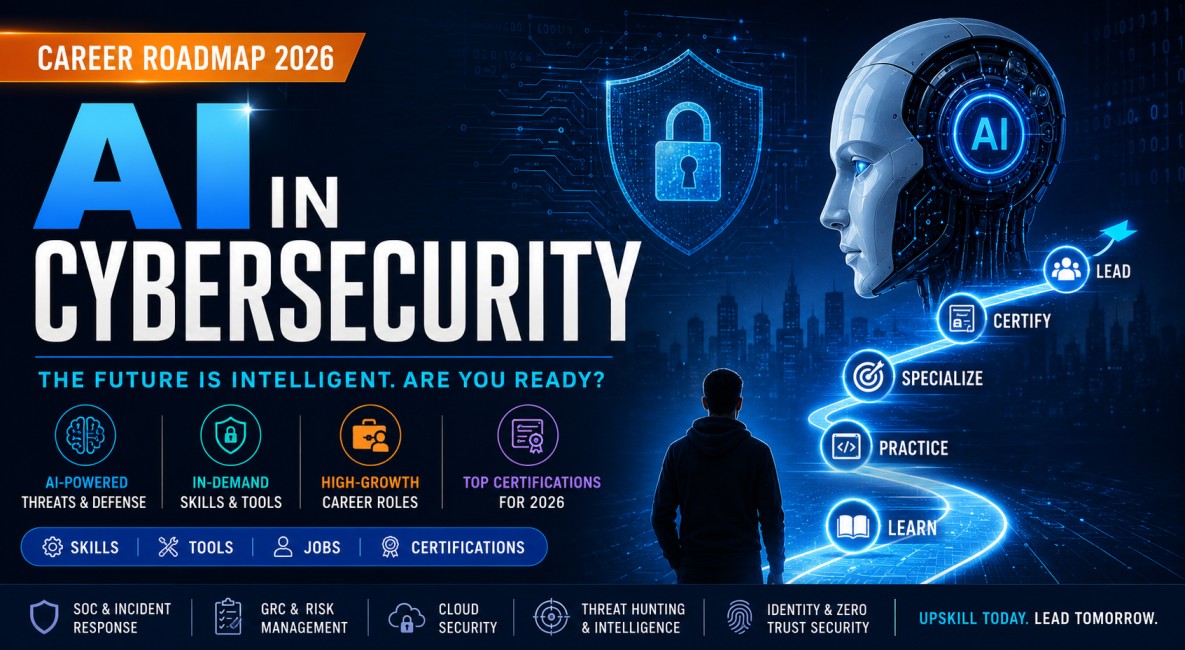
AI in Cybersecurity Career Roadmap 2026: Skills, Tools, Jobs and Certifications
Artificial Intelligence is changing cybersecurity faster than most professionals expected. Attackers are using AI to move faster, defenders are using AI to investigate smarter, and companies now need security professionals who understand both cyber risk and AI-driven security operations.
Cybersecurity careers are entering a new phase. Earlier, many security roles were focused mainly on firewalls, antivirus, SIEM alerts, vulnerability scans, access control, and compliance checklists. These areas are still important, but Artificial Intelligence is now changing how cyberattacks happen and how security teams defend organizations.
```In 2026, AI is not just a buzzword. It is becoming part of phishing attacks, malware analysis, SOC automation, threat intelligence, vulnerability prioritization, incident response, cloud security, identity protection, and governance. This means cybersecurity professionals who understand AI will have a clear advantage.
Simple truth: AI will not remove the need for cybersecurity professionals. But cybersecurity professionals who know how to use AI responsibly may replace those who ignore it.
This roadmap will help students, working professionals, SOC analysts, GRC professionals, IT engineers, security managers, and career changers understand how to build an AI-ready cybersecurity career in 2026.
```Why AI Matters in Cybersecurity in 2026
```AI matters in cybersecurity because it changes both sides of the battlefield. Attackers can use AI to create more convincing phishing messages, automate reconnaissance, identify weaknesses faster, generate malicious scripts, and scale attacks. Defenders can use AI to analyze logs, summarize incidents, prioritize alerts, detect abnormal behavior, and speed up investigation.
The biggest shift is speed. In traditional security, defenders had time to review alerts, analyze logs, and respond manually. In AI-driven attacks, the window to respond may become much smaller. This is why security teams need professionals who can combine cybersecurity knowledge with AI-assisted investigation and decision-making.
What this means for your career
If you are learning cybersecurity in 2026, do not learn only tools. Learn how attacks work, how security operations work, how risk is managed, and how AI can support faster and better security decisions.
How AI Is Changing Cyberattacks
```AI is not creating a completely new world of cybercrime overnight. Instead, it is making many existing attacks faster, more convincing, and easier to scale.
1 AI-Powered Phishing
Attackers can use AI to write polished emails, customize messages for specific employees, translate phishing content, and create more believable social engineering campaigns.
2 Deepfake Impersonation
Voice and video deepfakes can be used to impersonate executives, vendors, customers, or employees. This creates new risks for finance teams, help desks, and leadership communication.
3 Faster Vulnerability Exploitation
AI can help attackers understand known vulnerabilities faster and identify weak systems that are still unpatched.
4 Automated Reconnaissance
Attackers can use AI to collect public information, analyze exposed assets, identify employees, and prepare targeted attacks faster.
5 Malware and Script Assistance
AI can assist attackers in modifying scripts, understanding code, and automating parts of attack workflows, even if it does not replace expert attackers.
6 Shadow AI and Data Leakage
Employees may paste sensitive customer data, source code, logs, contracts, or internal information into public AI tools without understanding the risk.
Career lesson: Future security professionals must understand both traditional attacks and AI-enhanced versions of those attacks.
How AI Is Helping Cybersecurity Teams
```AI is not only a threat. It is also a powerful assistant for defenders. Security teams are using AI to reduce noise, speed up analysis, summarize incidents, support threat hunting, and improve response time.
Common Defensive Uses of AI in Cybersecurity
- Alert triage and prioritization
- Log analysis and pattern detection
- Threat intelligence summarization
- Malware behavior analysis
- Phishing detection and email analysis
- User and entity behavior analytics
- Incident response playbook support
- Vulnerability prioritization
- Security report generation
- GRC evidence summarization and policy review
Example
A SOC analyst may receive hundreds of alerts in a day. AI can help group similar alerts, summarize suspicious activity, recommend next investigation steps, and identify whether the event is likely to be false positive, suspicious, or critical.
Top AI Cybersecurity Career Paths in 2026
```AI in cybersecurity does not mean everyone must become a data scientist. There are multiple career paths depending on your interest and background.
| Career Path | Best For | AI Relevance |
|---|---|---|
| AI-Ready SOC Analyst | Beginners, SOC learners, blue team professionals | Uses AI for alert triage, log analysis, phishing investigation, and incident summaries. |
| Threat Hunter with AI Skills | SOC analysts and detection engineers | Uses AI-assisted queries, anomaly detection, and threat intelligence enrichment. |
| AI Security/GRC Analyst | GRC, compliance, risk professionals | Focuses on AI risk, shadow AI, data leakage, AI policy, and governance. |
| Cloud Security Analyst with AI Awareness | Cloud and infrastructure professionals | Secures cloud workloads, AI services, data pipelines, identities, and access controls. |
| AI Application Security Analyst | AppSec and developers | Focuses on prompt injection, model abuse, API security, data exposure, and secure AI app design. |
| AI Governance and Risk Professional | GRC, audit, security managers | Builds policies, controls, risk assessments, and compliance processes for AI usage. |
Skills You Need for AI in Cybersecurity
```To build a strong AI cybersecurity career, you need a mix of cybersecurity fundamentals, AI awareness, tools knowledge, risk thinking, and communication skills.
Cybersecurity Fundamentals
- Networking basics
- Operating system basics
- Security controls
- Threats and vulnerabilities
- Identity and access management
- Incident response lifecycle
SOC and Blue Team Skills
- SIEM monitoring
- Log analysis
- Alert triage
- MITRE ATT&CK mapping
- Phishing investigation
- Basic threat hunting
AI Awareness Skills
- How generative AI works at a high level
- AI limitations and hallucination risk
- Prompting for security analysis
- AI data privacy risks
- Shadow AI risk
- Prompt injection basics
GRC and Risk Skills
- Risk assessment
- Policy writing
- Control mapping
- Security awareness
- AI usage governance
- Management reporting
Tools and Technologies to Learn
```You do not need to learn every tool. Start with the tool category based on your target role.
| Area | Tools/Technologies to Explore | Why It Matters |
|---|---|---|
| SOC and SIEM | Microsoft Sentinel, Splunk, QRadar, Elastic Security | These tools help monitor alerts, investigate logs, and detect threats. |
| Endpoint Security | Microsoft Defender, CrowdStrike, SentinelOne | Endpoint data is critical for AI-assisted detection and incident response. |
| Cloud Security | AWS Security, Microsoft Defender for Cloud, Google Cloud Security | AI workloads and data platforms often run in cloud environments. |
| Identity Security | Microsoft Entra ID, Okta, Cisco Duo, PAM tools | Identity is one of the most targeted areas in AI-assisted attacks. |
| AI Security and Governance | AI usage policies, DLP, CASB/SASE, model risk controls | Organizations need controls to manage employee AI usage and sensitive data exposure. |
| Automation and Scripting | Python basics, PowerShell basics, security automation playbooks | Automation helps security teams respond faster and reduce repetitive work. |
AI in SOC: What SOC Analysts Should Learn
```SOC analysts will not disappear because of AI. Instead, the role will become more analytical. AI can help with repetitive investigation tasks, but analysts still need to validate findings, understand context, and make decisions.
SOC Analysts Should Learn:
- How to write better investigation questions for AI tools
- How to validate AI-generated summaries
- How to identify false positives and false negatives
- How to map alerts to MITRE ATT&CK tactics and techniques
- How to explain incidents clearly to stakeholders
- How to use AI without exposing sensitive log data
- How to create repeatable investigation playbooks
Career tip: A future-ready SOC analyst should not only ask, “What alert fired?” They should ask, “What story do the logs tell, what is the risk, and what action should be taken next?”
AI in GRC: What GRC Professionals Should Learn
```AI is creating a new opportunity for GRC professionals. As companies adopt tools like ChatGPT, Microsoft Copilot, AI chatbots, automation agents, and AI-enabled business platforms, they need policies, risk assessments, controls, awareness, and monitoring.
GRC Professionals Should Learn:
- AI usage policy development
- Shadow AI risk management
- Data classification for AI tools
- AI vendor risk assessment
- AI risk register creation
- Privacy and compliance considerations
- AI governance committee structure
- Security awareness for AI usage
- Audit evidence for AI controls
Example
If employees paste customer data into a public AI tool, it becomes a data leakage and compliance risk. A GRC professional should help define what data can be used, what tools are approved, who owns the risk, and how violations will be monitored.
Best Certifications for AI Cybersecurity Career Growth
```There is no single certification that makes someone an AI cybersecurity expert. The best approach is to combine cybersecurity fundamentals, security operations, GRC, cloud, and AI governance knowledge.
| Career Goal | Recommended Certification Direction | Why |
|---|---|---|
| Beginner Cybersecurity Career | Cybersecurity fundamentals, SOC basics, Security+ | Builds foundational security knowledge before moving into AI security topics. |
| SOC Analyst | SOC Analyst training, SIEM training, blue team labs | Helps you understand alerts, logs, incidents, and investigation workflows. |
| GRC and AI Governance | CISM, ISO 27001, GRC training, risk management | Useful for AI policy, governance, risk, compliance, and security program management. |
| Security Leadership | CISSP, CISM, risk and governance training | Helps professionals think strategically about business risk and security leadership. |
| Cloud and AI Workload Security | Cloud security training, CCSP, AWS/Azure security learning | AI systems often depend on cloud platforms, identity, APIs, storage, and data pipelines. |
| Zero Trust and Identity | Zscaler, Cisco Duo, IAM, Zero Trust training | Identity and secure access are critical in AI-enabled environments. |
Step-by-Step AI Cybersecurity Career Roadmap for 2026
```Use this roadmap based on your current level.
Stage 1: Build Cybersecurity Fundamentals
Start with networking, operating systems, security concepts, threats, vulnerabilities, identity, access control, and basic incident response. Without fundamentals, AI tools may give you answers that you cannot validate.
Stage 2: Choose Your Career Track
Do not try to learn everything at once. Choose one primary direction:
- SOC and blue team
- GRC and AI governance
- Cloud security
- Identity and Zero Trust
- Application and AI security
- Security leadership
Stage 3: Learn AI Basics for Security
You do not need to become a machine learning engineer immediately. Start with practical AI awareness:
- What generative AI can and cannot do
- How AI can assist attackers
- How AI can assist defenders
- How to use AI safely for analysis
- How to avoid sharing sensitive data with AI tools
- How to validate AI-generated outputs
Stage 4: Learn Role-Based Tools
If you are targeting SOC, learn SIEM and alert investigation. If you are targeting GRC, learn risk registers, policies, control mapping, and AI governance. If you are targeting cloud security, learn identity, storage, API, and workload protection.
Stage 5: Practice Real Scenarios
Build small projects and examples:
- Analyze a phishing email with AI assistance
- Create an incident summary from sample logs
- Create an AI usage policy for employees
- Build a sample AI risk register
- Map an attack scenario to MITRE ATT&CK
- Create a vulnerability prioritization report
Stage 6: Build Communication Skills
AI can summarize data, but humans still need to communicate risk. Learn how to explain security findings to managers, customers, auditors, and business teams.
Stage 7: Keep Learning Continuously
AI security will keep changing. Stay updated with official reports, vendor advisories, security blogs, government guidance, and real incident case studies.
```90-Day Learning Plan for AI in Cybersecurity
```| Timeline | Learning Focus | Practical Output |
|---|---|---|
| Days 1–15 | Cybersecurity fundamentals, threats, identity, risk, incident response | Create a personal cybersecurity concept map |
| Days 16–30 | AI basics, generative AI risks, phishing, deepfakes, shadow AI | Create an AI security awareness checklist |
| Days 31–45 | SOC workflows, SIEM, logs, MITRE ATT&CK, alert triage | Analyze sample alerts and write incident summaries |
| Days 46–60 | GRC, AI governance, risk register, policy, compliance | Create a sample AI usage policy and AI risk register |
| Days 61–75 | Cloud, identity, data protection, Zero Trust, access control | Create a secure AI access control checklist |
| Days 76–90 | Mock interviews, resume updates, projects, certification planning | Build your AI cybersecurity portfolio and career roadmap |
Example Job Roles in AI-Driven Cybersecurity
```Here are job roles that may increasingly require AI awareness or AI-enabled security skills.
SOC Analyst
Uses SIEM, EDR, AI-assisted triage, phishing analysis, and incident response workflows.
GRC Analyst
Supports AI policies, risk assessments, compliance mapping, audit evidence, and governance reporting.
Threat Hunter
Uses behavioral analysis, threat intelligence, AI-assisted queries, and anomaly detection.
Cloud Security Analyst
Secures cloud workloads, AI platforms, identities, APIs, storage, and data access.
AI Security Analyst
Focuses on AI application risks, prompt injection, data leakage, model abuse, and secure AI usage.
Security Manager
Builds AI risk strategy, governance controls, security programs, awareness, and leadership reporting.
You can explore live job demand using:
```How Beginners Should Start
```If you are new to cybersecurity, do not start directly with advanced AI security. First build your basics. AI tools can help you learn faster, but they cannot replace foundation knowledge.
Beginner roadmap: Cybersecurity Fundamentals → SOC Basics → SIEM and Logs → Incident Response → AI Security Awareness → Role-Based Projects → Certification Planning.
Beginners should focus on understanding how attacks happen, how defenders investigate them, and how security teams communicate risk. Once this foundation is clear, AI becomes a powerful learning and productivity tool.
```How Experienced Professionals Should Upgrade
```If you already work in IT, SOC, GRC, cloud, network security, or security operations, your goal should be to upgrade your current role with AI skills.
If You Are from SOC
Learn AI-assisted alert triage, incident summarization, threat intelligence enrichment, detection logic improvement, and automation playbooks.
If You Are from GRC
Learn AI usage policy, shadow AI risk, AI risk assessment, vendor AI risk, privacy impact, and AI governance reporting.
If You Are from Cloud
Learn how AI workloads use cloud storage, identity, APIs, data pipelines, encryption, monitoring, and access controls.
If You Are a Manager
Learn AI risk strategy, governance, responsible AI usage, security metrics, cyber resilience, and executive reporting.
Common Mistakes to Avoid
```- Using AI without validating output: AI can make mistakes, so always verify security findings.
- Sharing sensitive data: Never paste customer data, credentials, logs, source code, or confidential information into public AI tools.
- Ignoring fundamentals: AI cannot help much if you do not understand networking, logs, identity, and attacks.
- Thinking AI will replace all security jobs: AI will change tasks, but skilled professionals are still needed for judgment and accountability.
- Only learning prompts: Prompting is useful, but career growth requires real security knowledge.
- Ignoring governance: AI adoption without policies and controls can create serious business risk.
Useful External Resources
```Use trusted resources to stay updated on AI and cybersecurity trends:
```Related Career Guides
```Continue your cybersecurity career planning with these related guides:
```Final Thoughts: AI Will Reward Cybersecurity Professionals Who Adapt
```AI is changing cybersecurity, but it is not removing the need for skilled professionals. In fact, it is increasing the need for people who can understand risk, validate AI outputs, investigate incidents, protect data, manage governance, and communicate clearly.
The best cybersecurity professionals in 2026 will not be those who blindly trust AI. They will be those who know how to use AI carefully, verify results, protect sensitive information, and make better security decisions.
Final Career Message
Learn cybersecurity fundamentals. Understand AI risks. Practice real scenarios. Build role-based skills. Use AI responsibly. That is the roadmap to stay relevant in cybersecurity in 2026 and beyond.
Need Help Building Your Cybersecurity Career Roadmap?
At CybersecurityTRAIN.com, we help students and professionals build practical cybersecurity skills through career-focused training in SOC, GRC, CISSP, CISM, Zscaler, Zero Trust, and cybersecurity fundamentals.
If you are confused about where to start or which path to choose, speak with our training advisor and get a practical roadmap based on your background and career goal.
Explore SOC Training Explore GRC with CISM Explore Zero Trust TrainingCall or WhatsApp: +91 98857 89887
Frequently Asked Questions
```1. Is AI important for cybersecurity careers in 2026?
Yes. AI is becoming important because it affects both attackers and defenders. Attackers can use AI to scale phishing, reconnaissance, and vulnerability exploitation, while defenders can use AI for alert triage, log analysis, threat intelligence, and incident response.
2. Will AI replace cybersecurity jobs?
AI may automate some repetitive tasks, but it will not remove the need for skilled cybersecurity professionals. Human judgment is still required for risk decisions, investigation validation, incident response, governance, and communication.
3. Which cybersecurity role is best with AI skills?
Good roles include AI-ready SOC Analyst, Threat Hunter, GRC Analyst, AI Security Analyst, Cloud Security Analyst, Identity Security Analyst, and Security Manager with AI governance knowledge.
4. Do I need coding to work in AI cybersecurity?
Not always. Coding helps in automation, detection engineering, and advanced AI security roles. However, SOC, GRC, risk, compliance, and governance roles can start with cybersecurity fundamentals, AI awareness, tool knowledge, and analytical thinking.
5. What should a SOC analyst learn about AI?
A SOC analyst should learn AI-assisted alert triage, phishing analysis, log summarization, threat intelligence enrichment, MITRE ATT&CK mapping, and safe use of AI without exposing sensitive data.
6. What should a GRC professional learn about AI?
A GRC professional should learn AI usage policies, shadow AI risk, AI risk assessments, AI vendor risk, data classification, privacy impact, governance reporting, and AI security awareness.
7. What is shadow AI?
Shadow AI means employees use AI tools without formal approval or governance. This can create risks such as data leakage, compliance violations, uncontrolled processing of sensitive information, and poor visibility for security teams.
8. What are the best certifications for AI cybersecurity?
There is no single certification for every AI cybersecurity role. Beginners can start with cybersecurity fundamentals and SOC training. GRC professionals can consider CISM and ISO 27001. Security leaders can consider CISSP and CISM. Cloud professionals can consider cloud security and CCSP-style learning paths.
9. Is AI security good for beginners?
Beginners can learn AI security awareness, but they should first build cybersecurity fundamentals. Without basics like networking, logs, identity, threats, and incident response, AI security concepts may become confusing.
10. How can I start a career in AI cybersecurity?
Start with cybersecurity fundamentals, choose a role such as SOC or GRC, learn AI risks and defensive use cases, practice real scenarios, build a small portfolio, and follow a structured training roadmap.