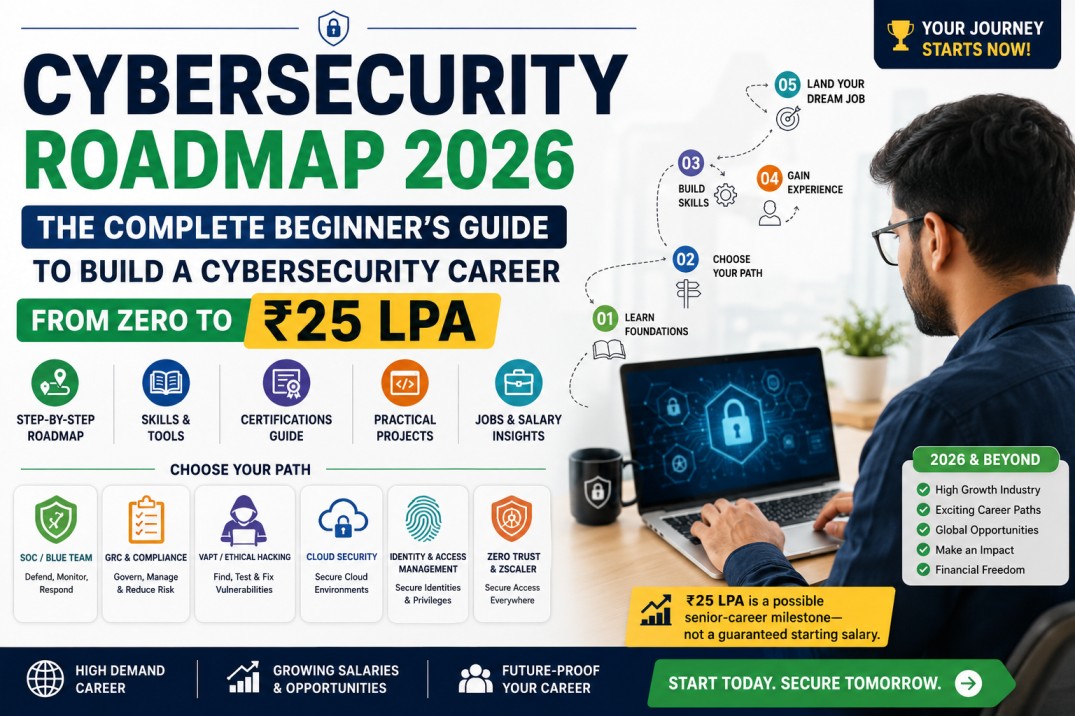
Cybersecurity Roadmap 2026: The Complete Beginner’s Guide to Build a Cybersecurity Career—from Zero to ₹25 LPA
Starting with no cybersecurity experience? This complete roadmap explains exactly what to learn, which career path to choose, what tools and certifications matter, how to build practical projects, where internships fit, and how professionals can progress from entry-level roles toward specialist and leadership salaries.
Cybersecurity is no longer a single job called “ethical hacker.” It is a broad profession containing security operations, governance, risk, compliance, cloud security, application security, digital forensics, identity security, penetration testing, security architecture, privacy, incident response and leadership roles.
This variety creates opportunity, but it also creates confusion. Beginners frequently ask:
- Should I start with ethical hacking or SOC?
- Do I need coding?
- Which certification should I complete first?
- Can a non-technical graduate enter cybersecurity?
- How much time does it take to become job-ready?
- Can cybersecurity professionals really earn ₹25 LPA?
The most important answer: Do not start by collecting random tools and certifications. First build foundations, understand the available job roles, select one career path, develop role-specific skills, complete practical projects and then use certifications to validate your knowledge.
₹25 LPA Is a Career Milestone—not a Fresher Promise
A ₹25 lakh annual package is possible in experienced cloud security, application security, security architecture, cybersecurity management, risk leadership and specialised consulting roles. It is not a standard entry-level salary and cannot be guaranteed by any course or certification.
Your compensation will depend on experience, practical capability, location, organisation, communication, role complexity, certifications and your ability to deliver measurable security outcomes.
What Is Cybersecurity?
Cybersecurity is the practice of protecting people, information, identities, applications, devices, networks, cloud services and business operations from unauthorised access, disruption, fraud, misuse and cyberattacks.
Cybersecurity uses a combination of:
People
Security teams, employees, users, leaders, auditors, developers, administrators and external partners.
Processes
Policies, risk assessments, incident response, change management, audits, access reviews and business continuity.
Technology
Firewalls, SIEM, EDR, IAM, encryption, cloud controls, vulnerability scanners and Zero Trust platforms.
Beginner-Friendly Example
When an employee receives a phishing email, cybersecurity involves more than blocking the message. It may include email filtering, awareness training, log investigation, malware analysis, account protection, incident response, management reporting and improvements to preventive controls.
Why Cybersecurity Is a Strong Career in 2026
Organisations continue to depend on cloud platforms, remote access, mobile devices, SaaS applications, digital payments, APIs, third parties, AI systems and interconnected supply chains. Every expansion creates new security risks that must be governed, monitored and controlled.
Cloud Adoption
Businesses need professionals who understand cloud IAM, data protection, logging, workload security and secure access.
AI-Enabled Threats
Security teams must address AI-powered phishing, deepfakes, data leakage, shadow AI and governance risks.
Regulatory Expectations
Organisations need GRC, privacy, audit, risk and compliance professionals to demonstrate effective security controls.
Identity-Based Attacks
Stolen credentials and excessive privileges make IAM, MFA, Zero Trust and privileged-access skills increasingly valuable.
Employers increasingly look for professionals who can demonstrate practical skills, communication, problem-solving and role-specific competence. A certification can support your profile, but it should be combined with projects, labs and clear evidence of what you can do.
Can a Non-Technical Person Enter Cybersecurity?
Yes. Cybersecurity contains both highly technical and business-oriented roles. Your starting route should depend on your existing strengths.
| Your Background | Suitable Starting Path | Skills to Add |
|---|---|---|
| IT support or networking | SOC, network security, Zero Trust or cloud security | SIEM, logs, security controls, incident response |
| Audit, finance or compliance | GRC, ISO 27001, IT audit or third-party risk | Security fundamentals, risk, controls and evidence |
| Software development | Application security, DevSecOps or cloud security | Secure coding, OWASP, SAST, DAST and threat modelling |
| Student or fresher | Fundamentals followed by SOC, GRC or VAPT | Networking, Linux, Windows, security basics and projects |
| Project or business management | GRC, cybersecurity programme management or awareness | Risk, governance, policies, controls and security frameworks |
| Cloud or system administration | Cloud security, IAM, security engineering or SOC | Cloud logs, least privilege, posture management and detection |
You do not need to know everything before starting. You need enough foundation to understand security problems and one clearly chosen pathway in which to build depth.
The Complete Cybersecurity Learning Roadmap
Roadmap at a Glance
1Build IT Foundations
Before learning advanced security tools, understand how computers, users, applications and networks operate.
Learn:
- Computer hardware and operating-system basics
- Files, processes, services and permissions
- Virtual machines and basic troubleshooting
- Client-server architecture
- Web applications and browsers
- Basic cloud concepts
Practical task:
Install VirtualBox or another virtualisation platform and create one Windows and one Linux virtual machine. Learn how to manage users, services, network settings and system logs.
2Learn Networking Fundamentals
Networking is one of the most valuable cybersecurity foundations. Security incidents frequently involve IP addresses, ports, protocols, DNS, web traffic and network paths.
- OSI and TCP/IP models
- IP addressing and subnetting basics
- TCP and UDP
- Ports and common protocols
- DNS, DHCP, HTTP, HTTPS, SMTP and SSH
- Routers, switches, firewalls and proxies
- VPN, segmentation and NAT
- Packet-capture fundamentals
Practical task:
Use Wireshark to capture DNS and HTTP traffic. Identify the source, destination, protocol, request and response.
3Understand Windows and Linux
Security professionals investigate endpoints, servers and logs. You should therefore be comfortable navigating both operating systems.
Windows Skills
- Users and groups
- Services and processes
- Event Viewer
- Registry basics
- PowerShell basics
- Active Directory fundamentals
Linux Skills
- File-system navigation
- Permissions and ownership
- Processes and services
- Logs and systemd
- Networking commands
- Bash basics
4Learn Core Cybersecurity Concepts
- Confidentiality, integrity and availability
- Threat, vulnerability and risk
- Security controls and defence in depth
- Authentication and authorisation
- Encryption and hashing
- Malware, phishing and social engineering
- Vulnerability management
- Incident-response lifecycle
- Risk assessment and compliance
- Cloud shared-responsibility model
Do Not Skip This Stage
Tools change, but security principles remain. Strong fundamentals allow you to learn new products more quickly and explain your decisions during interviews.
5Select One Cybersecurity Career Path
After learning the foundations, choose a specialisation. Trying to become a SOC analyst, penetration tester, cloud engineer and GRC specialist simultaneously usually results in shallow knowledge.
Path 1: SOC Analyst and Blue Team
A SOC Analyst monitors security alerts, investigates suspicious activity, reviews logs and supports incident response.
Core Skills
- Networking and operating systems
- Log analysis
- SIEM
- Phishing investigation
- Incident triage
- MITRE ATT&CK
Tools to Explore
- Microsoft Sentinel
- Splunk
- IBM QRadar
- Elastic Security
- Wireshark
- VirusTotal
Beginner SOC Projects
- Investigate a simulated phishing email
- Analyse failed logins and account lockouts
- Create five SIEM detection use cases
- Map an incident to MITRE ATT&CK techniques
- Write an incident-escalation report
Read: SOC Analyst Career Roadmap 2026
Explore: SOC Analyst Training Program
Path 2: Governance, Risk and Compliance
GRC professionals help organisations define policies, assess risk, implement controls, prepare for audits and demonstrate compliance. This path can be suitable for technical and non-technical learners.
Core Skills
- Risk assessment
- Security policies
- Control design and testing
- Audit evidence
- ISO 27001
- Third-party risk
Platforms and Frameworks
- ServiceNow GRC
- Archer
- ISO 27001
- NIST CSF
- SOC 2
- CIS Controls
Beginner GRC Projects
- Create a cybersecurity risk register
- Write a sample access-control policy
- Prepare an ISO 27001 audit checklist
- Perform a third-party security assessment
- Map controls to identified risks
Read: GRC Career Roadmap 2026
Explore: GRC with CISM Training
Path 3: VAPT and Ethical Hacking
Vulnerability Assessment and Penetration Testing professionals identify weaknesses, validate exposure and provide remediation recommendations.
Core Skills
- Networking and Linux
- Web-application architecture
- OWASP Top 10
- Reconnaissance and enumeration
- Vulnerability validation
- Report writing
- Ethical and legal boundaries
Tools to Explore
Nmap
Network discovery and service enumeration.
Burp Suite
Web-application testing and HTTP traffic analysis.
Nessus or OpenVAS
Vulnerability scanning and finding validation.
Only practise penetration testing in environments you own or have explicit permission to test. Unauthorised scanning or exploitation can violate laws and organisational policies.
Path 4: Cloud Security
Cloud-security professionals protect cloud identities, data, workloads, applications, networks and configurations across platforms such as AWS, Microsoft Azure and Google Cloud.
Core Skills
- Cloud service and deployment models
- Shared responsibility
- IAM and least privilege
- Cloud logging and monitoring
- Encryption and key management
- Cloud network security
- Cloud posture management
- Cloud incident response
AWS Security
Learn IAM, CloudTrail, GuardDuty, Security Hub, KMS, S3 security and VPC controls.
Azure Security
Learn Entra ID, Conditional Access, Defender for Cloud, Sentinel, Key Vault and network-security groups.
Path 5: Zero Trust and Zscaler
Zero Trust focuses on granting access based on identity, device, application and context rather than trusting users merely because they are connected to an internal network.
Skills to Develop
- Proxy, DNS and TLS fundamentals
- Secure web gateway concepts
- ZTNA and application-specific access
- Identity and device posture
- ZIA, ZPA and ZDX concepts
- Traffic forwarding
- Policy management
- Troubleshooting and log analysis
Explore: Practical Zscaler Training
Read: Zscaler Training Roadmap
Path 6: Identity and Access Management
IAM professionals manage identities, authentication, access privileges, role design, MFA, federation and privileged-access controls.
Core Topics
- Authentication and authorisation
- Role-based access control
- Identity lifecycle
- Single sign-on
- Federation and SAML
- OAuth and OpenID Connect basics
- MFA and passwordless authentication
- Privileged Access Management
- Access reviews and segregation of duties
IAM can be a strong route for professionals from system administration, Microsoft 365, Active Directory, cloud support, audit and service-desk backgrounds.
Cybersecurity Tools Every Beginner Should Know
| Category | Tools | Why Learn Them? |
|---|---|---|
| Packet analysis | Wireshark, tcpdump | Understand network traffic and investigate communication. |
| SIEM | Splunk, Sentinel, QRadar, Elastic | Search logs, investigate alerts and create detections. |
| Endpoint security | Microsoft Defender, CrowdStrike concepts | Investigate endpoint alerts and response actions. |
| Vulnerability management | Nessus, OpenVAS | Identify, validate and prioritise weaknesses. |
| Web security | Burp Suite, OWASP ZAP | Understand HTTP requests, responses and web risks. |
| Threat research | VirusTotal, AbuseIPDB, URLScan | Enrich suspicious indicators during investigation. |
| Cloud security | GuardDuty, Defender for Cloud, Sentinel | Monitor cloud activity, posture and threats. |
| GRC | ServiceNow GRC, Archer | Manage risks, controls, findings and compliance workflows. |
Do not write twenty tools on your resume after watching demonstrations. List a tool only when you can explain its purpose, common workflow, evidence generated and one practical scenario in which you used it.
Do You Need Coding for Cybersecurity?
Coding is useful, but it is not mandatory for every entry-level cybersecurity role.
| Career Path | Coding Requirement | Useful Languages |
|---|---|---|
| SOC Analyst | Helpful but not mandatory initially | Python, PowerShell, KQL or SPL |
| GRC | Usually not required | Excel formulas, basic reporting and optional SQL |
| VAPT | Increasingly important | Python, JavaScript, Bash and PowerShell |
| Cloud Security | Helpful for automation | Python, PowerShell, Bash and infrastructure as code |
| Application Security | Strongly recommended | JavaScript, Python, Java, C# or relevant application language |
| Security Leadership | Not generally required | Understanding architecture and development risks is valuable |
Best Cybersecurity Certifications by Career Stage
Certifications should support your selected role and experience level. Do not choose a certification only because it is popular.
| Career Stage | Certification Direction | Suitable For |
|---|---|---|
| Absolute beginner | Cybersecurity fundamentals, Security+ or equivalent learning | Students, career switchers and IT beginners |
| SOC beginner | SOC training, SIEM skills, SC-200 where appropriate | Blue-team and monitoring roles |
| VAPT beginner | Ethical-hacking foundation and practical labs | Vulnerability and penetration-testing roles |
| GRC professional | ISO 27001, CISA, CISM or CRISC based on experience | Risk, audit, compliance and governance roles |
| Cloud professional | Azure/AWS security, CCSK or CCSP based on experience | Cloud-security engineering and governance |
| Experienced security professional | CISSP, CCSP, CISM or specialist credentials | Architecture, management and leadership roles |
Read: Best Cybersecurity Certifications for Beginners in India 2026
Certification Warning
Senior certifications such as CISSP and CCSP have experience requirements and are not designed to replace practical experience. Always check the latest requirements on the certification provider’s official website.
Practical Projects That Make Your Resume Stronger
Recruiters need evidence that you can apply what you learned. Build small, clearly documented projects rather than listing dozens of tools.
SOC Projects
- Phishing-email investigation
- Failed-login analysis
- Windows Event ID investigation
- SIEM detection dashboard
- Incident-response playbook
GRC Projects
- Cybersecurity risk register
- ISO 27001 audit checklist
- Third-party assessment
- Access-control policy
- Control-testing evidence sheet
Cloud Projects
- AWS IAM review
- Azure conditional-access design
- Cloud logging checklist
- Storage-security assessment
- Cloud incident scenario
VAPT Projects
- Legal web-lab assessment
- OWASP Top 10 demonstration
- Vulnerability report
- Nmap enumeration exercise
- Remediation validation
How to Document Every Project
Remove passwords, personal data, customer information and confidential screenshots before publishing any project on LinkedIn, GitHub or your portfolio.
Why Internship Experience Matters
An internship helps bridge the gap between course completion and workplace readiness. A meaningful cybersecurity internship should involve structured learning, practical tasks, documentation, feedback and a project—not only watching recorded videos.
A Good Internship Should Provide:
- A clear learning plan
- Hands-on assignments
- Mentor feedback
- Team communication
- Evidence of completed work
- A capstone project
- Resume and interview support
Explore: CyberReady 360 Internship Program
Cybersecurity Salary Roadmap in India
Salaries vary significantly by city, company, role, experience, communication, certifications and practical skill. The following figures are broad, indicative career ranges rather than guaranteed packages.
| Career Level | Indicative Experience | Possible Annual Range | Typical Roles |
|---|---|---|---|
| Foundation / internship | 0–1 year | Stipend to approximately ₹3–5 LPA | Intern, trainee, security support |
| Entry level | 0–2 years | Approximately ₹4–7 LPA | SOC L1, junior analyst, GRC analyst, IAM support |
| Early career | 2–4 years | Approximately ₹6–12 LPA | SOC L2, security analyst, consultant, cloud analyst |
| Mid-level specialist | 4–7 years | Approximately ₹10–20 LPA | Engineer, senior consultant, incident responder, GRC specialist |
| Senior / specialist | 7+ years | Approximately ₹18–30+ LPA | Architect, manager, cloud-security lead, AppSec lead |
| Leadership / niche expertise | Usually extensive experience | ₹25 LPA and above may be possible | Security architect, programme leader, risk manager, consultant |
These figures are indicative and may differ substantially. A course, internship or certification cannot ethically guarantee a particular salary or job.
What Helps Professionals Reach Higher Packages?
- Depth in a valuable specialisation
- Strong practical and troubleshooting capability
- Clear communication with business and technical teams
- Experience handling enterprise environments
- Cloud, identity, architecture or governance expertise
- Leadership and programme-management ability
- Recognised certifications aligned with experience
- Measurable business and security impact
Complete 12-Month Cybersecurity Roadmap
1Month 1: IT and Networking Basics
Learn computers, operating systems, IP addressing, ports, protocols, DNS, HTTP and basic troubleshooting.
2Month 2: Windows and Linux
Practise users, permissions, processes, services, logs, command line and virtual machines.
3Month 3: Security Fundamentals
Learn risk, threats, vulnerabilities, controls, IAM, encryption, malware and incident response.
4Month 4: Explore Career Paths
Study SOC, GRC, VAPT, cloud security, IAM and Zero Trust. Select one primary specialisation.
5Months 5–6: Role-Specific Training
Complete structured learning and practical labs for your selected career path.
6Month 7: Build Two Projects
Create documented projects that demonstrate investigation, assessment, configuration or risk-management skills.
7Month 8: Internship or Practical Exposure
Work on guided tasks, team communication, documentation and a capstone assignment.
8Month 9: Certification Preparation
Prepare for a certification aligned with your chosen role and current experience.
9Month 10: Resume and LinkedIn
Build a role-focused resume, improve LinkedIn and publish selected project summaries.
10Month 11: Interview Preparation
Practise concept questions, tools, scenarios, project explanations and behavioural questions.
11Month 12: Applications and Improvement
Apply consistently, track feedback, refine weak areas and continue practical learning.
How to Create a Cybersecurity Resume
Your resume should clearly show the role you are targeting and evidence that supports your suitability.
Recommended Structure
- Professional headline aligned with the target role
- Three- to four-line career summary
- Relevant skills grouped logically
- Practical projects with outcomes
- Internship or professional experience
- Relevant certifications
- Education
- LinkedIn and portfolio links
Avoid These Resume Mistakes
- Listing tools you cannot explain
- Using one generic resume for every role
- Writing “expert” after a short course
- Copying job descriptions
- Adding confidential customer information
- Focusing only on certificates without projects
How to Prepare for Cybersecurity Interviews
Interview preparation should cover four areas:
Concepts
Explain networking, risk, controls, logs, authentication, encryption and incident response in clear language.
Tools
Explain what a tool does, the workflow you followed, the output produced and its limitations.
Scenarios
Practise website blocks, phishing incidents, failed logins, vulnerability findings and audit-control failures.
Projects
Be prepared to explain your contribution, evidence, challenges, decisions and lessons learned.
Common Cybersecurity Career Mistakes
Learning Everything at Once
Choose one initial role and build depth before expanding into adjacent domains.
Collecting Certifications
Certifications without projects, communication and practical ability rarely make someone job-ready.
Ignoring Fundamentals
Tools become difficult to understand when networking, operating systems and security concepts are weak.
Expecting Immediate High Salary
Cybersecurity careers grow through capability, experience, specialisation and business impact.
Using Fake Experience
Misrepresenting experience creates ethical and professional risk. Present labs and projects honestly.
Neglecting Communication
Security professionals must explain incidents, risks, controls and recommendations to different audiences.
Your Cybersecurity Job-Readiness Checklist
- I understand networking, Windows and Linux fundamentals.
- I can explain core cybersecurity concepts clearly.
- I have selected one primary career path.
- I understand the tools commonly used in that role.
- I have completed at least two documented projects.
- I can explain my projects without reading notes.
- I have practical or internship exposure.
- My resume is aligned with my target role.
- My LinkedIn profile shows relevant skills and projects.
- I practise scenario-based interview questions.
- I apply consistently and track feedback.
- I continue learning after completing a course.
Final Thoughts: From Zero to a Cybersecurity Professional
Cybersecurity is not a shortcut to a high salary. It is a profession that rewards curiosity, discipline, integrity, continuous learning and the ability to solve real security problems.
Your first objective should not be ₹25 LPA. Your first objective should be becoming useful in a clearly defined cybersecurity role. Once you can investigate incidents, assess risk, secure cloud environments, test applications or design effective controls, career growth becomes much more realistic.
The Complete Success Formula
- Build strong IT and networking foundations.
- Understand security concepts.
- Select one career path.
- Complete structured training.
- Practise in labs.
- Build projects.
- Gain internship or workplace exposure.
- Use certifications strategically.
- Improve communication.
- Develop deeper specialisation over time.
Your career does not need to start perfectly. It needs to start with a clear plan, consistent learning and honest evidence of progress.
Start Your Cybersecurity Career with Structured Guidance
At CybersecurityTRAIN.com, we help students, career switchers and working professionals build practical cybersecurity skills through structured training, internships, mentoring and career guidance.
Explore learning paths in:
- SOC and Security Operations
- GRC, ISO 27001 and CISM
- VAPT and Ethical Hacking
- Cloud Security
- Zscaler and Zero Trust
- CISSP, CCSP and security leadership
- Career-focused cybersecurity internships
Training cannot guarantee a job or salary, but the right programme can give you structure, practical exposure, mentor guidance and a clearer route toward becoming job-ready.
Explore Cybersecurity Programs Explore SOC Training Explore GRC Training Explore Zscaler TrainingCall or WhatsApp: +91 98857 89887
Frequently Asked Questions
1. How can a beginner start a cybersecurity career in 2026?
Start with IT, networking, Windows, Linux and security fundamentals. Then choose one career path, complete practical training, build projects and apply for internships or entry-level roles.
2. Can I enter cybersecurity without an IT degree?
Yes. Employers may accept candidates from different educational backgrounds when they demonstrate relevant skills, projects, certifications and practical understanding.
3. Is coding mandatory for cybersecurity?
No. Coding is not mandatory for every SOC, GRC, IAM or governance role, but scripting and automation can improve long-term career growth.
4. Which cybersecurity field is best for beginners?
SOC, GRC and cybersecurity fundamentals are common starting options. The right choice depends on whether you prefer technical investigation, business risk, compliance or offensive security.
5. How long does it take to become job-ready?
A focused learner may build a meaningful foundation within six to twelve months. Readiness depends on prior experience, study time, practical work and the target role.
6. Can a fresher earn ₹25 LPA in cybersecurity?
It is not a normal or realistic expectation for most freshers. Packages around ₹25 LPA are more commonly associated with experienced, specialised or leadership roles.
7. What is a typical entry-level cybersecurity salary in India?
Many entry-level roles fall broadly around ₹4–7 LPA, although actual compensation varies by company, location, role and candidate capability.
8. Which certifications should beginners consider?
Beginners should consider foundational security, SOC, cloud or GRC learning aligned with their selected role. Avoid advanced credentials until you have the required experience and foundational understanding.
9. Is ethical hacking the only cybersecurity career?
No. Cybersecurity also includes SOC, GRC, cloud security, IAM, application security, incident response, forensics, privacy, architecture and leadership.
10. Do cybersecurity projects help in getting a job?
Yes. Well-documented projects demonstrate practical ability and give candidates useful scenarios to explain during interviews.
11. Is an internship important for cybersecurity beginners?
An internship can provide practical exposure, mentor feedback, documentation experience and evidence that supports job applications.
12. Which cybersecurity roles can become high-paying?
Cloud security, application security, identity security, security architecture, incident response, GRC leadership and security management can become high-paying with relevant experience and depth.
13. Should I learn AWS or Azure for cloud security?
Both are valuable. Azure can be useful for Microsoft-focused enterprise environments, while AWS offers broad cloud-infrastructure exposure. Start with one and learn the common security principles deeply.
14. Where can I get structured cybersecurity guidance?
CybersecurityTRAIN.com offers career-oriented learning paths in SOC, GRC, cloud security, VAPT, Zscaler, Zero Trust, CISSP and CCSP, along with internship and career-support programmes.