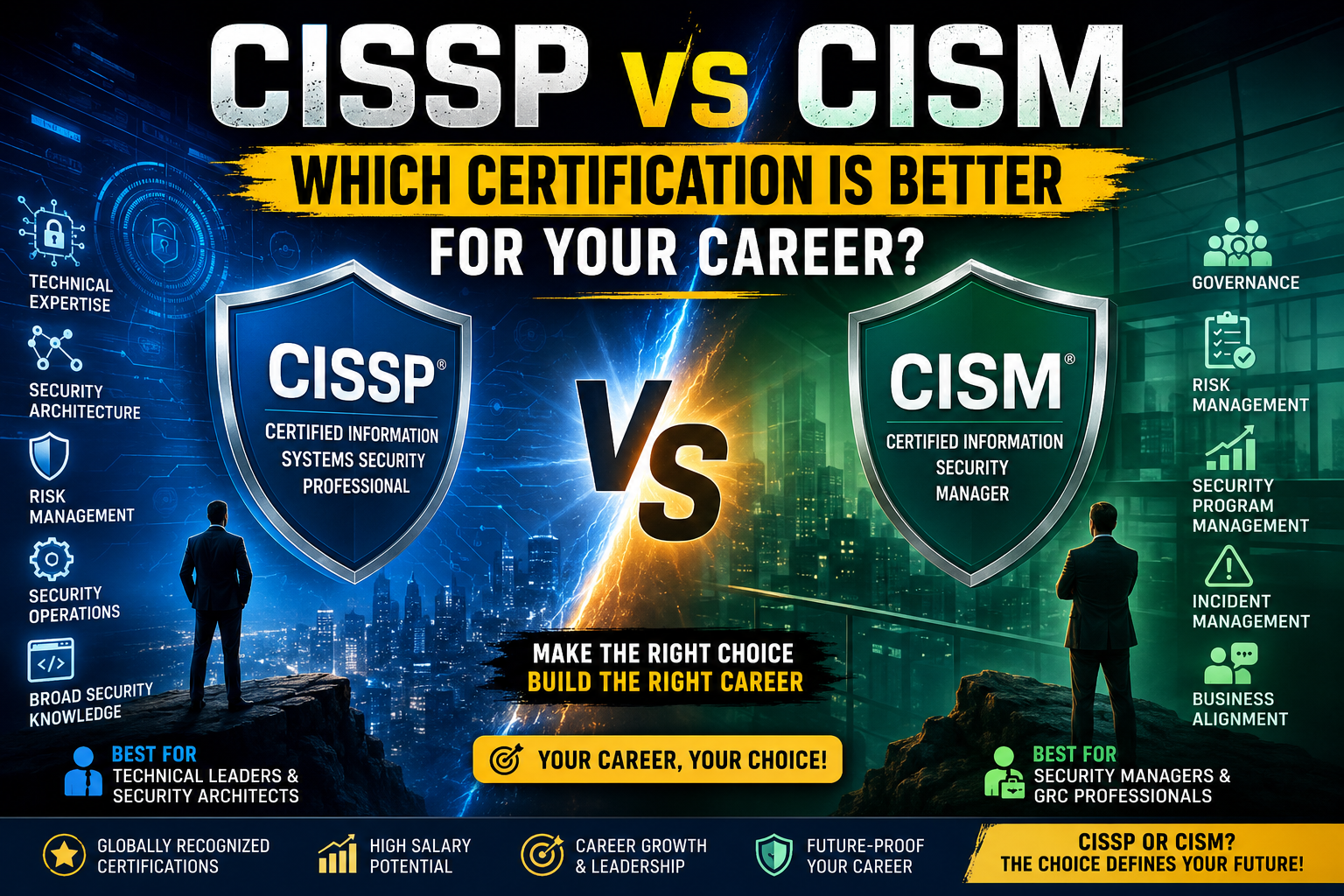
CISSP vs CISM: Which Certification Is Better for Your Cybersecurity Career?
Confused between CISSP and CISM? This detailed guide explains the difference, career value, job roles, exam focus, who should choose CISSP, who should choose CISM, and how to make the right decision based on your professional goals.
Choosing between CISSP and CISM is one of the most important certification decisions for cybersecurity professionals. Both certifications are respected globally, both can help in senior cybersecurity roles, and both are strongly connected to security leadership. However, they are designed for different career directions.
```CISSP is broader. It validates your knowledge across multiple cybersecurity domains including risk management, security architecture, network security, identity and access management, security operations, testing, and software security.
CISM is more focused on information security management. It is designed for professionals who want to manage security programs, governance, risk, compliance, and incident management from a business leadership perspective.
Simple answer: Choose CISSP if you want broad cybersecurity leadership knowledge. Choose CISM if you want to specialize in security management, governance, risk, compliance, and security program leadership.
CISSP vs CISM: Quick Decision Summary
```Choose CISSP If You Want
- Broad cybersecurity leadership knowledge
- Security architecture and consulting career growth
- Technical-to-management career transition
- Strong understanding across multiple security domains
- Career options across SOC, cloud, IAM, network, GRC, and security operations
Choose CISM If You Want
- Information security management career growth
- GRC, risk, governance, and compliance leadership
- Security program management skills
- Business-aligned cybersecurity decision-making
- Managerial roles such as Security Manager, GRC Manager, or Risk Manager
What Is CISSP?
```CISSP stands for Certified Information Systems Security Professional. It is offered by ISC2 and is one of the most recognized certifications for experienced cybersecurity professionals.
CISSP is not only a technical certification. It is a leadership-level cybersecurity certification that expects you to understand how security works across an organization. It helps professionals think beyond tools and technologies and understand security from a broader business, governance, risk, architecture, and operations perspective.
CISSP Covers Eight Security Domains
The official CISSP exam outline includes eight domains:
- Security and Risk Management
- Asset Security
- Security Architecture and Engineering
- Communication and Network Security
- Identity and Access Management
- Security Assessment and Testing
- Security Operations
- Software Development Security
You can review the official CISSP exam outline here: ISC2 CISSP Exam Outline.
Career value of CISSP: CISSP is useful when you want to prove that you understand cybersecurity at a wider organizational level. It is especially valuable for professionals who want to become security architects, security consultants, security managers, or future CISOs.
Why Should You Choose CISSP?
```You should choose CISSP if you want to build a strong foundation across cybersecurity leadership, security architecture, risk management, identity, network security, operations, testing, and secure software concepts.
Many professionals start their career in one specific area such as SOC, networking, cloud, IAM, vulnerability management, or IT operations. The challenge comes when they want to move into senior roles. Senior roles require a broader view. You need to understand how different security functions connect with business risk, compliance, architecture, operations, and leadership decisions.
This is where CISSP becomes valuable.
CISSP Is a Strong Choice for These Professionals
- SOC analysts who want to move into security leadership
- Network security engineers who want to become security architects
- Cloud security engineers who want broader security knowledge
- IAM professionals who want to understand enterprise security
- Security consultants who need credibility across multiple domains
- IT managers moving into cybersecurity leadership
- GRC professionals who want stronger technical security understanding
- Experienced cybersecurity professionals targeting CISO-level growth
Example Job Roles Where CISSP Helps
| Job Role | Why CISSP Helps |
|---|---|
| Security Architect | CISSP helps with architecture, engineering, identity, risk, network security, and operations knowledge. |
| Security Consultant | Consultants need to advise clients across multiple security domains. CISSP builds that broad advisory capability. |
| Security Manager | Managers need to understand risk, operations, policies, access control, testing, and secure design. |
| Cloud Security Lead | CISSP supports broader decision-making around cloud risk, identity, governance, architecture, and operations. |
| SOC Manager | Security operations leaders benefit from understanding incident response, logging, risk, governance, and business continuity. |
| Future CISO | CISSP provides a wide view of cybersecurity that supports executive-level security decision-making. |
Example CISSP Career Path
SOC Analyst → Security Engineer → Security Consultant → Security Architect → Security Manager → CISO
Network Engineer → Network Security Engineer → Cloud Security Engineer → Security Architect → Cybersecurity Leader
What Is CISM?
```CISM stands for Certified Information Security Manager. It is offered by ISACA and is designed for professionals who manage, govern, and lead information security programs.
CISM is highly suitable for professionals who want to work in security governance, risk management, compliance, policy, security program management, and incident management. It is not focused on deep technical implementation. Instead, it focuses on managing cybersecurity as a business function.
CISM Covers Four Main Domains
The official CISM exam content outline includes four job-practice domains:
- Information Security Governance
- Information Security Risk Management
- Information Security Program
- Incident Management
You can review the official CISM exam content outline here: ISACA CISM Exam Content Outline.
Career value of CISM: CISM is valuable when your role is connected to security governance, risk, compliance, security programs, stakeholder management, leadership reporting, and incident management from a business perspective.
Why Should You Choose CISM?
```You should choose CISM if your goal is to manage information security rather than only implement security controls. CISM is ideal for professionals who want to understand how to build security programs, manage enterprise risk, report to management, handle audits, and align security with business objectives.
For example, a firewall engineer may configure security rules. A CISM-focused security manager will ask whether those rules support business risk appetite, regulatory requirements, security policy, incident response readiness, and governance expectations.
CISM Is a Strong Choice for These Professionals
- GRC analysts who want to become GRC managers
- Risk professionals who want security management credibility
- Compliance professionals working with ISO 27001, SOC 2, PCI DSS, or regulatory audits
- Security managers responsible for teams, programs, and reporting
- SOC leads moving toward security operations management
- Incident response leads moving toward incident management leadership
- IT auditors who want to move into security governance
- Professionals targeting CISO or senior information security leadership roles
Example Job Roles Where CISM Helps
| Job Role | Why CISM Helps |
|---|---|
| Information Security Manager | CISM directly supports security program management, governance, risk, and incident management. |
| GRC Manager | CISM aligns strongly with governance, risk management, compliance, and business-driven security decisions. |
| IT Risk Manager | CISM helps risk professionals understand security risk from an enterprise management perspective. |
| Security Program Manager | CISM supports program design, stakeholder communication, metrics, reporting, and governance. |
| Incident Response Manager | CISM includes incident management from a process, leadership, and business impact perspective. |
| Future CISO | CISM supports executive-level security governance, risk ownership, and program leadership. |
Example CISM Career Path
GRC Analyst → Risk Consultant → Information Security Manager → Security Program Manager → CISO
SOC Lead → Incident Response Lead → Security Operations Manager → Information Security Manager → CISO
CISSP vs CISM: Detailed Comparison
```| Comparison Area | CISSP | CISM |
|---|---|---|
| Certification Body | ISC2 | ISACA |
| Main Focus | Broad cybersecurity knowledge across multiple domains | Information security management, governance, risk, and program leadership |
| Best For | Security architects, consultants, engineers, managers, and future CISOs | Security managers, GRC professionals, risk managers, compliance leaders, and future CISOs |
| Thinking Style | Think like a cybersecurity leader and security advisor | Think like an information security manager |
| Technical Depth | Broader and more technical compared to CISM | Less technical, more management and governance focused |
| GRC Alignment | Useful, but broader than GRC | Very strongly aligned with GRC and information security management |
| Security Architecture Alignment | Strong alignment | Limited alignment |
| Security Program Management | Useful, but not the only focus | Strong alignment |
| Common Career Direction | Security Architect, Security Consultant, Security Manager, CISO | Information Security Manager, GRC Manager, Risk Manager, Security Program Manager, CISO |
| Best First Choice For | Technical professionals moving into leadership | GRC, risk, compliance, and management professionals |
Which Certification Is Better for Technical Security Professionals?
```If you are from a technical cybersecurity background, CISSP is usually the better first choice. This includes professionals from SOC, network security, cloud security, IAM, vulnerability management, penetration testing, security engineering, or IT infrastructure.
The reason is simple: technical professionals often already know tools and technologies, but they need broader security leadership thinking to move into senior roles. CISSP helps you connect technical security with risk, governance, architecture, operations, business continuity, access control, and secure design.
Example
A SOC analyst may know how to investigate alerts. CISSP helps the same professional understand incident response governance, evidence handling, logging strategy, business continuity, security operations, risk treatment, and management reporting.
Recommended certification for technical professionals: CISSP first, then CISM later if you want to move deeper into management or CISO-level responsibilities.
```Which Certification Is Better for GRC Professionals?
```If you are working in GRC, risk, audit coordination, compliance, security policy, ISO 27001, SOC 2, PCI DSS, third-party risk, or security governance, CISM is usually more directly aligned.
CISM focuses on security governance, risk management, information security program development, and incident management. These areas are very close to daily GRC responsibilities.
Example
A GRC analyst may work on policies, risk registers, audit evidence, control mapping, and management reporting. CISM helps that professional understand how these activities fit into a larger information security management program.
Recommended certification for GRC professionals: CISM first, then CISSP later if you want broader cybersecurity leadership credibility.
```Which Certification Is Better for Managers?
```If you are already managing people, projects, risk, compliance, security operations, or security programs, CISM may be the more natural fit. CISM is designed around management thinking. It helps you understand how to build and run security programs that align with business objectives.
However, if you are a manager responsible for multiple technical security areas such as IAM, cloud security, network security, application security, security testing, and operations, CISSP can provide a wider foundation.
Simple rule for managers: Choose CISM if your work is governance, risk, compliance, and program management. Choose CISSP if your role needs broader understanding of technical and architectural security areas.
CISSP vs CISM for CISO Career
```Both CISSP and CISM can support a CISO career, but they support it in different ways.
How CISSP Helps a Future CISO
- Builds broad cybersecurity understanding
- Improves security architecture and risk-based thinking
- Helps discuss security controls across domains
- Supports decision-making across technical and business areas
- Gives credibility with technical teams and leadership
How CISM Helps a Future CISO
- Builds information security management skills
- Strengthens governance and risk leadership
- Helps build security programs and roadmaps
- Supports board-level and management reporting
- Improves business alignment of cybersecurity
If your long-term goal is to become a CISO, the ideal path is often to complete both over time. CISSP gives you breadth, while CISM gives you focused governance and management depth.
```Decision Matrix: Should You Choose CISSP or CISM?
```| Your Current Situation | Better Choice | Reason |
|---|---|---|
| You are from SOC, network security, IAM, cloud, or security engineering | CISSP | It helps you move from technical execution to broader security leadership. |
| You work in GRC, risk, audit, compliance, or policy | CISM | It directly aligns with governance, risk, and security program management. |
| You want to become a Security Architect | CISSP | CISSP covers architecture, engineering, identity, operations, and risk. |
| You want to become an Information Security Manager | CISM | CISM is designed around managing information security programs. |
| You want a CISO career | Both | CISSP gives broad cybersecurity knowledge; CISM gives governance and management depth. |
| You are confused and want one certification with broad recognition | CISSP | CISSP applies across many cybersecurity roles and domains. |
| You want to move into governance and security management faster | CISM | CISM is more focused on security management, governance, and risk decisions. |
Who Should Choose CISSP?
```You should choose CISSP if you want a broad and respected cybersecurity certification that can support multiple career paths.
- You have experience in cybersecurity, IT, network, cloud, SOC, IAM, or security operations.
- You want to become a security architect, consultant, manager, or future CISO.
- You want to understand security across multiple domains.
- You want to move from technical implementation to leadership-level thinking.
- You want a certification that can support many cybersecurity roles.
- You want better credibility for senior cybersecurity positions.
Best-fit CISSP profile: A cybersecurity or IT professional who wants to build strong security leadership knowledge across many areas and become eligible for senior security roles.
Who Should Choose CISM?
```You should choose CISM if your goal is to manage information security as a business function.
- You are working in GRC, risk, compliance, audit coordination, or security management.
- You want to become an Information Security Manager or GRC Manager.
- You want to manage security programs instead of only implementing controls.
- You work with policies, risk registers, audit evidence, security roadmaps, and leadership reporting.
- You want to work closely with business leaders, auditors, risk committees, and senior management.
- You want a certification focused on governance, risk, security program management, and incident management.
Best-fit CISM profile: A security, risk, or GRC professional who wants to manage security programs and grow into information security leadership roles.
Should You Do CISSP First or CISM First?
```Do CISSP First If
- You are from a technical background.
- You want broader cybersecurity knowledge.
- You want to become a security architect or consultant.
- You are not fully focused on GRC or management yet.
- You want a certification that keeps multiple career options open.
Do CISM First If
- You are already working in GRC, risk, compliance, or management.
- Your next target role is Information Security Manager or GRC Manager.
- You work with policies, audits, risk registers, governance, or reporting.
- You want a more focused management-oriented certification.
- You want to grow into security program leadership.
Can You Do Both CISSP and CISM?
```Yes. In fact, CISSP and CISM complement each other very well. Many senior cybersecurity leaders eventually pursue both certifications because they strengthen different sides of leadership.
CISSP gives you broad cybersecurity knowledge. CISM gives you focused information security management knowledge. Together, they create a strong profile for senior security roles.
Recommended sequence:
- Technical background: CISSP first, then CISM
- GRC or management background: CISM first, then CISSP
- CISO ambition: Plan for both over time
Common Mistake: Choosing Based Only on Popularity
```Many professionals choose a certification only because it is popular on LinkedIn or because someone else recommended it. This is not the right approach.
You should choose based on your current background, your next target role, and your long-term career direction.
Avoid Choosing CISSP Only Because
- Everyone says it is the top cybersecurity certification.
- You think it will automatically make you a manager.
- You have not checked whether the domains match your career goals.
Avoid Choosing CISM Only Because
- You think it is easier than CISSP.
- You want management roles but do not understand governance or risk.
- You are purely technical and not ready for security management thinking.
The best certification is not always the most popular certification. The best certification is the one that supports your next career move.
```Job Search Links for CISSP and CISM
```Before deciding, it is smart to check job demand in your target location. Search for CISSP and CISM roles on major job platforms and observe which certification appears more often in job descriptions related to your desired role.
CISSP Job Search Links
CISM Job Search Links
Also review the official certification pages:
```Preparation Roadmap: How to Plan CISSP or CISM
```Once you decide your certification, follow a structured preparation plan instead of randomly watching videos or reading disconnected notes.
| Step | CISSP Preparation Plan | CISM Preparation Plan |
|---|---|---|
| Step 1 | Understand all eight CISSP domains and their purpose. | Understand four CISM domains and how security management works. |
| Step 2 | Build conceptual clarity around risk, architecture, IAM, operations, and security testing. | Build clarity around governance, risk, program management, and incident management. |
| Step 3 | Use real-world examples to connect technical controls with business risk. | Use real-world examples such as risk registers, policies, governance committees, and incident reporting. |
| Step 4 | Practice scenario-based questions with a security leadership mindset. | Practice management-based questions with business alignment and risk prioritization mindset. |
| Step 5 | Revise weak domains and practice full-length tests. | Revise domain-level concepts and practice case-based questions. |
Exam Mindset Difference
CISSP mindset: Think like a senior security advisor who understands risk, architecture, operations, identity, governance, and business impact.
CISM mindset: Think like an information security manager who aligns security programs with business goals, manages risk, and communicates with leadership.
Final Verdict: CISSP or CISM?
```Choose CISSP if you want broad cybersecurity leadership knowledge and want to keep your career options open across security architecture, consulting, operations, risk, cloud security, IAM, and security management.
Choose CISM if you want to specialize in information security management, governance, risk, compliance, incident management, and security program leadership.
Choose both if your long-term goal is to move into senior cybersecurity leadership or CISO-level roles.
Final simple rule: CISSP is better for broad cybersecurity leadership. CISM is better for focused information security management and governance leadership.
Need Help Choosing Between CISSP and CISM?
At CybersecurityTRAIN.com, we help cybersecurity professionals choose the right certification based on their background, current role, and future career target. Whether you are from SOC, network security, cloud, GRC, audit, compliance, or IT operations, the right roadmap can save months of confusion.
Explore our certification training programs and speak with our training advisor for practical guidance.
Explore CISSP Training Explore GRC with CISM Training Explore Zero Trust TrainingCall or WhatsApp: +91 98857 89887
Frequently Asked Questions
```1. Is CISSP better than CISM?
CISSP is better if you want broad cybersecurity leadership knowledge across multiple security domains. CISM is better if you want to focus on information security management, governance, risk, and security program leadership.
2. Is CISM easier than CISSP?
CISM is more focused because it has fewer domains, but it still requires strong management thinking. CISSP is broader and requires understanding of many security areas. Difficulty depends on your background.
3. Can I do CISM without CISSP?
Yes. You can prepare for CISM without doing CISSP first, especially if your background is in GRC, risk, compliance, audit coordination, incident management, or security management.
4. Can I do CISSP without CISM?
Yes. CISSP is a standalone certification and is often selected by professionals from technical security, architecture, operations, consulting, cloud security, IAM, and security management backgrounds.
5. Which certification is better for GRC?
CISM is more directly aligned with GRC because it focuses on governance, risk management, security programs, and incident management. CISSP is also useful if you want broader cybersecurity knowledge.
6. Which certification is better for a CISO role?
Both are useful for a CISO role. CISSP provides broad cybersecurity leadership knowledge, while CISM provides strong security governance and program management knowledge.
7. Which should I choose first: CISSP or CISM?
If you are from a technical background, choose CISSP first. If you are from GRC, risk, compliance, audit, or security management background, choose CISM first.
8. Are CISSP and CISM only for experienced professionals?
Both certifications are designed for experienced professionals. However, even if you are still building experience, studying their concepts can help you understand how cybersecurity leadership decisions are made.
9. Is CISSP useful for managers?
Yes. CISSP is useful for managers who need broad cybersecurity understanding across risk, architecture, operations, identity, testing, network security, and software security.
10. Is CISM useful for technical professionals?
Yes, but it is more useful when a technical professional wants to move into management, governance, risk, compliance, program leadership, or incident management roles.