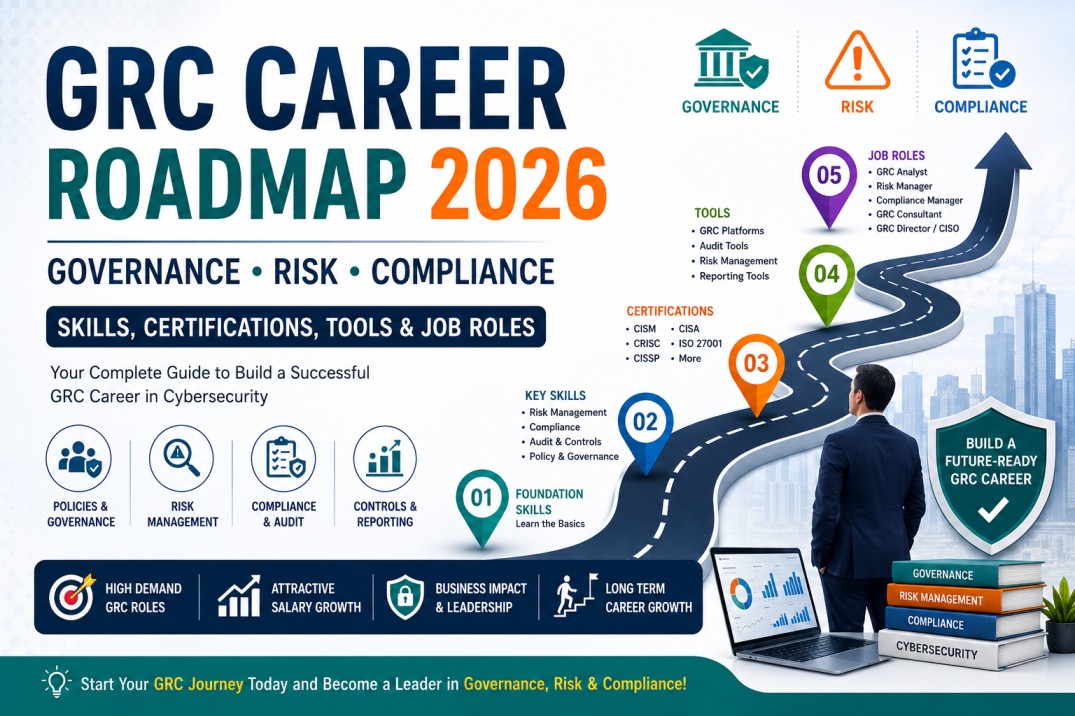
GRC Career Roadmap 2026: Skills, Certifications, Tools and Job Roles
Want to build a cybersecurity career without going too deep into coding, hacking or complex security engineering? GRC can be one of the best career paths for professionals who like governance, risk, compliance, security controls, audits, policies and business-focused cybersecurity.
Cybersecurity is not only about ethical hacking, SOC monitoring, malware analysis or firewall configuration. Every organization also needs people who can answer important business questions:
```- Are our security policies properly defined?
- Do we understand our cybersecurity risks?
- Are our controls working effectively?
- Are we ready for audits and compliance reviews?
- Are vendors and third parties creating risk?
- Can leadership understand our security posture clearly?
- Are we aligned with frameworks such as ISO 27001, NIST CSF, SOC 2, PCI DSS or regulatory requirements?
This is where GRC comes in. GRC stands for Governance, Risk and Compliance. It is a career path that connects cybersecurity with business risk, regulatory expectations, audit readiness, control maturity and leadership reporting.
Simple career truth: GRC is ideal for professionals who want a cybersecurity career with strong business impact, risk thinking, communication, documentation and governance skills.
This roadmap will help you understand what GRC is, what skills are required, which certifications to choose, what tools to learn, what job roles are available and how to become job-ready in 2026.
```What Is GRC in Cybersecurity?
```GRC stands for Governance, Risk and Compliance. In cybersecurity, GRC helps organizations manage security in a structured, accountable and business-aligned way.
Governance
Governance defines how security is directed, controlled and measured. It includes policies, roles, responsibilities, committees, reporting and leadership oversight.
Risk
Risk management identifies what can go wrong, how serious it can be, how likely it is and what actions should be taken to reduce or accept that risk.
Compliance
Compliance ensures that the organization meets legal, regulatory, contractual and framework requirements such as ISO 27001, SOC 2, PCI DSS, HIPAA or NIST CSF.
GRC is not just paperwork. Good GRC helps organizations make better security decisions, prioritize investments, reduce audit surprises and communicate cybersecurity risk in a language business leaders understand.
Example
If a company stores customer data in the cloud, GRC professionals help ensure that data classification, access controls, encryption, vendor risk, compliance obligations, monitoring and audit evidence are properly managed.
Why GRC Is a High-Growth Career in 2026
```GRC is becoming more important because cybersecurity is now a board-level and business-level topic. Companies are not only asking, “Do we have security tools?” They are asking, “Are we managing cyber risk properly?”
Modern organizations face risks from ransomware, cloud misconfiguration, third-party vendors, AI usage, privacy regulations, identity compromise, remote work, data leakage and regulatory audits. These challenges require structured governance, risk management and compliance programs.
GRC Is Growing Because Organizations Need To:
- Meet regulatory and contractual requirements
- Prepare for internal and external audits
- Manage cybersecurity risks in business language
- Track control effectiveness
- Manage third-party and vendor risks
- Build security policies and standards
- Report risk to senior leadership
- Handle AI governance and shadow AI risks
- Improve cyber resilience and incident readiness
Career opportunity
GRC is attractive because it is suitable for professionals from IT, audit, compliance, risk, operations, project management, SOC, cybersecurity and even non-technical backgrounds who are ready to learn security fundamentals and risk concepts.
Is GRC Technical or Non-Technical?
```GRC is not as technically deep as penetration testing, malware analysis or security engineering. However, it is not completely non-technical either.
A GRC professional does not usually configure firewalls every day, but they should understand what firewalls do. They may not write code, but they should understand application security risks. They may not investigate every SOC alert, but they should understand incident management, control failures and business impact.
Best way to understand GRC: GRC is a business-focused cybersecurity career that requires enough technical understanding to evaluate risk, controls and compliance effectively.
You Do Not Need Deep Expertise In:
- Advanced coding
- Exploit development
- Reverse engineering
- Deep packet analysis
- Advanced malware analysis
But You Should Understand Basics Of:
- Networking and cloud concepts
- Identity and access management
- Data protection
- Security policies and controls
- Vulnerability management
- Incident response
- Third-party risk
- Compliance frameworks
What Does a GRC Analyst Do?
```A GRC Analyst helps an organization manage security governance, risk and compliance activities. The role can vary depending on the company, but most GRC analysts work with policies, controls, risks, audits, evidence and reporting.
Common Responsibilities of a GRC Analyst
- Maintain risk registers
- Support risk assessments
- Review security policies and procedures
- Map controls to frameworks such as ISO 27001, NIST CSF, SOC 2 or PCI DSS
- Collect audit evidence
- Support internal and external audits
- Track remediation plans
- Review third-party security questionnaires
- Coordinate with IT, security, legal, compliance and business teams
- Prepare management dashboards and reports
- Support security awareness and policy exception processes
Real-world example
An auditor asks for evidence that privileged user access is reviewed every quarter. A GRC analyst coordinates with the IAM team, collects access review reports, validates approvals, documents exceptions and tracks remediation for overdue reviews.
GRC Career Levels and Job Roles
```GRC offers a clear career progression from analyst roles to leadership roles.
| Career Level | Common Job Roles | Main Responsibilities |
|---|---|---|
| Entry Level | GRC Analyst, Compliance Analyst, Risk Analyst, IT Controls Analyst | Evidence collection, control tracking, policy support, risk register updates and audit coordination. |
| Intermediate | Senior GRC Analyst, IT Risk Consultant, Compliance Specialist, Third-Party Risk Analyst | Risk assessments, control testing, vendor reviews, compliance mapping and remediation tracking. |
| Advanced | GRC Consultant, Security Governance Lead, IT Risk Manager, Compliance Manager | Program ownership, framework implementation, control maturity, management reporting and risk treatment planning. |
| Leadership | GRC Manager, Information Security Manager, Cyber Risk Manager, Security Program Manager | Strategy, governance, risk committees, audit leadership, stakeholder management and executive reporting. |
| Executive Path | Head of GRC, Director of Cyber Risk, CISO | Security strategy, enterprise risk oversight, board reporting, budget decisions and security program leadership. |
Skills Required for GRC Jobs in 2026
```GRC professionals need a combination of cybersecurity understanding, risk thinking, compliance knowledge, documentation ability and communication skills.
1. Cybersecurity Fundamentals
- Security controls
- Threats and vulnerabilities
- Identity and access management
- Data protection
- Incident response
- Cloud security basics
2. Risk Management Skills
- Risk identification
- Risk assessment
- Inherent and residual risk
- Risk treatment
- Risk acceptance
- Risk reporting
3. Compliance and Framework Knowledge
- ISO 27001
- NIST CSF
- SOC 2
- PCI DSS
- GDPR and privacy basics
- Internal policy requirements
4. Audit and Control Skills
- Control design
- Control testing
- Evidence collection
- ITGC basics
- Audit readiness
- Remediation tracking
5. Documentation and Reporting
- Policy writing
- Procedure review
- Risk register updates
- Control matrix preparation
- Dashboard reporting
- Management summaries
6. Communication Skills
- Stakeholder coordination
- Audit communication
- Business impact explanation
- Executive-level reporting
- Problem-solving
- Critical thinking
Important: Communication is not optional in GRC. A strong GRC professional must explain technical risk in simple business language.
Important GRC Concepts You Must Learn
```Before applying for GRC jobs, make sure you can explain these concepts confidently.
| Concept | Simple Meaning | Example |
|---|---|---|
| Risk Register | A document that tracks risks, owners, impact, likelihood, treatment and status. | Weak MFA coverage is listed as a risk with owner, severity and remediation plan. |
| Control | A safeguard used to reduce risk. | MFA, encryption, logging, access review and backup controls. |
| Control Testing | Checking whether a control is working effectively. | Validating whether quarterly access reviews were completed and approved. |
| Residual Risk | The risk remaining after controls are applied. | Even after MFA, phishing risk remains due to social engineering. |
| Risk Treatment | Decision on how to handle risk: mitigate, accept, transfer or avoid. | Mitigate by implementing MFA and user awareness training. |
| Audit Evidence | Proof that a control or process is operating. | Access review reports, screenshots, logs, approvals or tickets. |
| Policy Exception | Approved temporary deviation from policy. | A legacy system cannot support MFA for 60 days, so compensating controls are documented. |
| Third-Party Risk | Risk created by vendors, partners or service providers. | A vendor storing customer data without encryption or audit reports. |
Tools Used by GRC Professionals
```GRC professionals use tools to manage risks, policies, controls, audits, evidence and compliance activities. You do not need to master every tool at the beginning, but you should understand tool categories.
| Tool Category | Examples | Why It Is Used |
|---|---|---|
| GRC Platforms | ServiceNow GRC, Archer, MetricStream, OneTrust | To manage risks, controls, policies, audits, issues and compliance workflows. |
| Audit and Evidence Tools | AuditBoard, Workiva, Hyperproof, Drata, Vanta | To collect evidence, track controls and support audit readiness. |
| Risk Register Tools | Excel, Google Sheets, ServiceNow, Archer | To document and track risks, owners, treatment plans and status. |
| Policy Management Tools | SharePoint, Confluence, OneTrust, ServiceNow | To manage policies, approvals, versions, exceptions and reviews. |
| Security Tools for Evidence | SIEM, IAM, EDR, vulnerability scanners, cloud security dashboards | To collect security evidence such as logs, access reviews, vulnerabilities and alerts. |
| Reporting Tools | Excel, Power BI, Tableau, Google Looker Studio | To create dashboards for leadership, audit teams and risk committees. |
Beginner advice
Start with Excel or Google Sheets for risk registers, control matrices and audit trackers. Once your concepts are clear, learning enterprise GRC tools becomes much easier.
Best Certifications for a GRC Career
```Certifications help prove your knowledge and improve your credibility, but they should be combined with practical GRC skills.
| Certification | Best For | Career Value |
|---|---|---|
| CISM | Security governance, information security management, GRC leadership | Good for GRC Manager, Information Security Manager and security leadership roles. |
| CISA | IT audit, control testing, assurance and compliance | Good for IT Auditor, Compliance Analyst, ITGC Analyst and audit roles. |
| CRISC | IT risk management, risk assessment, risk response and reporting | Good for IT Risk Manager, Risk Consultant and technology risk roles. |
| ISO 27001 Lead Auditor / Lead Implementer | Information security management system audits and implementation | Good for ISO 27001 consulting, audit readiness and compliance roles. |
| CISSP | Broad cybersecurity leadership | Good for senior security leadership, GRC leadership and CISO-track professionals. |
| Security+ | Cybersecurity fundamentals | Good for beginners who need basic security understanding before GRC specialization. |
Which Certification Should You Choose First?
Choose CISM If
You want to grow into information security management, security governance, GRC leadership or CISO-track roles.
Choose CISA If
You want to work in IT audit, control testing, compliance validation, ITGC or assurance roles.
Choose CRISC If
You want to specialize in IT risk management, risk assessment, risk response and risk reporting.
Useful related guide: CISM vs CRISC vs CISA: Which Certification Is Best for GRC?
```GRC vs SOC vs VAPT: Which Career Path Is Right for You?
```Many cybersecurity beginners are confused between GRC, SOC and VAPT. Each path is valuable, but the skills and personality fit are different.
| Career Path | Best For | Work Style |
|---|---|---|
| GRC | People who like risk, compliance, documentation, audits, policies, reporting and business communication. | Business-focused, analytical, structured and communication-heavy. |
| SOC | People who like monitoring, logs, incidents, alerts, investigation and blue team operations. | Operational, alert-driven, investigation-focused and shift-based in many organizations. |
| VAPT | People who like ethical hacking, testing, exploitation, web security and vulnerability discovery. | Technical, hands-on, testing-focused and report-driven. |
Simple decision: Choose GRC if you want a cybersecurity career that combines business, risk, compliance and security governance rather than deep technical exploitation.
GRC Career Roadmap: Step-by-Step Learning Path
```Use this roadmap if you are starting from beginner level or moving from another IT/security area into GRC.
1 Build Cybersecurity Fundamentals
Learn basic security concepts before jumping into frameworks. Understand threats, vulnerabilities, controls, identity, data protection, incident response, cloud and network basics.
2 Learn Governance Basics
Understand policies, standards, procedures, roles, responsibilities, risk committees, security strategy and reporting structures.
3 Learn Risk Management
Practice identifying risks, scoring likelihood and impact, defining risk owners, documenting risk treatment and tracking residual risk.
4 Learn Compliance Frameworks
Start with ISO 27001 and NIST CSF, then understand SOC 2, PCI DSS, GDPR and other frameworks based on your target industry.
5 Learn Control Testing
Understand how to validate whether controls are properly designed and operating effectively. Practice with access reviews, backup controls, vulnerability management and logging controls.
6 Build Practical Templates
Create a risk register, policy exception form, control matrix, audit evidence tracker, vendor risk checklist and management dashboard.
7 Choose a Certification Direction
Choose CISM, CISA, CRISC, ISO 27001 or CISSP based on your target role.
8 Prepare for Interviews
Practice explaining real GRC scenarios, risk treatment, audit evidence, control testing and stakeholder communication.
```90-Day GRC Learning Plan
```Here is a practical 90-day roadmap to become GRC interview-ready.
| Timeline | Learning Focus | Practical Output |
|---|---|---|
| Days 1–15 | Cybersecurity fundamentals, CIA triad, threats, vulnerabilities, basic controls, identity and data protection | Create a cybersecurity fundamentals mind map |
| Days 16–30 | Governance, policies, standards, procedures, roles, responsibilities and security strategy | Create a sample information security policy outline |
| Days 31–45 | Risk management, risk register, likelihood, impact, inherent risk, residual risk and treatment plans | Create a sample cybersecurity risk register |
| Days 46–60 | Compliance frameworks such as ISO 27001, NIST CSF, SOC 2 and PCI DSS | Create a simple control mapping sheet |
| Days 61–75 | Audit evidence, control testing, ITGC, access review, vulnerability management and remediation tracking | Create an audit evidence tracker and control testing checklist |
| Days 76–90 | Interview preparation, certification planning, dashboards, stakeholder communication and case studies | Build a GRC portfolio with risk, control and audit examples |
Beginner GRC Projects to Build Practical Experience
```If you do not have direct GRC experience, build small practical projects. These can help you during interviews.
Project 1: Cybersecurity Risk Register
Create a risk register with 10 risks such as weak MFA, unpatched systems, lack of logging, vendor risk and data leakage.
Project 2: ISO 27001 Control Mapping
Select 10 ISO 27001 controls and map them to sample policies, evidence and responsible teams.
Project 3: Audit Evidence Tracker
Create a tracker for evidence requests, owner, due date, status, evidence link and auditor comments.
Project 4: Vendor Risk Questionnaire
Create a vendor assessment checklist covering data access, encryption, incident response, compliance and audit reports.
Project 5: Policy Exception Form
Create a form for temporary exceptions with business justification, risk, compensating controls and expiry date.
Project 6: Security Dashboard
Create a simple dashboard showing open risks, overdue remediation, audit findings, control health and vendor status.
GRC Interview Preparation
```GRC interviews usually test your understanding of risk, controls, compliance, audit and communication. You should be ready with practical examples.
Common GRC Interview Topics
- What is GRC?
- Difference between governance, risk and compliance
- How to create a risk register
- Inherent risk vs residual risk
- Risk treatment options
- What is control testing?
- How to collect audit evidence
- How to manage policy exceptions
- ISO 27001 basics
- NIST CSF basics
- Third-party risk assessment
- How to report risk to management
- How to handle overdue remediation
- How to coordinate with technical teams
Interview Tip
Do not answer only with definitions. Use examples. For example, if asked about risk treatment, explain how you would handle weak MFA, missing backups or unpatched critical servers.
GRC Resume Keywords to Include
```If you are applying for GRC roles, your resume should include relevant keywords naturally based on your real skills and experience.
Risk Keywords
- Risk assessment
- Risk register
- Risk treatment
- Residual risk
- Risk reporting
- Third-party risk
Compliance Keywords
- ISO 27001
- NIST CSF
- SOC 2
- PCI DSS
- Audit readiness
- Control mapping
Audit Keywords
- Control testing
- Audit evidence
- ITGC
- Access review
- Remediation tracking
- Policy exceptions
AI Governance: New Opportunity for GRC Professionals
```AI is creating a new area of responsibility for GRC professionals. Employees are using AI tools, businesses are adopting AI-enabled platforms and organizations need controls to manage data leakage, privacy, model risk, vendor risk and responsible AI usage.
GRC Professionals Should Learn AI Governance Topics Such As:
- AI usage policy
- Shadow AI risk
- Data classification for AI tools
- AI vendor risk assessment
- Privacy impact assessment
- AI risk register
- Responsible AI controls
- AI governance committee structure
- Awareness training for safe AI usage
Future-ready GRC skill: In 2026, GRC professionals who understand AI governance and AI risk will have an advantage over those who only know traditional compliance checklists.
Related guide: AI in Cybersecurity Career Roadmap 2026
```Useful External Resources
```Use trusted resources to strengthen your GRC knowledge:
```Related Career Guides
```Continue your cybersecurity career planning with these related guides:
```Final Thoughts: Is GRC a Good Career in 2026?
```Yes. GRC is a strong cybersecurity career path for professionals who want to work at the intersection of business, risk, compliance and information security.
It is especially suitable for people who are analytical, organized, good at communication and interested in how cybersecurity decisions are made at the management level.
Final career message: Learn cybersecurity fundamentals. Understand risk. Practice control testing. Build GRC templates. Learn frameworks. Improve communication. Choose the right certification. That is how you build a strong GRC career in 2026.
Want to Start Your GRC Career?
At CybersecurityTRAIN.com, we help students and working professionals build practical GRC skills through real-world training in governance, risk management, compliance, ISO 27001, control testing, audit readiness, CISM concepts and interview preparation.
If you are confused about where to start, speak with our training advisor and get a practical roadmap based on your background and career goal.
Explore GRC with CISM Training Explore GRC Self-Paced TrainingCall or WhatsApp: +91 98857 89887
Frequently Asked Questions
```1. What is GRC in cybersecurity?
GRC stands for Governance, Risk and Compliance. In cybersecurity, it helps organizations manage security policies, risks, controls, compliance requirements, audits and leadership reporting.
2. Is GRC a good career in 2026?
Yes. GRC is a strong cybersecurity career path because organizations need professionals who can manage risk, compliance, audit readiness, policies, controls and security governance.
3. Is GRC technical or non-technical?
GRC is business-focused and less technical than SOC, VAPT or security engineering. However, GRC professionals still need basic cybersecurity knowledge to understand risks and controls.
4. Can I start a GRC career without coding?
Yes. Coding is usually not required for entry-level GRC roles. You should focus on cybersecurity fundamentals, risk management, compliance frameworks, audit evidence, policies and communication skills.
5. Which certification is best for GRC?
CISM is good for security governance and management, CISA is good for audit and compliance, CRISC is good for risk management, and ISO 27001 is good for information security management system roles.
6. What does a GRC Analyst do?
A GRC Analyst supports risk assessments, policy reviews, control mapping, audit evidence collection, compliance tracking, vendor risk assessments, remediation tracking and management reporting.
7. What skills are required for GRC jobs?
Important skills include risk management, compliance frameworks, control testing, policy writing, audit evidence collection, cybersecurity fundamentals, third-party risk and stakeholder communication.
8. What tools are used in GRC?
Common GRC tools include ServiceNow GRC, Archer, MetricStream, OneTrust, AuditBoard, Workiva, Hyperproof, Drata, Vanta, Excel, Power BI and SharePoint.
9. How long does it take to learn GRC?
With focused learning, many beginners can build basic GRC readiness in 3 to 6 months. Practical projects such as risk registers, control matrices and audit trackers can speed up learning.
10. What is the career growth after GRC Analyst?
After GRC Analyst, you can grow into Senior GRC Analyst, GRC Consultant, IT Risk Manager, Compliance Manager, GRC Manager, Information Security Manager, Head of GRC or CISO-track roles.
11. Is GRC better than SOC?
GRC and SOC are different career paths. GRC is better if you like risk, compliance, audit and governance. SOC is better if you like logs, alerts, incidents and technical investigations.
12. Can non-IT professionals enter GRC?
Yes, but they should first learn cybersecurity fundamentals, risk concepts, compliance frameworks and basic controls. Professionals from audit, compliance, operations and project management can transition into GRC with structured learning.