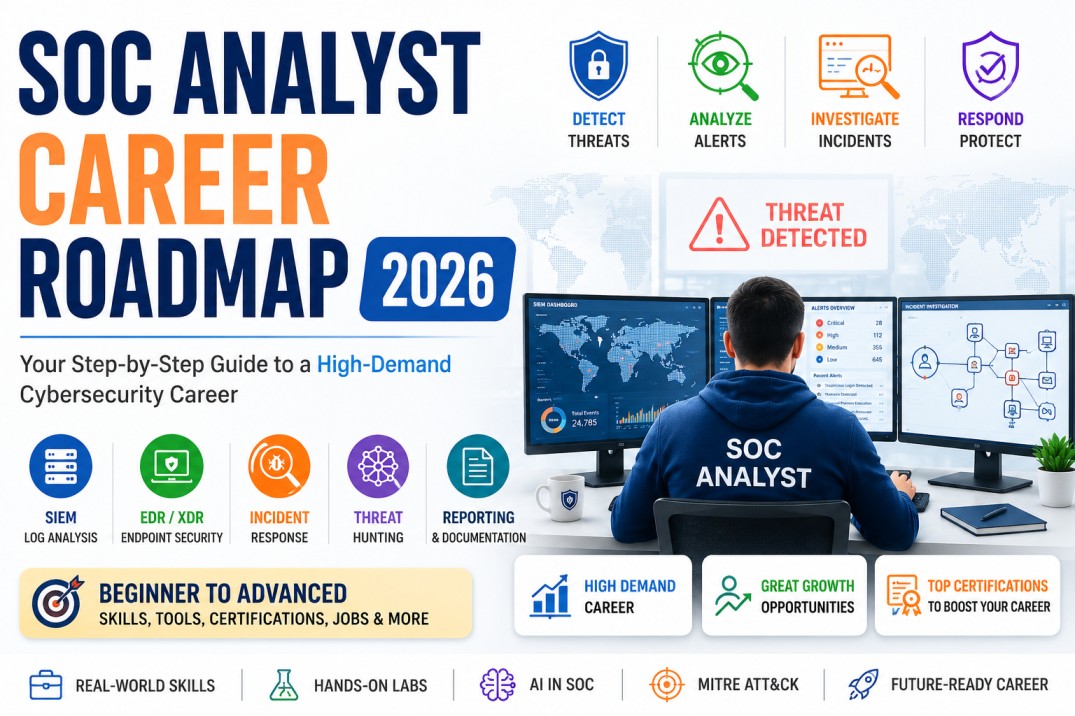
SOC Analyst Career Roadmap 2026: Skills, Tools, Jobs and Certifications
Want to start a cybersecurity career but confused where to begin? The SOC Analyst role is one of the most practical entry points into cybersecurity. This roadmap explains what to learn, which tools to practice, how SOC levels work, and how to become job-ready in 2026.
Cybersecurity is one of the fastest-growing career fields, but many beginners get stuck at the same point: “Where should I start?” Some people jump directly into ethical hacking. Some start collecting certifications without hands-on practice. Some keep watching videos but never build real investigation skills.
```If you want a practical and job-focused entry into cybersecurity, the SOC Analyst path is one of the best choices. A Security Operations Center, or SOC, is responsible for monitoring, detecting, investigating, and responding to cyber threats. IBM describes a SOC as a function that improves threat detection, response, and prevention by coordinating cybersecurity people, technologies, and operations.
Simple career truth: A SOC Analyst does not just watch alerts. A good SOC Analyst understands logs, investigates suspicious activity, connects evidence, communicates clearly, and helps protect the organization from real cyber threats.
This roadmap will help you understand how to become a SOC Analyst in 2026, what skills you need, what tools to learn, how to build hands-on experience, and how to move from beginner to advanced SOC roles.
```What Is a SOC Analyst?
```A SOC Analyst is a cybersecurity professional who works inside a Security Operations Center to monitor security alerts, investigate suspicious activities, identify potential incidents, and help respond to threats.
SOC Analysts usually work with tools such as SIEM, EDR, threat intelligence platforms, ticketing systems, email security tools, vulnerability scanners, and incident response playbooks.
Common Responsibilities of a SOC Analyst
- Monitor security alerts from SIEM and EDR tools
- Analyze logs from endpoints, servers, firewalls, cloud and identity systems
- Investigate phishing emails and suspicious user activity
- Validate whether an alert is true positive or false positive
- Escalate confirmed incidents to senior analysts or incident response teams
- Document investigation steps and findings
- Map attacker behavior to MITRE ATT&CK techniques
- Follow incident response playbooks
- Support threat hunting and vulnerability prioritization
- Prepare reports for security and management teams
Example
A SIEM alert says a user account had multiple failed logins followed by a successful login from a new country. A SOC Analyst checks the user history, IP reputation, login timeline, MFA status, endpoint activity, and other logs to decide whether this is normal travel, credential compromise, or an attack attempt.
SOC Analyst Levels: L1, L2, L3 and SOC Lead
```SOC teams are usually divided into levels. Each level has different responsibilities and skill expectations.
| SOC Level | Main Responsibility | Skills Required |
|---|---|---|
| L1 SOC Analyst | Initial alert monitoring, triage, basic investigation and escalation. | SIEM basics, log reading, phishing analysis, ticketing, incident documentation. |
| L2 SOC Analyst | Deeper investigation, correlation, threat validation and containment recommendation. | Windows/Linux logs, network analysis, EDR, MITRE ATT&CK, incident response. |
| L3 SOC Analyst / Threat Hunter | Advanced investigation, threat hunting, detection improvement and malware behavior analysis. | Threat hunting, detection engineering, scripting, attacker TTPs, advanced incident response. |
| SOC Lead / SOC Manager | Team management, process improvement, metrics, reporting, playbooks and customer communication. | Leadership, governance, SLA management, reporting, risk understanding, process maturity. |
Career tip: Do not try to become L3 on day one. First become strong in L1 fundamentals: logs, alerts, phishing, SIEM, tickets, and clear investigation notes.
Core Skills Every SOC Analyst Needs in 2026
```To become job-ready, you need a combination of technical skills, investigation skills, security mindset, and communication skills.
Technical Foundation
- Networking basics: IP, DNS, HTTP, HTTPS, ports, protocols
- Windows and Linux basics
- Active Directory fundamentals
- Cloud basics: AWS, Azure or Google Cloud concepts
- Firewall, proxy, VPN and endpoint security basics
Security Investigation Skills
- Log analysis
- Alert triage
- Phishing email investigation
- Malware behavior basics
- Incident timeline creation
- Root cause thinking
Frameworks and Process
- MITRE ATT&CK
- Cyber Kill Chain
- NIST incident response lifecycle
- Incident response playbooks
- Escalation and communication process
Soft Skills
- Clear documentation
- Customer communication
- Analytical thinking
- Patience and attention to detail
- Shift handover communication
- Ability to explain risk simply
Tools Every SOC Analyst Should Learn
```A SOC Analyst does not need to master every security product. But you should understand the major categories and practice at least one tool from each important area.
| Tool Category | Examples | Why SOC Analysts Use It |
|---|---|---|
| SIEM | Microsoft Sentinel, Splunk, IBM QRadar, Elastic Security | To collect logs, correlate events, generate alerts, and support investigations. |
| EDR/XDR | Microsoft Defender, CrowdStrike, SentinelOne, Palo Alto Cortex | To investigate endpoint behavior, malware activity, process execution and containment. |
| Threat Intelligence | VirusTotal, AbuseIPDB, URLScan, AlienVault OTX | To check IP reputation, domain reputation, malicious URLs, hashes and indicators. |
| Email Security | Microsoft Defender for Office 365, Proofpoint, Mimecast | To investigate phishing, malicious attachments, suspicious links and impersonation. |
| Ticketing and Case Management | ServiceNow, Jira, TheHive | To document alerts, incidents, actions, ownership and escalation. |
| SOAR and Automation | Splunk SOAR, Cortex XSOAR, Sentinel Playbooks | To automate repetitive actions, enrichment, notifications and response workflows. |
Beginner recommendation
Start with one SIEM tool, one endpoint security concept, one threat intelligence workflow, and one phishing investigation process. This is enough to build a strong foundation before moving into advanced tools.
Why SIEM Is the Heart of SOC Learning
```SIEM stands for Security Information and Event Management. It collects logs from multiple systems and helps analysts detect suspicious activities.
For a SOC Analyst, SIEM is like a central investigation console. It helps answer questions such as:
- Which user logged in?
- From which IP address?
- Was the login successful or failed?
- Which device was used?
- Was there suspicious process execution?
- Was any malware detected?
- Was data transferred outside the organization?
- Was the same IP seen in other alerts?
Learning tip: Do not only learn where to click in a SIEM tool. Learn what the logs mean. A strong SOC Analyst understands the story behind the logs.
MITRE ATT&CK: A Must-Know Framework for SOC Analysts
```MITRE ATT&CK is a globally used knowledge base of attacker tactics and techniques. SOC teams use it to understand how attackers behave during different stages of an attack.
For SOC Analysts, MITRE ATT&CK is useful because it helps convert random alerts into an attack story. Instead of saying “PowerShell alert triggered,” you can say the activity may relate to execution, defense evasion, credential access, or lateral movement depending on context.
How SOC Analysts Use MITRE ATT&CK
- Map alerts to attacker tactics and techniques
- Understand attacker behavior
- Improve incident investigation
- Create better detection rules
- Build threat hunting hypotheses
- Improve incident response playbooks
Explore the official MITRE ATT&CK framework here: MITRE ATT&CK.
```Incident Response Knowledge for SOC Analysts
```SOC Analysts are closely connected with incident response. You may not lead every major incident as a beginner, but you should understand how the incident response lifecycle works.
Common Incident Response Phases
- Preparation
- Detection and analysis
- Containment
- Eradication
- Recovery
- Post-incident lessons learned
Example
If ransomware activity is detected on one endpoint, a SOC Analyst should not only close the alert. The analyst should check related hosts, user activity, file changes, network connections, suspicious processes, backup impact, and escalation requirements.
Useful resource: NIST SP 800-61 Computer Security Incident Handling Guide.
```How AI Is Changing SOC Analyst Roles in 2026
```AI is becoming part of modern security operations. Microsoft describes Security Copilot as a generative AI-powered security solution designed to help improve defender efficiency and security outcomes at machine speed and scale. Research and industry discussions also show that AI can support SOC workflows such as alert triage, context enrichment and incident response, while human analysts remain responsible for validation and judgment.
How AI Can Help SOC Analysts
- Summarize large alert details quickly
- Explain suspicious commands and scripts
- Generate incident timelines
- Recommend investigation steps
- Map activity to MITRE ATT&CK
- Draft customer or management incident summaries
- Reduce repetitive investigation workload
What AI Cannot Replace
- Human judgment
- Business context
- Final incident validation
- Ethical decision-making
- Customer communication
- Accountability for response actions
Career lesson for 2026: Learn how to use AI as an assistant, not as a replacement for your brain. A strong SOC Analyst validates AI output before taking action.
SOC Analyst Career Path
```The SOC career path can grow in multiple directions. You do not need to remain in alert monitoring forever.
| Career Stage | Typical Role | Next Growth Direction |
|---|---|---|
| Entry Level | L1 SOC Analyst | L2 SOC Analyst, Incident Analyst |
| Intermediate | L2 SOC Analyst | Threat Hunter, Detection Engineer, Incident Responder |
| Advanced | L3 SOC Analyst | SOC Lead, Threat Intelligence Analyst, Malware Analyst |
| Leadership | SOC Lead / SOC Manager | Security Operations Manager, Cyber Defense Manager, CISO Path |
| Specialization | Detection Engineer / Threat Hunter | Advanced blue team, purple team, adversary emulation |
Best Certifications for SOC Analysts in 2026
```Certifications can help, but they should not replace hands-on practice. A SOC Analyst should combine certification learning with labs, log analysis, case studies and real investigation scenarios.
| Career Level | Certification Direction | Why It Helps |
|---|---|---|
| Beginner | Cybersecurity fundamentals, Security+, SOC fundamentals | Builds basic security concepts, threats, controls, and incident response understanding. |
| Entry-Level SOC | SOC Analyst training, SIEM training, blue team labs | Helps with alert triage, log analysis, phishing investigation and ticket handling. |
| Intermediate SOC | Microsoft Sentinel, Splunk, EDR/XDR training, threat hunting | Builds practical tool-based investigation skills. |
| Advanced SOC | Incident response, threat hunting, detection engineering, malware analysis | Supports movement into L2, L3, threat hunting and IR roles. |
| Leadership | CISSP, CISM, security operations management | Supports SOC lead, SOC manager and security leadership roles. |
Important advice
If you are a beginner, do not collect certifications without practical skills. Recruiters and interviewers increasingly expect you to explain real scenarios, logs, alerts and investigation steps.
90-Day SOC Analyst Learning Plan
```Here is a practical 90-day roadmap for beginners and early-career professionals.
| Timeline | Learning Focus | Practical Output |
|---|---|---|
| Days 1–15 | Networking basics, operating systems, security concepts, common attacks | Create a basic cybersecurity concept map |
| Days 16–30 | Windows logs, Linux logs, authentication events, web logs, firewall logs | Analyze sample logs and identify normal vs suspicious activity |
| Days 31–45 | SIEM basics, alert triage, correlation, severity, ticketing | Create sample SOC tickets with investigation notes |
| Days 46–60 | Phishing investigation, threat intelligence, IP/domain/hash analysis | Investigate sample phishing emails and prepare reports |
| Days 61–75 | MITRE ATT&CK, incident response lifecycle, EDR basics | Map sample alerts to MITRE ATT&CK and create incident timelines |
| Days 76–90 | Mock interviews, resume, labs, AI-assisted investigation, final revision | Build a SOC analyst portfolio with 3–5 investigation case studies |
Beginner Projects to Become Job-Ready
```Projects help you stand out because they prove that you can apply concepts.
Project 1: Phishing Email Investigation
Analyze email headers, sender domain, URL reputation, attachment hash, and write a short investigation report.
Project 2: Failed Login Analysis
Review authentication logs, identify brute-force patterns, check successful login after failures, and recommend action.
Project 3: Suspicious PowerShell Activity
Analyze command-line activity, parent process, user context, and possible MITRE ATT&CK mapping.
Project 4: Malware Alert Case Study
Review endpoint alert details, file hash, process tree, network connections, and containment recommendation.
Project 5: Incident Timeline Creation
Create a timeline from sample logs showing initial access, execution, privilege escalation, and containment.
Project 6: SOC Ticket Documentation
Create a complete ticket with summary, severity, evidence, analysis, conclusion and escalation recommendation.
SOC Analyst Interview Preparation
```SOC interviews usually test your fundamentals, investigation approach, communication skills, and ability to think logically.
Common SOC Interview Topics
- Difference between true positive and false positive
- How to investigate a phishing email
- Common Windows Event IDs
- Brute-force attack investigation
- SIEM alert triage process
- Incident severity classification
- MITRE ATT&CK basics
- Difference between IDS, IPS, firewall, EDR and SIEM
- What to do when malware is detected
- How to write a good SOC ticket
Interview Tip
Do not answer only with definitions. Explain your investigation steps. Interviewers want to see how you think when an alert appears.
Useful External Resources
```Use trusted resources to strengthen your SOC knowledge:
```Related Career Guides
```Continue your cybersecurity career planning with these related resources:
```Final Thoughts: SOC Is More Than Alert Monitoring
```The SOC Analyst role is one of the best starting points for a cybersecurity career because it teaches you how real attacks are detected, investigated and handled. It builds practical security thinking that can later help you move into threat hunting, incident response, detection engineering, cloud security, GRC, or security leadership.
In 2026, SOC Analysts must become more than alert watchers. They need to understand logs, identity, cloud, endpoints, MITRE ATT&CK, incident response, AI-assisted investigation and clear communication.
Final career message: Learn the fundamentals. Practice real investigations. Document clearly. Use AI responsibly. Build projects. That is how you become a job-ready SOC Analyst in 2026.
Want to Become a Job-Ready SOC Analyst?
At CybersecurityTRAIN.com, we help students and professionals build practical SOC skills through hands-on training in cybersecurity fundamentals, SIEM, alert triage, phishing investigation, incident response, MITRE ATT&CK, and real-world SOC workflows.
If you are serious about starting your cybersecurity career, explore our SOC Analyst training program and speak with our training advisor for a practical roadmap.
Explore SOC Analyst Training Explore Job-Ready Blue Team TrainingCall or WhatsApp: +91 98857 89887
Frequently Asked Questions
```1. Is SOC Analyst a good career in 2026?
Yes. SOC Analyst is a strong cybersecurity career path because organizations need professionals who can monitor alerts, investigate threats, analyze logs, respond to incidents and support cyber defense operations.
2. Can beginners become SOC Analysts?
Yes. Beginners can start with networking, operating systems, cybersecurity fundamentals, SIEM basics, log analysis and phishing investigation. Hands-on practice is very important.
3. Does a SOC Analyst need coding?
Coding is not mandatory for entry-level SOC roles. However, basic scripting in Python or PowerShell can help with automation, log analysis and advanced investigation as you grow.
4. Which tool should a beginner SOC Analyst learn first?
Start with a SIEM tool because SIEM is central to SOC monitoring and investigation. After that, learn threat intelligence, phishing analysis and endpoint security concepts.
5. What is the difference between L1 and L2 SOC Analyst?
L1 analysts usually perform initial monitoring, triage and escalation. L2 analysts handle deeper investigation, correlation, validation, containment recommendations and more complex incidents.
6. Is AI going to replace SOC Analysts?
AI may automate repetitive tasks and assist with alert triage, but it will not replace skilled SOC Analysts. Human judgment is still needed for validation, business context, escalation and response decisions.
7. What are the best certifications for SOC Analyst roles?
Beginners can start with cybersecurity fundamentals, Security+, SOC Analyst training and SIEM-focused learning. Intermediate professionals can add EDR, incident response, threat hunting and detection engineering skills.
8. What should I learn for SOC Analyst interviews?
Focus on networking basics, Windows logs, SIEM alerts, phishing investigation, brute-force detection, true positive vs false positive, MITRE ATT&CK, incident response and ticket documentation.
9. How long does it take to become a SOC Analyst?
With focused learning and hands-on practice, many beginners can become entry-level ready in 3 to 6 months. The timeline depends on your existing IT knowledge and daily practice consistency.
10. What is the career growth after SOC Analyst?
After SOC Analyst, you can grow into L2 Analyst, Incident Responder, Threat Hunter, Detection Engineer, Malware Analyst, SOC Lead, SOC Manager or broader security leadership roles.