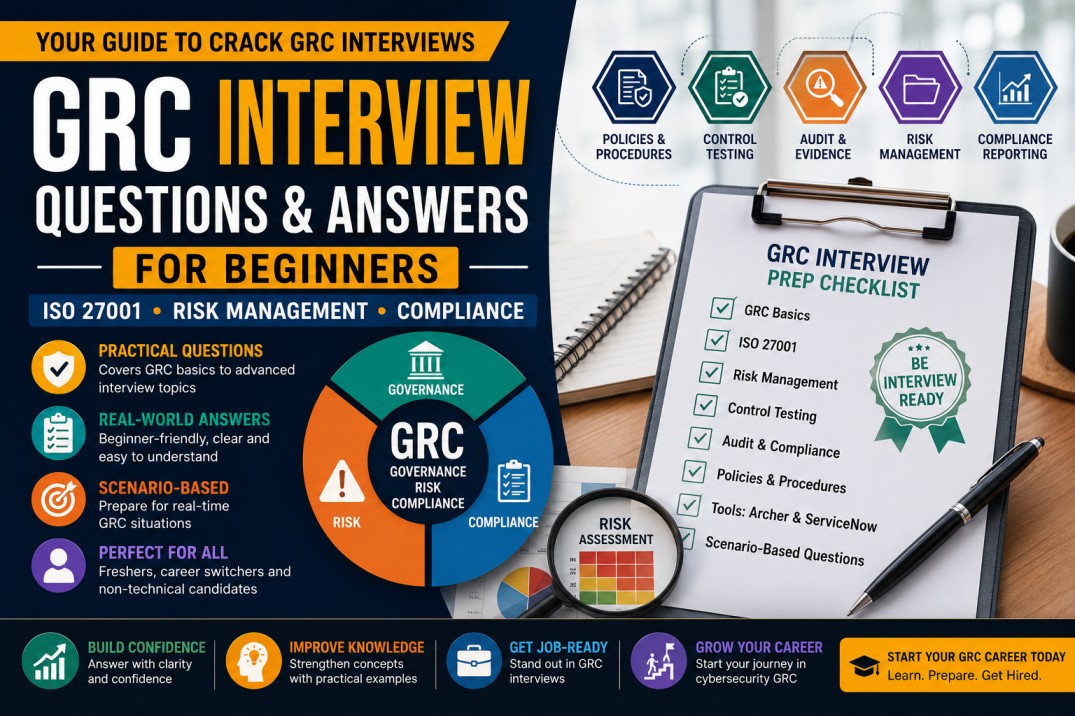
GRC Interview Questions and Answers for Beginners: ISO 27001, Risk Management and Compliance
Preparing for your first GRC Analyst interview? This guide gives you practical beginner-friendly interview questions and answers on ISO 27001, risk management, compliance, audit, control testing, evidence, policies, Archer, ServiceNow and real-world GRC scenarios.
GRC interviews are different from technical cybersecurity interviews. In a SOC interview, you may be asked about logs, alerts and phishing investigation. In a VAPT interview, you may be asked about vulnerabilities and testing tools. But in a GRC interview, the interviewer wants to know whether you understand governance, risk, compliance, controls, audit evidence, policies, frameworks and business communication.
This makes GRC a great cybersecurity career path for beginners, audit professionals, compliance professionals, MBA graduates, commerce students, IT support professionals and career switchers who want to enter cybersecurity without starting from deep coding or ethical hacking.
Simple interview mindset: In GRC interviews, do not only give definitions. Explain concepts using practical examples such as risk register, access review, audit evidence, control testing, ISO 27001 clauses, policy exceptions and corrective actions.
This article will help you prepare for entry-level roles such as GRC Analyst, Information Security Compliance Analyst, Risk Analyst, ISMS Coordinator, IT Audit Associate, Control Testing Analyst and Cybersecurity Governance Analyst.
What Interviewers Expect from Beginner GRC Candidates
For beginner GRC roles, interviewers usually do not expect you to be a complete security manager or senior auditor. But they do expect you to understand the basic language of governance, risk and compliance.
They Expect Conceptual Clarity
- What is GRC?
- What is ISO 27001?
- What is risk assessment?
- What is control testing?
- What is audit evidence?
They Expect Practical Thinking
- How do you collect evidence?
- How do you update a risk register?
- How do you track remediation?
- How do you handle a policy exception?
- How do you report compliance status?
They Expect Communication Skills
- Clear explanation
- Business-friendly language
- Professional documentation
- Follow-up with control owners
- Audit-ready communication
They Expect Tool Awareness
- Archer basics
- ServiceNow GRC basics
- Excel trackers
- SharePoint evidence repositories
- Ticketing workflow understanding
Beginner Tip
Do not say “I know ISO 27001” and stop there. Say: “I understand ISMS scope, risk assessment, Annex A controls, Statement of Applicability, internal audit, nonconformity and corrective action.” That sounds much more interview-ready.
Basic GRC Interview Questions and Answers
1. What is GRC?
Sample AnswerGRC stands for Governance, Risk and Compliance. Governance ensures security is aligned with business goals and leadership expectations. Risk management identifies and treats risks that may affect business or information assets. Compliance ensures the organization follows applicable laws, regulations, standards, policies and contractual requirements.
In cybersecurity, GRC helps organizations manage security in a structured, auditable and business-aligned way.
2. What does a GRC Analyst do?
Sample AnswerA GRC Analyst supports risk assessments, compliance checks, control testing, policy reviews, audit evidence collection, issue tracking and reporting. The role involves working with control owners, auditors, IT teams and business teams to ensure security controls are documented, implemented and monitored.
3. What is the difference between governance, risk and compliance?
Sample AnswerGovernance is about direction, accountability, policies and decision-making. Risk is about identifying what can go wrong and deciding how to handle it. Compliance is about meeting requirements from standards, regulations, contracts and internal policies.
For example, a company may create an access control policy under governance, assess weak access review as a risk, and then test access review evidence for compliance.
4. Why is GRC important in cybersecurity?
Sample AnswerGRC is important because cybersecurity is not only about tools and technology. Organizations also need policies, risk management, control ownership, evidence, audits, reporting and continuous improvement. GRC helps ensure security is managed consistently and aligned with business and compliance expectations.
5. What are some common GRC activities?
Sample Answer- Risk assessment
- Risk register updates
- Control testing
- Policy review
- Audit evidence collection
- Compliance reporting
- Issue and remediation tracking
- Vendor risk assessment
- Security awareness tracking
ISO 27001 Interview Questions and Answers
6. What is ISO 27001?
Sample AnswerISO 27001 is an international standard for an Information Security Management System, also called ISMS. It helps organizations manage information security through a risk-based approach, including policies, risk assessment, controls, internal audits, management review and continual improvement.
7. What is an ISMS?
Sample AnswerISMS stands for Information Security Management System. It is a structured framework of policies, processes, people, technology, risks and controls used to manage and improve information security within an organization.
8. What is the purpose of ISO 27001?
Sample AnswerThe purpose of ISO 27001 is to help organizations protect information assets by identifying risks, selecting appropriate controls, assigning responsibilities, maintaining documentation, monitoring performance and improving security over time.
9. What are ISO 27001 clauses?
Sample AnswerISO 27001 clauses define management system requirements. Important clauses include context of the organization, leadership, planning, support, operation, performance evaluation and improvement. These clauses help ensure the ISMS is planned, implemented, monitored and improved properly.
10. What is Annex A in ISO 27001?
Sample AnswerAnnex A is a list of information security controls that organizations can select based on risk assessment. These controls cover areas such as organizational security, people security, physical security and technological security.
11. What is Statement of Applicability?
Sample AnswerStatement of Applicability, or SoA, is a key ISO 27001 document that lists Annex A controls and explains whether each control is applicable or not applicable. It also provides justification and implementation status for the selected controls.
12. What is the difference between ISO 27001 Lead Auditor and Lead Implementer?
Sample AnswerLead Auditor focuses on auditing an ISMS to check whether it meets ISO 27001 requirements. Lead Implementer focuses on designing, building and maintaining the ISMS. In simple terms, the auditor checks, while the implementer builds and improves.
Risk Management Interview Questions and Answers
13. What is risk in cybersecurity?
Sample AnswerRisk is the possibility that a threat may exploit a vulnerability and cause harm to an asset or business process. In cybersecurity, risk is usually analyzed based on likelihood and impact.
14. What is risk assessment?
Sample AnswerRisk assessment is the process of identifying risks, analyzing their likelihood and impact, assigning risk ratings, identifying risk owners and deciding how the risks should be treated.
15. What is a risk register?
Sample AnswerA risk register is a document or system record used to track identified risks. It usually includes risk description, asset, threat, vulnerability, likelihood, impact, inherent risk, existing controls, residual risk, risk owner, treatment plan and target date.
For example, “MFA not enabled for remote users” can be recorded as a risk with identity team as the owner and MFA rollout as the treatment plan.
16. What is inherent risk and residual risk?
Sample AnswerInherent risk is the level of risk before controls are applied. Residual risk is the remaining risk after controls are implemented. For example, the inherent risk of phishing may be high, but after security awareness training, email filtering and MFA, the residual risk may reduce to medium.
17. What are the common risk treatment options?
Sample AnswerCommon risk treatment options are:
- Mitigate: Reduce the risk by implementing controls.
- Accept: Accept the risk with business approval.
- Transfer: Transfer risk through insurance or outsourcing.
- Avoid: Stop the activity causing the risk.
18. What is risk appetite?
Sample AnswerRisk appetite is the amount and type of risk an organization is willing to accept while pursuing business objectives. It helps decide which risks need treatment and which risks may be accepted.
Interview tip: Risk answers become stronger when you use examples. For instance, explain phishing risk, access control risk, vendor risk, backup risk or cloud misconfiguration risk.
Control Testing Interview Questions and Answers
19. What is a control?
Sample AnswerA control is a safeguard or measure implemented to reduce risk. Controls can be administrative, technical or physical. For example, password policy, MFA, access review, CCTV, backup process and security awareness training are all controls.
20. What is control testing?
Sample AnswerControl testing is the process of checking whether a control is designed properly and operating effectively. For example, if the control says user access must be reviewed quarterly, control testing checks whether reviews were actually performed and evidence was retained.
21. What is design effectiveness and operating effectiveness?
Sample AnswerDesign effectiveness checks whether the control is properly designed to address the risk. Operating effectiveness checks whether the control is working consistently in practice.
For example, an access review process may be well-designed, but if reviews are not performed on time, the operating effectiveness is weak.
22. Give an example of control testing.
Sample AnswerFor access review control testing, I would request evidence such as user access lists, review records, approvals, removal records for inappropriate access, review date and control owner confirmation. I would check whether the review was completed within the required timeline and whether exceptions were remediated.
23. What is control evidence?
Sample AnswerControl evidence is proof that a control was performed. Examples include screenshots, system reports, access review sign-offs, training completion reports, incident tickets, backup logs, vulnerability scan reports and policy approval records.
24. What is a control deficiency?
Sample AnswerA control deficiency occurs when a control is missing, poorly designed or not operating effectively. For example, if quarterly access reviews are required but there is no evidence of review, it may be a control deficiency.
Audit and Compliance Interview Questions and Answers
25. What is compliance?
Sample AnswerCompliance means meeting applicable requirements from laws, regulations, standards, contracts, frameworks and internal policies. In cybersecurity, compliance helps ensure security controls are implemented and documented according to expected requirements.
26. What is an internal audit?
Sample AnswerAn internal audit is an independent review conducted within the organization to check whether processes, controls and requirements are being followed. In ISO 27001, internal audits help verify whether the ISMS is implemented and effective.
27. What is audit evidence?
Sample AnswerAudit evidence is information used to support audit conclusions. It can include documents, screenshots, system reports, tickets, logs, approvals, policies, meeting records and interview notes.
28. What is a nonconformity?
Sample AnswerA nonconformity is a failure to meet a requirement. For example, if a policy requires annual security awareness training but there is no evidence that employees completed it, that may be a nonconformity.
29. What is corrective action?
Sample AnswerCorrective action is the action taken to fix a nonconformity and prevent it from recurring. It should address the root cause, define an owner, set a target date and include closure evidence.
30. What is the difference between compliance and security?
Sample AnswerCompliance means meeting required standards or rules. Security means protecting systems, data and business processes from threats. Compliance supports security, but being compliant does not always mean an organization is fully secure. A strong program should aim for both compliance and real risk reduction.
Policy, Standard and Procedure Interview Questions
31. What is the difference between policy, standard, procedure and guideline?
Sample AnswerA policy is a high-level management statement. A standard defines mandatory requirements. A procedure explains step-by-step actions. A guideline provides recommended best practices.
For example, an access control policy may say access must be controlled. A password standard may define minimum password requirements. A user access provisioning procedure explains how access is requested and approved.
32. What is a policy exception?
Sample AnswerA policy exception is a formal approval to temporarily deviate from a policy requirement due to business or technical reasons. It should include justification, risk assessment, approval, compensating controls and expiry date.
33. Why is policy review important?
Sample AnswerPolicy review is important to ensure policies remain current, accurate and aligned with business needs, regulatory requirements and security risks. Policies should be reviewed periodically and approved by appropriate stakeholders.
34. What is an information security policy?
Sample AnswerAn information security policy is a high-level document that defines the organization’s commitment, direction and expectations for protecting information assets. It usually covers roles, responsibilities, risk management, compliance and security objectives.
Archer and ServiceNow GRC Tool Interview Questions
Beginner GRC candidates are not always expected to be tool experts. But knowing how GRC tools are used gives you an advantage.
35. What is Archer used for in GRC?
Sample AnswerArcher is a GRC platform used to manage risk, controls, compliance, issues, assessments, policies and reporting. It helps organizations centralize GRC data and track risk and compliance activities.
36. What is ServiceNow GRC used for?
Sample AnswerServiceNow GRC is used to manage governance, risk, compliance, audit, policy, control testing, issues and remediation workflows. It can help automate evidence collection, task assignment and compliance reporting.
37. What kind of records are managed in GRC tools?
Sample AnswerGRC tools may manage risk records, control records, policies, audit findings, issues, remediation tasks, evidence, assessments, exceptions and compliance reports.
38. If you do not have hands-on Archer experience, how would you answer?
Sample AnswerI have conceptual understanding of how GRC tools such as Archer are used to manage risks, controls, issues, assessments and evidence. I understand the workflow and data structure, and I am confident I can learn the platform quickly with hands-on access.
Interview tip: Never claim advanced hands-on experience with a GRC tool if you do not have it. Instead, explain your conceptual understanding and willingness to learn.
Scenario-Based GRC Interview Questions and Answers
39. Scenario: A control owner has not submitted evidence before the audit deadline. What will you do?
Sample AnswerI would first remind the control owner with the required evidence details and deadline. If there is no response, I would follow the escalation matrix and inform the responsible manager or compliance lead. I would also document the follow-up attempts and status in the tracker. If evidence is still not available, I would mark it as pending or potential finding based on audit process.
40. Scenario: A high-risk finding is overdue for remediation. What will you do?
Sample AnswerI would check the remediation owner, original due date, current status, blockers and business impact. Then I would request an updated action plan and revised timeline. If the risk is high, I would escalate to management and ensure risk acceptance or exception approval is documented if remediation cannot be completed on time.
41. Scenario: An application team says they cannot implement MFA due to technical limitations. How will you handle it?
Sample AnswerI would first understand the technical limitation and business impact. Then I would document the risk, check whether compensating controls can be implemented, such as IP restrictions, stronger monitoring, privileged access control or shorter session timeout. If MFA cannot be implemented immediately, I would recommend a formal risk acceptance or exception with expiry date and remediation plan.
42. Scenario: During audit, you find access review evidence is missing. What will you report?
Sample AnswerI would report that the access review control could not be verified due to missing evidence. I would capture the requirement, expected evidence, missing evidence, impacted system, control owner and risk. Depending on audit criteria, it may be reported as a control deficiency or nonconformity.
43. Scenario: Business wants to accept a risk. What should be documented?
Sample AnswerThe risk acceptance should include risk description, impact, reason for acceptance, compensating controls if any, business justification, approval from authorized risk owner, review date and expiry date. Risk acceptance should not be informal or open-ended.
44. Scenario: A vendor does not provide SOC 2 or ISO certificate. What will you do?
Sample AnswerI would check if alternate assurance evidence is available, such as security questionnaire responses, policies, penetration test summary, data protection practices, incident response process or contractual security clauses. If the vendor handles sensitive data, I would document the risk and recommend additional review, compensating controls or risk acceptance.
Questions for Career Switchers and Non-Technical Candidates
45. You are from a non-technical background. Why do you want to enter GRC?
Sample AnswerGRC is a cybersecurity path that combines security awareness, risk management, compliance, audit, documentation and business communication. My background has helped me build analytical and process-oriented skills, and I am now building cybersecurity knowledge through ISO 27001, risk management, control testing and compliance concepts. This makes GRC a suitable career direction for me.
46. How will you compensate for lack of technical experience?
Sample AnswerI understand that technical awareness is important in GRC, so I am learning cybersecurity basics such as access control, incident management, vulnerability management, cloud basics and security controls. At the same time, I can contribute through documentation, evidence tracking, risk register updates, audit coordination and compliance reporting.
47. How will your previous experience help in GRC?
Sample AnswerMy previous experience has helped me build communication, documentation, process understanding, stakeholder coordination and follow-up skills. These are important in GRC because the role requires working with control owners, auditors, managers and technical teams to track evidence, risks and remediation activities.
48. How do you explain a career gap in a GRC interview?
Sample AnswerI had a career gap due to personal reasons, but I used this restart phase to focus on building a new career direction in cybersecurity GRC. I have been learning ISO 27001, risk management, control testing, audit evidence and GRC tools. I am now ready to restart professionally with a focused and practical career path.
Quick Reference Table: GRC Terms You Must Know
| Term | Simple Meaning | Interview Example |
|---|---|---|
| Risk | Possibility of loss due to threat exploiting vulnerability. | Weak password policy may lead to account compromise. |
| Control | Safeguard used to reduce risk. | MFA reduces risk of account takeover. |
| Evidence | Proof that a control was performed. | Access review sign-off report. |
| Risk Register | Tracker of identified risks and treatment plans. | Cloud misconfiguration risk assigned to cloud team. |
| SoA | Statement of Applicability for ISO 27001 controls. | Explains selected Annex A controls. |
| Nonconformity | Failure to meet a requirement. | Missing internal audit evidence. |
| Corrective Action | Action to fix a finding and prevent recurrence. | Implement access review process and retain evidence. |
| Policy Exception | Approved temporary deviation from policy. | Legacy app cannot enforce MFA for 90 days. |
15-Day GRC Interview Preparation Plan
If your interview is coming soon, use this focused preparation plan.
| Days | Focus Area | Practical Task |
|---|---|---|
| Day 1–2 | GRC basics | Prepare simple answers for governance, risk, compliance and GRC Analyst role. |
| Day 3–4 | ISO 27001 basics | Understand ISMS, clauses, Annex A, SoA and internal audit. |
| Day 5–6 | Risk management | Create a sample risk register with 5 risks. |
| Day 7–8 | Control testing | Prepare examples for access review, backup, awareness and vulnerability control testing. |
| Day 9–10 | Audit and evidence | Learn evidence examples and how findings are documented. |
| Day 11–12 | GRC tools | Understand Archer, ServiceNow GRC, Excel trackers and workflow basics. |
| Day 13–14 | Scenario practice | Practice overdue remediation, missing evidence, policy exception and vendor risk scenarios. |
| Day 15 | Mock interview | Record your answers and improve clarity, confidence and structure. |
Best Practice
Create a small interview portfolio with a sample risk register, audit checklist, corrective action tracker and policy exception example. This helps you stand out from other beginners.
Common Mistakes to Avoid in GRC Interviews
1. Giving Only Definitions
Do not stop at textbook answers. Add examples from risk, controls, audit evidence or compliance workflows.
2. Saying “I Know ISO 27001” Too Broadly
Be specific. Talk about ISMS, clauses, Annex A, SoA, risk assessment, internal audit and corrective action.
3. No Practical Examples
Prepare examples for access review, backup evidence, phishing risk, vendor risk and policy exceptions.
4. Overclaiming Tool Experience
Do not claim advanced Archer or ServiceNow experience if you only have conceptual knowledge. Be honest and confident.
5. Ignoring Communication Skills
GRC roles require stakeholder follow-up, documentation and reporting. Show that you can communicate professionally.
6. Not Knowing Risk Register Basics
Risk register is one of the most important GRC concepts. Prepare it well with examples.
Useful Related Guides
Final Thoughts: How to Clear a Beginner GRC Interview
To clear a beginner GRC interview, focus on clarity, examples and practical understanding. You do not need to sound like a senior security manager. But you should show that you understand how governance, risk, compliance, controls and audits work together.
Your GRC Interview Success Formula
- Learn ISO 27001 basics clearly.
- Understand risk assessment and risk register.
- Prepare control testing examples.
- Understand audit evidence and corrective action.
- Practice scenario-based answers.
- Explain GRC tools honestly.
- Show communication and documentation strength.
GRC is a strong cybersecurity path for beginners, especially those from non-technical, audit, compliance, risk, commerce, MBA or IT coordination backgrounds. With the right preparation, you can confidently position yourself for entry-level GRC roles.
Final career message: A good GRC candidate is not someone who memorizes frameworks. A good GRC candidate understands risk, evidence, controls, business impact and how to communicate security clearly.
Want to Prepare for GRC Interviews with Practical Training?
At CybersecurityTRAIN.com, we help freshers, career switchers and working professionals build practical GRC skills through structured training in ISO 27001, risk management, control testing, audit readiness, policies, Archer, ServiceNow and CISM-oriented governance topics.
If you want to enter cybersecurity through a compliance-focused, non-coding career path, explore our GRC training program.
Explore GRC with CISM Training Read ISO 27001 Career RoadmapCall or WhatsApp: +91 98857 89887
Frequently Asked Questions
1. What is asked in a GRC Analyst interview?
GRC Analyst interviews usually include questions on governance, risk management, compliance, ISO 27001, control testing, audit evidence, policies, risk register, remediation tracking and stakeholder communication.
2. Is GRC good for beginners?
Yes. GRC is a good cybersecurity career path for beginners, especially those interested in compliance, audit, risk management, documentation and business-facing security roles.
3. Can a non-technical person become a GRC Analyst?
Yes. Non-technical candidates can enter GRC if they learn cybersecurity basics, ISO 27001, risk management, control testing, compliance and audit concepts.
4. What should I learn first for a GRC interview?
Start with GRC basics, ISO 27001, ISMS, risk assessment, risk register, control testing, audit evidence, policies and compliance reporting.
5. What is the most important concept in GRC interviews?
Risk management is one of the most important concepts. You should understand risk assessment, risk register, inherent risk, residual risk, risk treatment and risk acceptance.
6. Do I need coding for GRC jobs?
No. Coding is usually not required for beginner GRC jobs. However, basic IT and security understanding is useful.
7. What tools are used in GRC roles?
Common tools include Archer, ServiceNow GRC, Excel, SharePoint, Jira, ticketing tools, policy management platforms and compliance tracking tools.
8. What is control testing in GRC?
Control testing checks whether a control is properly designed and operating effectively. It usually involves reviewing evidence and identifying gaps.
9. How do I prepare for scenario-based GRC questions?
Practice scenarios around missing evidence, overdue remediation, policy exceptions, vendor risk, access reviews, high-risk findings and risk acceptance.
10. Where can I learn GRC practically?
You can explore the GRC with CISM training program at CybersecurityTRAIN.com, which covers ISO 27001, risk management, control testing, audit readiness, Archer, ServiceNow and interview preparation.