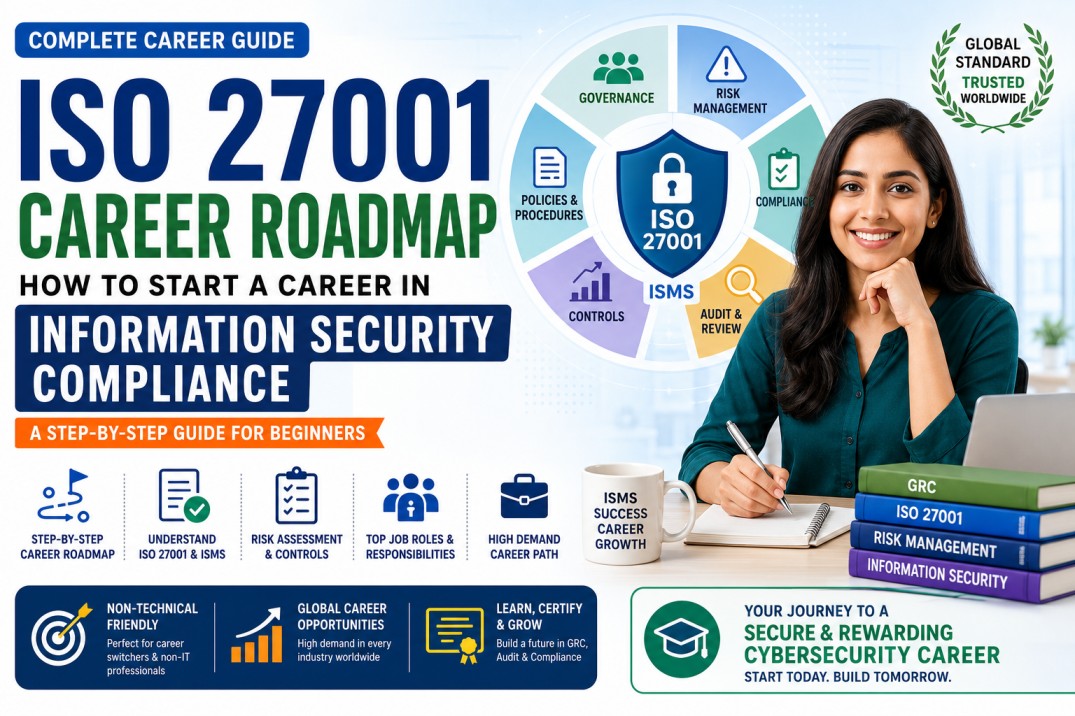
ISO 27001 Career Roadmap: How to Start a Career in Information Security Compliance
Want to enter cybersecurity without deep coding, hacking or SOC monitoring experience? ISO 27001 is one of the best starting points for people interested in GRC, compliance, audit, risk management, policies, controls and information security governance.
Many people think cybersecurity means only ethical hacking, coding, malware analysis or working in a Security Operations Center. But that is not true. Cybersecurity also needs professionals who can create policies, manage risks, prepare organizations for audits, check controls, maintain compliance evidence and communicate security requirements to business teams.
This career path is called GRC, which stands for Governance, Risk and Compliance. One of the most important foundations for GRC and information security compliance is ISO 27001.
Simple career message: ISO 27001 is one of the best cybersecurity career paths for non-technical learners, audit professionals, compliance professionals, MBA graduates, commerce students, IT support engineers and anyone who wants to enter cybersecurity through governance and compliance.
ISO/IEC 27001 is the international standard for an Information Security Management System, also called an ISMS. It helps organizations manage information security through leadership, policies, risk assessment, controls, audits, evidence and continual improvement.
What Is ISO 27001?
ISO 27001 is an international standard that defines requirements for building and maintaining an Information Security Management System. In simple words, it helps an organization manage information security in a structured, risk-based and auditable way.
ISO 27001 is not only about firewalls, antivirus or security tools. It covers how an organization manages information security through leadership, policies, risk assessment, controls, roles, responsibilities, awareness, monitoring, internal audits and continual improvement.
Beginner-friendly example
Imagine a company that stores customer data, employee records, contracts, financial documents and internal business information. ISO 27001 helps that company identify risks to this information, apply controls, assign responsibilities, document processes and continuously improve security.
ISO 27001 in One Line
Why ISO 27001 Is Important for Career Growth
ISO 27001 is used by organizations across industries such as IT services, SaaS companies, banks, healthcare, fintech, consulting, manufacturing, outsourcing, government suppliers and global service providers. Many companies need ISO 27001 compliance to win customer trust, pass vendor assessments, meet contract requirements and show that they follow recognized information security practices.
This creates demand for professionals who understand ISO 27001, ISMS documentation, risk assessment, control implementation, audit readiness and compliance evidence.
ISO 27001 Skills Are Useful For:
- GRC Analyst roles
- Information Security Compliance roles
- ISO 27001 Coordinator roles
- ISMS Analyst roles
- Internal Auditor roles
- IT Audit roles
- Risk Analyst roles
- Security Governance roles
- Vendor Risk Management roles
- Security Program Management roles
Why candidates like this path
ISO 27001 gives a clear entry route into cybersecurity for people who may not want to start with coding, ethical hacking or 24x7 SOC monitoring. It rewards documentation skills, process thinking, communication, audit mindset, risk understanding and business awareness.
Is ISO 27001 Good for Non-Technical Candidates?
Yes. ISO 27001 is one of the best cybersecurity career paths for non-technical and semi-technical candidates. You do not need to be a hacker or programmer to begin learning ISO 27001. However, you should be willing to understand basic information security concepts, IT processes, risks and controls.
Good Fit If You Are From
- Commerce background
- MBA background
- Audit background
- Compliance background
- Risk management background
- IT support background
- Quality management background
- Project coordination background
You Need to Learn
- Basic cybersecurity concepts
- Risk assessment
- Information classification
- Access control basics
- Policies and procedures
- Audit evidence
- Control testing
- Business communication
Reality check: ISO 27001 is non-coding friendly, but it is not “no effort.” You must understand how business processes, people, technology, risk and documentation connect with each other.
Real Success Story: Swapna’s Career Switch into Cybersecurity GRC
A practical example of how the ISO 27001 and GRC path can help career switchers rebuild confidence and move toward cybersecurity compliance roles.
Many people hesitate to enter cybersecurity because they think, “I am not from a cybersecurity background,” “I have a career gap,” “I am not very technical,” or “Is it too late for me to restart?”
Swapna joined CybersecurityTRAIN.com from the UK as a career switcher with a career gap of almost five years. Like many professionals, she wanted to restart her career but needed a practical and realistic path that could help her move into cybersecurity without starting from heavy coding, ethical hacking or deep technical operations.
After understanding her background and goals, we guided her toward the GRC and information security compliance path. This was a suitable direction because GRC allows professionals to build cybersecurity careers through governance, risk management, compliance, audit readiness, documentation, controls and business-facing security skills.
How CybersecurityTRAIN.com Helped Her
During her GRC training journey, Swapna received structured conceptual and practical training across important cybersecurity compliance areas.
ISO 27001 Domain Knowledge
She learned ISMS, clauses, Annex A controls, audit readiness, compliance expectations, security policies and documentation flow.
Risk Management
She learned risk identification, likelihood, impact, risk register, risk treatment, risk ownership and residual risk understanding.
GRC Tools Exposure
She received practical understanding of tools such as Archer and ServiceNow from a GRC workflow perspective.
Hands-On Practice
She practiced documentation, control tracking, audit evidence, risk records, compliance workflows and real-world GRC scenarios.
The key transformation: Swapna moved from uncertainty to clarity. She developed confidence in ISO 27001, risk management, Archer, ServiceNow, compliance documentation and practical GRC workflows. Today, she is actively pursuing her cybersecurity GRC career path.
This Could Be Your Story Too
If you are someone with a career gap, non-technical background, audit background, compliance experience, MBA background, commerce background, or IT support experience, Swapna’s journey can be highly relatable.
You do not always need to start cybersecurity with coding or hacking. You can enter through GRC, ISO 27001, compliance, risk management, internal audit, control testing and security governance. What matters is choosing the right roadmap and learning through practical examples instead of only theory.
What You Can Learn from Swapna’s Journey
- A career gap does not permanently stop your career growth.
- Cybersecurity has multiple paths, including non-coding and compliance-focused roles.
- ISO 27001 and GRC are strong entry points for career switchers.
- Hands-on practice with risk registers, audit evidence and GRC workflows builds confidence.
- Tools like Archer and ServiceNow can make your profile more relevant for GRC roles.
- The right mentorship can help you connect your past experience with cybersecurity opportunities.
Watch Swapna’s LinkedIn Success Story
Here is Swapna’s LinkedIn success story shared as part of her cybersecurity career transition journey:
Your Career Restart Can Begin with the Right First Step
If you are waiting for the perfect time to restart your career, the right time may be now. Start with the basics, learn ISO 27001 and GRC concepts, practice risk management and audit scenarios, understand tools like Archer and ServiceNow, and gradually build confidence for cybersecurity compliance roles.
What Is an ISMS?
ISMS stands for Information Security Management System. It is a structured framework of policies, processes, people, technology, risks and controls used to manage information security.
An ISMS helps an organization answer important questions:
- What information assets do we need to protect?
- What risks can affect those assets?
- Which controls are required?
- Who is responsible for those controls?
- How do we prove controls are working?
- How do we handle incidents and nonconformities?
- How do we improve security over time?
Illustration: ISMS Building Blocks
1. Governance
Leadership, scope, policies, roles and responsibilities.
2. Risk
Risk assessment, risk treatment, risk owners and risk acceptance.
3. Controls
Access control, awareness, supplier security, backup, incident management and more.
ISO 27001 Clauses Explained in Simple Language
ISO 27001 has management system requirements called clauses. Beginners do not need to memorize everything on day one. Instead, understand what each clause is trying to achieve.
| Clause | Simple Meaning | What a Candidate Should Understand |
|---|---|---|
| Clause 4: Context of the Organization | Understand the organization, interested parties and ISMS scope. | Know how to define what is included in the ISMS. |
| Clause 5: Leadership | Management must support and take accountability for information security. | Security is not only an IT responsibility; leadership involvement is required. |
| Clause 6: Planning | Identify risks and plan how to treat them. | Understand risk assessment, risk treatment and security objectives. |
| Clause 7: Support | Provide resources, awareness, communication and documented information. | Know why training, records and documentation matter. |
| Clause 8: Operation | Run the ISMS processes and perform risk treatment. | Understand how planned controls and processes are operated. |
| Clause 9: Performance Evaluation | Monitor, measure, audit and review the ISMS. | Understand internal audit, metrics and management review. |
| Clause 10: Improvement | Fix nonconformities and improve continuously. | Understand corrective action and continual improvement. |
Interview tip: If an interviewer asks about ISO 27001 clauses, explain them in business language. Do not just say clause numbers. Explain what they mean in practice.
What Are Annex A Controls?
ISO 27001 includes Annex A controls. These controls help organizations reduce information security risks. They cover areas such as policies, people, physical security, access control, operations, supplier relationships, incident management and business continuity.
In ISO/IEC 27001:2022, Annex A controls are commonly grouped into four themes:
Organizational Controls
Policies, roles, asset management, supplier relationships, incident management, business continuity and compliance.
People Controls
Screening, awareness, training, confidentiality, remote working and responsibilities before, during and after employment.
Physical Controls
Physical security perimeter, secure areas, equipment protection, clear desk, visitor controls and environmental protection.
Technological Controls
Access control, authentication, malware protection, logging, backup, network security, secure coding and vulnerability management.
Beginner-friendly understanding
Annex A controls are like a security control library. The organization selects applicable controls based on risk assessment and explains applicability through the Statement of Applicability.
Important ISO 27001 Documents You Should Know
If you want to work in ISO 27001, GRC or compliance, you must understand common ISMS documents. These documents are frequently discussed in interviews and audits.
| Document | Purpose | Beginner Example |
|---|---|---|
| ISMS Scope | Defines what part of the organization is covered by ISO 27001. | Cloud-based SaaS product and supporting teams. |
| Information Security Policy | Defines management direction and commitment to information security. | High-level security policy approved by leadership. |
| Risk Assessment Methodology | Explains how risks are identified, scored and evaluated. | Likelihood x Impact scoring method. |
| Risk Register | Tracks identified risks, owners, ratings and treatment plans. | Weak MFA coverage risk assigned to IAM owner. |
| Risk Treatment Plan | Explains how selected risks will be mitigated, accepted, transferred or avoided. | Enable MFA for all remote users by a target date. |
| Statement of Applicability | Lists Annex A controls and explains whether each control is applicable. | Access control is applicable because users access business systems. |
| Internal Audit Report | Records audit findings, evidence, nonconformities and improvement areas. | Audit found access review evidence missing for one application. |
| Corrective Action Plan | Tracks actions to fix nonconformities and prevent recurrence. | Define monthly access review process and retain evidence. |
For a deeper practical understanding, read our guide: What Is a Risk Register in Cybersecurity? Examples and Template.
ISO 27001 Job Roles for Beginners and Professionals
ISO 27001 knowledge can lead to many job roles in cybersecurity compliance and GRC.
| Job Role | What You Do | Best Fit For |
|---|---|---|
| GRC Analyst | Supports risk assessments, compliance checks, control tracking and reporting. | Freshers, audit background, compliance learners. |
| Information Security Compliance Analyst | Maintains compliance evidence, policies, procedures and audit readiness. | Non-technical and semi-technical learners. |
| ISMS Coordinator | Coordinates ISO 27001 documentation, reviews, awareness and audit activities. | Project coordinators, compliance professionals. |
| Internal Auditor | Checks whether controls and ISMS processes are implemented properly. | Audit and quality management professionals. |
| Risk Analyst | Works on risk identification, scoring, treatment, reporting and follow-up. | Risk, audit, finance, security learners. |
| ISO 27001 Lead Auditor | Plans and conducts ISO 27001 audits against standard requirements. | Experienced audit/compliance professionals. |
| ISO 27001 Lead Implementer | Helps organizations build, implement and maintain ISMS. | Security consultants, GRC leads, implementation professionals. |
Lead Auditor vs Lead Implementer: Which One Should You Choose?
Many beginners get confused between ISO 27001 Lead Auditor and ISO 27001 Lead Implementer. Both are valuable, but they are used for different career directions.
| Area | Lead Auditor | Lead Implementer |
|---|---|---|
| Main Focus | Auditing an ISMS. | Building and implementing an ISMS. |
| Mindset | Check evidence, identify gaps and report findings. | Design processes, implement controls and maintain compliance. |
| Best For | Audit, assurance, certification audit, internal audit roles. | Consulting, implementation, ISMS management, GRC operations. |
| Beginner Suitability | Good if you have audit/compliance background. | Good if you want hands-on ISMS implementation work. |
Simple recommendation: If you like checking evidence and asking audit questions, choose Lead Auditor. If you like building processes and helping organizations become compliant, choose Lead Implementer. For a strong GRC career, understanding both is very useful.
Skills Required for an ISO 27001 Career
ISO 27001 careers need a mix of cybersecurity understanding, process knowledge, documentation ability, communication and risk-based thinking.
Core Security Knowledge
- CIA triad
- Information assets
- Access control basics
- Incident management basics
- Backup and business continuity basics
- Supplier security basics
- Data protection basics
GRC Skills
- Risk assessment
- Risk treatment planning
- Control mapping
- Policy review
- Internal audit
- Corrective action tracking
- Compliance reporting
Documentation Skills
- Policy writing
- Procedure writing
- Evidence collection
- Meeting notes
- Audit reports
- Risk register updates
- Management review inputs
Professional Skills
- Business communication
- Stakeholder coordination
- Attention to detail
- Interviewing control owners
- Follow-up discipline
- Excel and reporting
- Presentation skills
ISO 27001 Career Roadmap for Beginners
Use this step-by-step roadmap to build your ISO 27001 career from beginner level to job-ready level.
1 Learn Information Security Basics
Start with CIA triad, risk, threats, vulnerabilities, controls, access control, incidents and business continuity.
2 Understand ISO 27001 Structure
Learn clauses 4 to 10, Annex A controls, ISMS scope, leadership commitment, risk assessment, internal audit and continual improvement.
3 Learn ISMS Documentation
Understand policies, procedures, risk register, Statement of Applicability, audit plan, audit report, corrective action plan and management review records.
4 Practice Risk Assessment
Learn how to identify assets, threats, vulnerabilities, impact, likelihood, risk rating, risk owner and treatment plan.
5 Learn Control Testing
Understand how to check whether controls are working. For example, verify access review evidence, backup logs, training records or incident tickets.
6 Prepare for Audit Scenarios
Practice audit questions, evidence requests, finding writing and nonconformity examples. This is where your practical confidence grows.
7 Build a Portfolio
Create sample documents: risk register, ISMS scope, internal audit checklist, corrective action tracker and policy review checklist.
8 Apply for Entry-Level GRC Jobs
Target roles such as GRC Analyst, Compliance Analyst, ISMS Coordinator, Internal Audit Associate, Risk Analyst and Information Security Compliance Analyst.
90-Day ISO 27001 Learning Plan
This plan is useful for students, freshers, working professionals and non-technical candidates who can study 1–2 hours per day.
| Timeline | Learning Focus | Practical Output |
|---|---|---|
| Days 1–10 | Information security basics, CIA triad, risk, threats, vulnerabilities and controls. | Create a one-page cybersecurity basics summary. |
| Days 11–20 | ISO 27001 overview, ISMS, clauses, Annex A and certification process. | Create an ISO 27001 mind map. |
| Days 21–30 | ISMS scope, interested parties, leadership, policy and roles. | Draft a sample ISMS scope and security policy outline. |
| Days 31–45 | Risk assessment, risk register, risk treatment and Statement of Applicability. | Create a sample risk register with 8 risks. |
| Days 46–60 | Annex A controls, access control, supplier security, incident management and awareness. | Create a control checklist for 10 selected controls. |
| Days 61–75 | Internal audit, audit planning, evidence collection and findings. | Create an internal audit checklist and sample audit finding. |
| Days 76–90 | Corrective action, management review, interview preparation and resume keywords. | Build a small ISO 27001 portfolio for your resume. |
Portfolio tip
Do not only write “ISO 27001 knowledge” on your resume. Create sample documents and mention them as practical projects: risk register, internal audit checklist, Statement of Applicability sample, corrective action tracker and policy review checklist.
Sample ISO 27001 Portfolio Projects
A portfolio can help freshers and career switchers prove practical understanding even without direct job experience.
Project 1: Risk Register
Create a sample cybersecurity risk register with 8–10 risks such as weak MFA, phishing, unpatched systems, vendor risk and backup failure.
Project 2: Internal Audit Checklist
Create a checklist for access control, awareness training, incident management and supplier security controls.
Project 3: Statement of Applicability Sample
Create a mini SoA for 10 Annex A controls and explain whether each control is applicable and why.
Project 4: Corrective Action Tracker
Create a tracker with finding, root cause, corrective action, owner, due date and closure evidence.
ISO 27001 Resume Keywords
Use these keywords only if you understand them and can explain them in interviews.
Core ISO Keywords
- ISO 27001
- ISMS
- Annex A Controls
- Statement of Applicability
- Internal Audit
Risk Keywords
- Risk Assessment
- Risk Register
- Risk Treatment Plan
- Residual Risk
- Risk Acceptance
Compliance Keywords
- Policy Review
- Control Testing
- Audit Evidence
- Corrective Action
- Management Review
Common ISO 27001 Interview Questions and Answers
| Interview Question | Strong Beginner Answer |
|---|---|
| What is ISO 27001? | ISO 27001 is an international standard that defines requirements for an Information Security Management System, helping organizations manage information security in a structured and risk-based way. |
| What is an ISMS? | An ISMS is a framework of policies, processes, people, technology, risks and controls used to manage and improve information security. |
| What is the purpose of risk assessment in ISO 27001? | Risk assessment helps identify information security risks, evaluate likelihood and impact, and decide how those risks should be treated. |
| What is a risk treatment plan? | A risk treatment plan defines how selected risks will be mitigated, accepted, transferred or avoided, including owners and target dates. |
| What is Statement of Applicability? | Statement of Applicability lists Annex A controls and explains whether each control is applicable, not applicable, implemented or planned, along with justification. |
| What is an internal audit? | An internal audit checks whether the ISMS meets ISO 27001 requirements and whether controls are implemented and effective. |
| What is a nonconformity? | A nonconformity is a failure to meet a requirement, such as missing evidence, incomplete process implementation or failure to follow documented procedure. |
| What is corrective action? | Corrective action is the action taken to fix a nonconformity and prevent it from happening again. |
| What is the difference between Lead Auditor and Lead Implementer? | Lead Auditor focuses on auditing an ISMS, while Lead Implementer focuses on building and implementing an ISMS. |
| Is ISO 27001 technical or non-technical? | ISO 27001 includes both technical and non-technical controls, but many ISO 27001 career roles focus on governance, risk, compliance, audit and documentation. |
Common Mistakes Beginners Make
1. Memorizing Clauses Without Understanding
Do not only memorize clause numbers. Understand what each clause means in real business practice.
2. Ignoring Risk Assessment
Risk assessment is central to ISO 27001. You must understand risk identification, scoring and treatment.
3. Confusing Policies with Evidence
A policy says what should happen. Evidence proves whether it actually happened.
4. Thinking ISO 27001 Is Only Documentation
Documentation is important, but ISO 27001 is about operating, monitoring and improving the ISMS.
5. Not Learning Audit Language
Terms like nonconformity, observation, corrective action and objective evidence are very important.
6. No Practical Samples
Freshers should create sample risk registers, audit checklists and corrective action trackers to show practical understanding.
Useful External Resources
Related CybersecurityTRAIN.com Guides and Courses
Final Thoughts: Is ISO 27001 a Good Career Path?
Yes. ISO 27001 is a strong career path for anyone interested in information security compliance, GRC, audit, risk management and cybersecurity governance. It is especially useful for candidates who want to enter cybersecurity without starting from coding, hacking or SOC monitoring.
ISO 27001 helps you understand how organizations manage security at a business level. It teaches you how to think about risk, policies, controls, evidence, audits and continual improvement.
Final career message: A strong ISO 27001 professional does not only know the standard. They understand risk, collect evidence, communicate with control owners, identify gaps and help the organization improve security maturity.
Want to Start a Career in GRC and Information Security Compliance?
At CybersecurityTRAIN.com, we help students, freshers and working professionals build practical GRC skills through structured training in ISO 27001 concepts, risk management, control testing, audit readiness, policies, compliance, Archer, ServiceNow and CISM-oriented governance topics.
Whether you are a fresher, working professional, career switcher, or someone restarting after a career gap, our GRC training is designed to help you build practical confidence step by step.
If you want to enter cybersecurity through a non-coding, compliance-focused career path, explore our GRC training program.
Explore GRC with CISM Training Read GRC Career RoadmapCall or WhatsApp: +91 98857 89887
Frequently Asked Questions
1. What is ISO 27001?
ISO 27001 is an international standard that defines requirements for an Information Security Management System, helping organizations manage information security through risk-based controls and continual improvement.
2. Is ISO 27001 good for beginners?
Yes. ISO 27001 is good for beginners interested in GRC, compliance, audit, risk management and information security governance.
3. Is ISO 27001 suitable for non-technical candidates?
Yes. ISO 27001 is suitable for non-technical and semi-technical candidates, especially those from audit, compliance, risk, commerce, MBA or quality management backgrounds.
4. Can I enter cybersecurity after a career gap?
Yes. A career gap does not stop you from entering cybersecurity. GRC, ISO 27001, compliance, risk management and audit-focused roles can be strong options for career restart candidates.
5. What jobs can I get with ISO 27001 knowledge?
You can target roles such as GRC Analyst, Compliance Analyst, ISMS Coordinator, Internal Auditor, Risk Analyst and Information Security Compliance Analyst.
6. What is an ISMS?
ISMS stands for Information Security Management System. It is a structured framework of policies, processes, people, technology, risks and controls used to manage information security.
7. What is the difference between ISO 27001 Lead Auditor and Lead Implementer?
Lead Auditor focuses on auditing an ISMS, while Lead Implementer focuses on building, implementing and maintaining an ISMS.
8. Do I need coding for ISO 27001 jobs?
No. Coding is not usually required for ISO 27001 compliance roles. However, understanding basic security and IT concepts is helpful.
9. What is Statement of Applicability?
Statement of Applicability is a document that lists Annex A controls and explains whether each control is applicable, not applicable, implemented or planned, along with justification.
10. Is ISO 27001 part of GRC?
Yes. ISO 27001 is strongly connected to GRC because it involves governance, risk assessment, compliance, controls, audit and management review.
11. How can I practice ISO 27001 as a fresher?
Create sample documents such as risk register, ISMS scope, internal audit checklist, Statement of Applicability sample, corrective action tracker and policy review checklist.
12. Where can I learn GRC and ISO 27001 practically?
You can explore the GRC with CISM training program at CybersecurityTRAIN.com, which covers governance, risk, compliance, ISO 27001 concepts, control testing, Archer, ServiceNow, audit readiness and interview preparation.