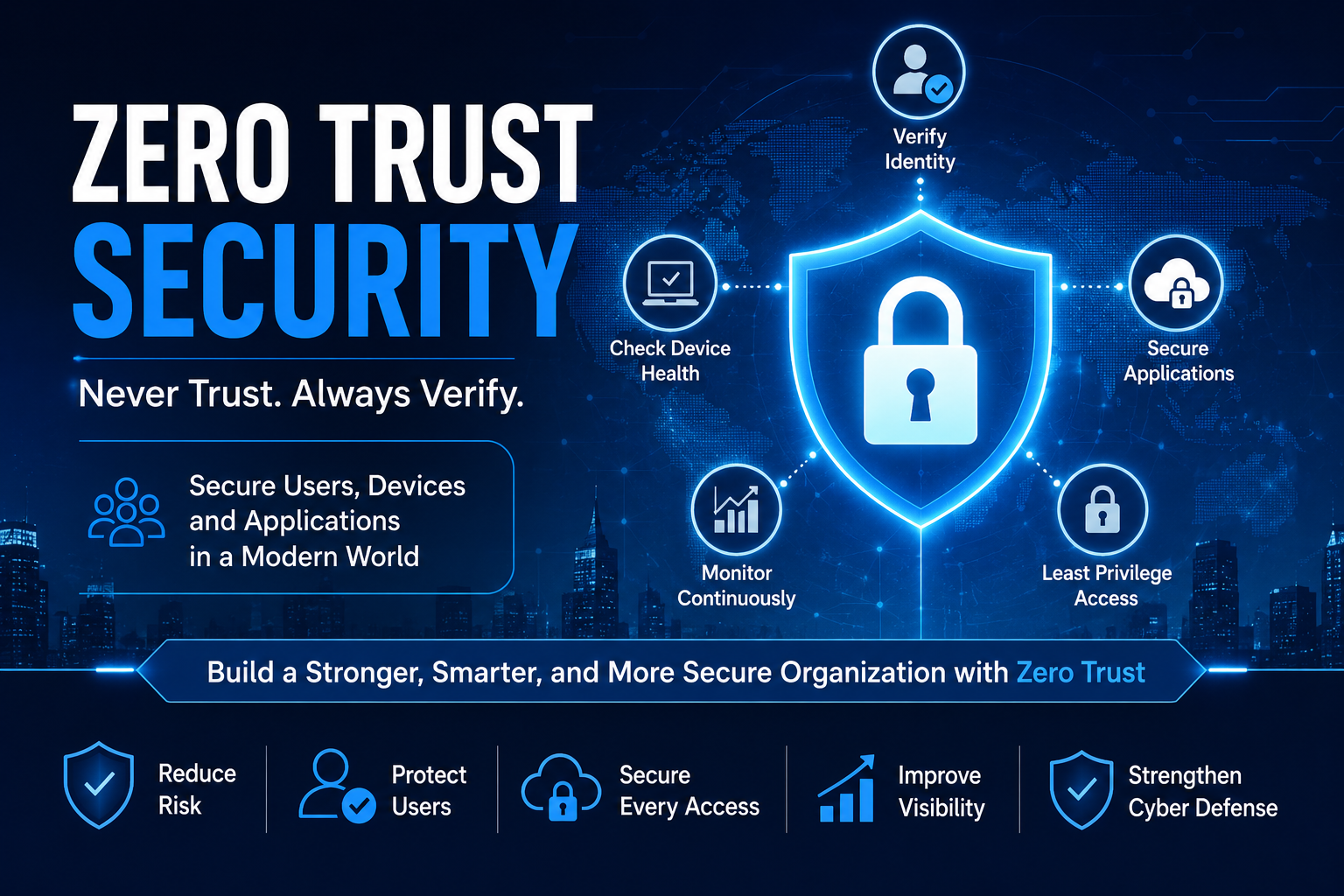
Zero Trust Security Explained: A Beginner-Friendly Guide to Modern Cybersecurity
For many years, organizations protected themselves using a simple security model: Trust users inside the company network and block everyone outside.
This approach worked when employees, applications, and data were inside office boundaries. Today cybersecurity has completely changed.
- Employees work from anywhere
- Applications run on cloud platforms
- Users connect from different devices
- Attackers target identities instead of networks
A stolen password or compromised device can give attackers access to critical business systems. This is why modern organizations are adopting Zero Trust Security.
What is Zero Trust Security?
Zero Trust follows one powerful principle:
Never Trust, Always Verify
Zero Trust means no user, device, application, or network should automatically be trusted. Every access request must be verified before allowing access.
Zero Trust asks:
- Who is requesting access?
- Is the identity verified?
- Is the device secure?
- Where is the request coming from?
- What application is required?
- Is the activity suspicious?
Zero Trust is not just a product. It is a complete cybersecurity strategy.
Why Do Companies Need Zero Trust?
1. Passwords Are No Longer Enough
Cyber attackers commonly use:
- Phishing attacks
- Stolen passwords
- Compromised accounts
- Weak authentication
Zero Trust assumes every login attempt needs verification. This is why companies use:
- Multi-Factor Authentication (MFA)
- Identity Security
- Conditional Access Policies
- User Behavior Monitoring
2. VPN Access Creates Security Risks
Traditional VPN provides users access to the corporate network. If attackers compromise VPN credentials, they may move deeper inside the environment.
Zero Trust changes this approach:
User → Verification → Required Application Only
Users receive access only to applications they need.
Main Components of Zero Trust Architecture
1. Identity Verification
Identity becomes the new security boundary. Organizations should implement:
- Strong authentication
- MFA
- Single Sign-On
- Identity monitoring
2. Device Security Validation
A trusted user with an infected laptop is still a security risk. Before allowing access, organizations should verify:
- Security updates
- Endpoint protection
- Device compliance
- Encryption status
3. Least Privilege Access
Zero Trust follows a simple rule:
Give users only the access required to perform their job.
For example: A finance employee should access finance applications, not developer servers or databases.
4. Continuous Monitoring
Security verification should continue even after login. Monitor:
- User activities
- Application access
- Data movement
- Unusual behavior
Practical Steps to Achieve Zero Trust
Step 1: Identify Important Assets
Start by identifying:
- Critical applications
- Business data
- Users
- Devices
Step 2: Secure User Identity
- Enable MFA everywhere
- Remove unused accounts
- Control administrator privileges
- Monitor risky logins
Step 3: Move From Network Access to Application Access
Traditional model:
User → Network → Multiple Applications
Zero Trust model:
User → Verification → Specific Application
Step 4: Reduce Attack Surface
Hide internal applications from the public internet. Allow access only through secure Zero Trust solutions.
Step 5: Protect Sensitive Data
Implement:
- Data Loss Prevention (DLP)
- Encryption
- Access monitoring
- Data classification
Zero Trust and Zscaler
Modern Zero Trust platforms like Zscaler help organizations securely connect users, devices, and applications without exposing internal networks.
Cyberseal Infosec Solutions helps businesses design and implement enterprise Zero Trust solutions using Zscaler technology.
Learn more: Zscaler Zero Trust Security Services
Build Your Career in Zero Trust Security
Zero Trust skills are becoming important for cybersecurity roles including:
- Zero Trust Engineer
- Zscaler Engineer
- Cloud Security Engineer
- Security Consultant
- Security Architect
Professionals who understand technologies like Zscaler have strong opportunities in modern cybersecurity careers.
Start practical Zero Trust learning here: Zscaler Zero Trust Training Course
Final Thoughts
Zero Trust does not mean trusting nobody. It means continuously verifying everything.
The future of cybersecurity is moving from:
"Where are you connecting from?"
to
"Who are you, what device are you using, and should you get access?"
Zero Trust is not just a technology change. It is a modern cybersecurity mindset.