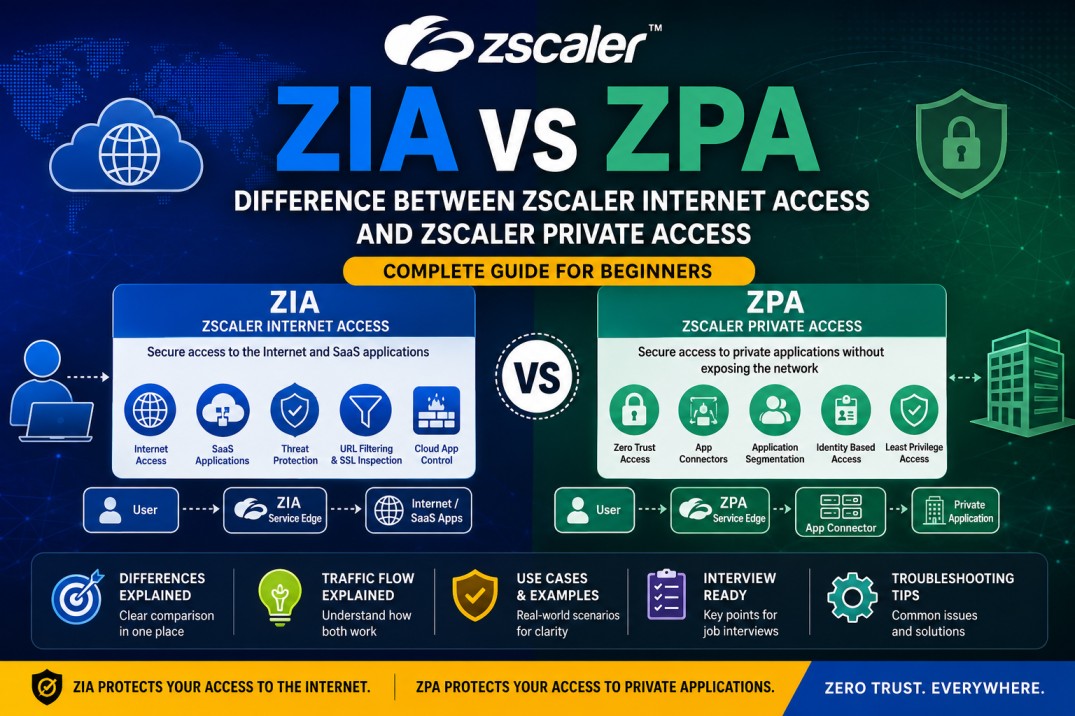
ZIA vs ZPA: Difference Between Zscaler Internet Access and Zscaler Private Access
Confused between ZIA and ZPA? This beginner-friendly guide explains the difference between Zscaler Internet Access and Zscaler Private Access with use cases, traffic flow, security controls, policies, examples, troubleshooting scenarios and interview-ready explanations.
If you are learning Zscaler, one of the first questions you will face is: What is the difference between ZIA and ZPA?
Many beginners assume ZIA and ZPA are similar because both are Zscaler products and both are related to secure access. But they solve two different problems.
Simple answer: ZIA secures user access to the internet and SaaS applications. ZPA secures user access to private internal applications without exposing the network.
Understanding this difference is very important for Zscaler interviews, cloud security roles, Zero Trust learning, SASE discussions, support troubleshooting and real-world implementation.
ZIA and ZPA in Simple Words
ZIA
Zscaler Internet Access
ZIA protects users when they access the internet, websites, cloud applications and SaaS platforms.
- Internet security
- SaaS security
- URL filtering
- SSL inspection
- Firewall policy
- Cloud app control
- Malware and threat protection
ZPA
Zscaler Private Access
ZPA gives users secure access to private applications hosted in data centers, public cloud or private environments.
- Private app access
- VPN replacement
- ZTNA
- Application segmentation
- App Connectors
- User-to-app access
- Least privilege access
Easy Memory Trick
ZIA = Internet Access. Think of users going out to the internet and SaaS apps.
ZPA = Private Access. Think of users going into private internal applications securely.
What Is ZIA?
ZIA stands for Zscaler Internet Access. It is used to secure user access to the internet and SaaS applications. Instead of sending internet traffic back to a traditional data center security stack, traffic is forwarded to Zscaler cloud service edges where policies are applied.
Zscaler documentation describes traffic forwarding as the method of sending traffic to the Zscaler service, using mechanisms such as Zscaler Client Connector, PAC files, tunneling and Cloud Connector depending on environment and requirements. :contentReference[oaicite:1]{index=1}
What ZIA Helps With
- Blocking malicious websites
- Controlling access to risky URL categories
- Inspecting encrypted HTTPS traffic where policy allows
- Controlling SaaS application usage
- Preventing malware downloads
- Applying outbound firewall rules
- Protecting users working from anywhere
- Applying consistent internet security policies
ZIA Traffic Flow Example
User Device → Client Connector / PAC / Tunnel → ZIA Service Edge → Internet / SaaS AppExample
A user tries to open a newly registered domain that may be risky. ZIA checks the URL category, threat reputation and policy. If the site is not allowed, ZIA blocks the request and logs the policy action.
What Is ZPA?
ZPA stands for Zscaler Private Access. It is used to provide secure access to private internal applications. Unlike traditional VPN, ZPA does not give users broad network access. Instead, it provides application-specific access based on identity, policy and context.
Zscaler describes ZPA as secure private access with Zero Trust connectivity, user-to-app segmentation and context-aware policies. Zscaler also notes that ZPA can replace legacy tools like VPNs and VDI in many use cases. :contentReference[oaicite:2]{index=2}
What ZPA Helps With
- Secure access to internal applications
- Replacing or reducing dependency on VPN
- Application-level access instead of network-level access
- Least privilege access
- Reducing lateral movement risk
- Hiding private applications from the public internet
- Supporting users working from anywhere
- Securing private applications in data centers or cloud
ZPA uses components such as App Connectors and application segments. Zscaler documentation explains that App Connectors are typically deployed on network segments that can access secured applications and the Private Access cloud, and application segments are used to define applications for access control. :contentReference[oaicite:3]{index=3}
ZPA Access Flow Example
User Device → Client Connector → ZPA Cloud → App Connector → Private AppExample
A finance user needs access to an internal ERP application hosted in a private data center. ZPA checks the user identity, group membership, application segment and access policy. If allowed, the user connects only to that application, not the full corporate network.
ZIA vs ZPA: Quick Comparison Table
| Area | ZIA | ZPA |
|---|---|---|
| Full Name | Zscaler Internet Access | Zscaler Private Access |
| Main Purpose | Secure internet and SaaS access. | Secure private application access. |
| Direction of Access | User to internet / SaaS. | User to private internal app. |
| Traditional Replacement | Secure web gateway, proxy, outbound firewall stack. | VPN / private app access model. |
| Common Controls | URL filtering, SSL inspection, cloud app control, firewall, DLP, malware protection. | Access policy, application segments, App Connectors, user-to-app segmentation. |
| Traffic Type | Internet-bound and SaaS traffic. | Private application traffic. |
| User Experience | User browses websites and SaaS apps securely. | User accesses approved private apps without traditional VPN. |
| Security Model | Cloud-delivered internet security. | Zero Trust Network Access for private apps. |
| Example Use Case | Block malware websites and risky cloud apps. | Allow HR team access to internal HR application. |
Traffic Flow Difference Between ZIA and ZPA
The easiest way to understand the difference between ZIA and ZPA is to understand traffic direction.
ZIA Traffic Flow
ZIA handles traffic that goes from the user to the internet or SaaS applications.
Example: User opens Gmail, LinkedIn, Salesforce, GitHub, YouTube or any public website.
ZPA Traffic Flow
ZPA handles traffic that goes from the user to private internal applications.
Example: User opens an internal HR portal, finance app, intranet, private API or internal admin tool.
Beginner tip: If the destination is a public website or SaaS app, think ZIA. If the destination is an internal private application, think ZPA.
Policy Difference Between ZIA and ZPA
ZIA and ZPA both use policies, but the purpose of those policies is different.
| Policy Area | ZIA | ZPA |
|---|---|---|
| Policy Goal | Control and secure access to internet/SaaS resources. | Control access to private applications. |
| Common Matching Criteria | User, group, location, URL category, cloud app, destination, protocol, file type. | User, group, application segment, device posture, access policy, context. |
| Common Policy Action | Allow, block, caution, inspect, bypass, apply DLP or cloud app control. | Allow or deny access to private application segments. |
| Example | Block personal cloud storage upload for finance users. | Allow finance users to access ERP application only. |
Interview-Ready Explanation
ZIA policies decide what users can do on the internet and SaaS applications. ZPA policies decide which private applications users can access. ZIA is more about secure outbound internet access, while ZPA is more about Zero Trust private app access.
Security Controls Difference
ZIA and ZPA protect different types of access, so their control areas are also different.
ZIA Security Controls
- URL filtering
- Cloud app control
- Firewall control
- SSL/TLS inspection
- Malware protection
- Sandboxing
- DLP
- File type control
- DNS security
- Bandwidth control
ZPA Security Controls
- User-to-application access
- Application segmentation
- App Connector-based private access
- Least privilege access
- Identity-based access
- Context-aware policy
- Private app invisibility
- Device posture-based access
- VPN replacement use cases
- Reduced lateral movement exposure
Use Case Examples: When to Use ZIA and When to Use ZPA
| Scenario | Use ZIA or ZPA? | Why? |
|---|---|---|
| User wants to browse the internet securely. | ZIA | ZIA secures internet-bound traffic. |
| User wants to access Salesforce or Microsoft 365. | ZIA | These are SaaS applications accessed over the internet. |
| User wants to access an internal HR portal hosted in a private data center. | ZPA | This is private application access. |
| Organization wants to replace traditional VPN for private applications. | ZPA | ZPA provides Zero Trust application-specific access. |
| Security team wants to block malware websites. | ZIA | ZIA provides URL filtering and threat protection. |
| Only finance users should access the finance application. | ZPA | ZPA access policy can restrict private app access by user/group. |
| Organization wants to inspect HTTPS traffic for threats. | ZIA | ZIA supports SSL/TLS inspection for internet traffic where policy permits. |
| Private application should not be exposed to the public internet. | ZPA | ZPA enables private access through App Connectors without broad inbound exposure. |
How ZIA and ZPA Work Together
ZIA and ZPA are not competitors. They are complementary. Many organizations use both together as part of a Zero Trust or SASE architecture.
Combined ZIA + ZPA View
- User accesses public internet or SaaS → ZIA applies internet security policies.
- User accesses private internal application → ZPA applies private access policies.
- Zscaler Client Connector can help steer traffic to the right Zscaler service.
- Identity and policy become central to access decisions.
- Users get secure access without relying only on traditional perimeter security.
Zscaler’s Zero Trust Exchange is described as a cloud-native platform that securely connects users, apps and devices using business policies over any network and from any location. :contentReference[oaicite:4]{index=4}
Simple architecture message: ZIA protects what users access on the internet. ZPA protects how users access private applications. Together, they help organizations move toward Zero Trust access.
Common Beginner Confusion
Confusion 1: “ZIA and ZPA both provide access, so they are the same.”
No. ZIA provides secure internet/SaaS access. ZPA provides secure private application access.
Confusion 2: “ZPA is just another VPN.”
No. VPN usually provides network-level access. ZPA provides application-specific Zero Trust access.
Confusion 3: “ZIA is only a web filter.”
No. ZIA includes multiple security controls such as URL filtering, firewall, cloud app control, SSL inspection, DLP and threat protection.
Confusion 4: “ZPA is only for remote users.”
ZPA is commonly used for remote access, but the concept is broader: secure application access based on identity and policy.
Confusion 5: “All traffic goes to both ZIA and ZPA.”
No. Traffic is steered based on destination and configuration. Internet-bound traffic generally goes to ZIA, while private app traffic goes to ZPA.
Confusion 6: “ZIA replaces ZPA.”
No. They solve different problems and often work together.
Interview-Ready Explanation of ZIA vs ZPA
Use the following answer in interviews when asked, “What is the difference between ZIA and ZPA?”
Short Interview Version
ZIA secures internet and SaaS access. ZPA secures private application access. ZIA is like a cloud secure web gateway. ZPA is like a Zero Trust alternative to VPN for private apps.
Real-World ZIA vs ZPA Scenarios
Scenario 1: YouTube is blocked for a user
Likely product: ZIA
Why: YouTube is an internet/SaaS destination. You would check ZIA web logs, URL category, cloud app policy and matched rule.
Scenario 2: User cannot access internal HR application
Likely product: ZPA
Why: Internal HR application is a private application. You would check ZPA access policy, application segment, App Connector health and user group membership.
Scenario 3: Salesforce upload is blocked
Likely product: ZIA
Why: Salesforce is a SaaS app, and upload activity may be controlled by cloud app control or DLP policy.
Scenario 4: VPN replacement project for private apps
Likely product: ZPA
Why: ZPA is commonly used to provide private app access without traditional VPN-style network access.
Scenario 5: SSL inspection breaks a banking website
Likely product: ZIA
Why: SSL inspection applies to internet/HTTPS traffic. You would check certificate trust, SSL inspection policy and bypass requirements.
Scenario 6: Only one group should access a private finance app
Likely product: ZPA
Why: ZPA access policy can allow a specific user group to access a defined application segment.
Troubleshooting Difference: ZIA vs ZPA
| Issue | Check in ZIA | Check in ZPA |
|---|---|---|
| Website blocked | Web logs, URL category, policy rule, SSL inspection, cloud app control. | Usually not ZPA unless destination is a private application. |
| Private app not opening | Check if traffic is incorrectly going to internet path. | Check access policy, app segment, App Connector, DNS and user group. |
| Slow SaaS application | Check forwarding, ZIA path, SSL inspection, policy and network latency. | Not usually a ZPA issue unless app is private. |
| User denied access | Check matched policy, location, user group and destination. | Check ZPA policy, app segment, identity group and posture conditions. |
| Certificate error | Check Zscaler root certificate, SSL inspection and bypass rules. | Check application certificate if private app access is involved. |
Which One Should You Learn First: ZIA or ZPA?
For most beginners, it is better to learn ZIA first because it connects with common concepts such as proxy, web filtering, SSL inspection, firewall rules, SaaS control and traffic forwarding.
After that, learn ZPA because it introduces Zero Trust private application access, App Connectors, application segments and identity-based access policy.
Learn ZIA First If You Are From
- Network security
- Firewall administration
- Proxy support
- SOC operations
- Web security
- IT support
Learn ZPA Next If You Want
- Zero Trust access skills
- VPN replacement knowledge
- Private application access skills
- ZTNA understanding
- Identity-based access control
- Cloud security career growth
Recommended path: Networking basics → Proxy/DNS/TLS basics → ZIA → Traffic forwarding → SSL inspection → ZPA → App Connector → Application segments → Troubleshooting.
ZIA vs ZPA for Job Roles
| Job Role | ZIA Relevance | ZPA Relevance |
|---|---|---|
| Zscaler Support Engineer | Very high | Very high |
| Network Security Engineer | Very high | High |
| Cloud Security Analyst | High | High |
| SOC Analyst | Medium to high | Medium |
| Zero Trust Engineer | High | Very high |
| Service Desk / IT Support | Medium | Medium |
| Security Architect | Very high | Very high |
Common Interview Questions on ZIA vs ZPA
1. What is the main difference between ZIA and ZPA?
ZIA secures internet and SaaS traffic, while ZPA secures private application access.
2. Is ZPA a VPN?
No. ZPA is a Zero Trust private access solution. It provides application-specific access instead of broad network access like traditional VPN.
3. Can ZIA and ZPA work together?
Yes. Organizations often use both together. ZIA protects internet and SaaS access, while ZPA protects private application access.
4. Which product uses App Connectors?
ZPA uses App Connectors to connect authorized users to private applications.
5. Which product uses URL filtering and SSL inspection?
ZIA commonly uses URL filtering and SSL inspection for internet-bound traffic.
Useful Official Resources
Related CybersecurityTRAIN.com Guides and Courses
Final Thoughts: ZIA vs ZPA Explained Clearly
ZIA and ZPA are both important parts of the Zscaler ecosystem, but they serve different purposes.
Final Summary
- ZIA secures internet and SaaS access.
- ZPA secures private application access.
- ZIA is commonly associated with secure web gateway, proxy, firewall, URL filtering, SSL inspection and cloud app control.
- ZPA is commonly associated with Zero Trust Network Access, App Connectors, application segments and VPN replacement.
- ZIA protects users going out to the internet.
- ZPA protects users accessing private applications.
- Together, they help organizations build a stronger Zero Trust access model.
Final career message: A strong Zscaler candidate should clearly explain not only what ZIA and ZPA stand for, but also when to use each one, how traffic flows, what policies apply and how to troubleshoot real-world access issues.
Want to Learn ZIA, ZPA and Zscaler Practically?
At CybersecurityTRAIN.com, we help learners build practical Zscaler skills through structured training in ZIA, ZPA, ZDX, Zero Trust, traffic forwarding, policy management, SSL inspection and troubleshooting scenarios.
If you want to specialize in Zero Trust, SASE and cloud security operations, explore our Zscaler training program.
Explore Zscaler Training Course Read Zscaler Career RoadmapCall or WhatsApp: +91 98857 89887
Frequently Asked Questions
1. What is the main difference between ZIA and ZPA?
ZIA secures user access to the internet and SaaS applications, while ZPA secures user access to private internal applications.
2. Is ZPA a replacement for VPN?
ZPA can be used as a modern Zero Trust alternative to traditional VPN for private application access because it gives users access to specific applications rather than broad network access.
3. Is ZIA a firewall?
ZIA includes firewall capabilities, but it is broader than a firewall. It can include URL filtering, cloud app control, SSL inspection, DLP, malware protection and other internet security controls.
4. Which is better: ZIA or ZPA?
Neither is better universally. They solve different problems. Use ZIA for internet and SaaS security. Use ZPA for private application access.
5. Can ZIA and ZPA be used together?
Yes. Many organizations use both together. ZIA secures internet/SaaS traffic, while ZPA secures private app access.
6. Which product uses App Connectors?
ZPA uses App Connectors to provide secure connectivity between authorized users and private applications.
7. Which product uses SSL inspection?
ZIA commonly uses SSL/TLS inspection for internet-bound HTTPS traffic where policy permits inspection.
8. Which should I learn first, ZIA or ZPA?
Most beginners should learn ZIA first because it builds understanding of proxy, internet traffic, URL filtering, SSL inspection and traffic forwarding. Then learn ZPA for private app access and Zero Trust.
9. Is ZIA used for SaaS applications?
Yes. ZIA is used to secure SaaS and internet access, including applying policies for cloud applications.
10. Where can I learn ZIA and ZPA practically?
You can explore the Zscaler Training Course at CybersecurityTRAIN.com, which covers ZIA, ZPA, ZDX, Zero Trust, traffic forwarding, policy management and troubleshooting.