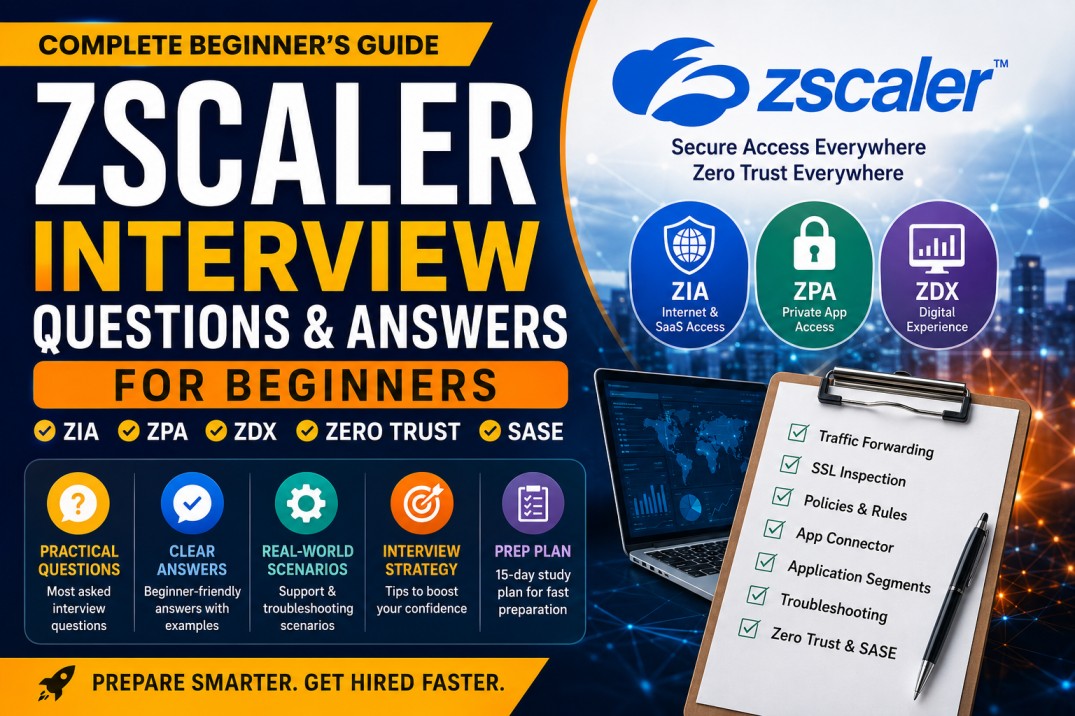
Zscaler Interview Questions and Answers for Beginners: ZIA, ZPA, ZDX and Zero Trust
Preparing for a Zscaler interview? This beginner-friendly guide explains practical interview questions and answers on ZIA, ZPA, ZDX, Zero Trust, SASE, traffic forwarding, SSL inspection, policy management, troubleshooting and real-world support scenarios.
Zscaler has become an important skill for professionals working in cloud security, network security, secure internet access, Zero Trust, remote access, SASE and managed security services. Many organizations are moving away from traditional perimeter-based security and adopting cloud-delivered security platforms.
For beginners, Zscaler can look confusing because it includes multiple products and concepts such as ZIA, ZPA, ZDX, Client Connector, traffic forwarding, PAC files, GRE/IPsec tunnels, SSL inspection, app segments, App Connectors, policy rules and Zero Trust.
Simple career message: Zscaler is a specialized cybersecurity skill. If you understand the basics of ZIA, ZPA, ZDX, traffic forwarding, policies and troubleshooting, you can stand out from generic cybersecurity candidates.
This article is written for freshers, network engineers, firewall/proxy engineers, cloud security learners, SOC analysts, support engineers and working professionals preparing for Zscaler interviews.
Why Zscaler Skills Are in Demand
Modern organizations need secure access for users working from offices, homes, branches, public networks and mobile devices. Traditional security models relied heavily on data center firewalls and VPNs. But today, users access SaaS apps, private apps, cloud workloads and internet resources from everywhere.
Zscaler skills are valuable because they connect multiple areas:
Cloud Security
Zscaler helps organizations secure internet, SaaS and private application access through cloud-delivered security services.
Zero Trust
Zscaler is strongly associated with Zero Trust access models where users get access based on identity, context and policy instead of broad network access.
Network Security
Zscaler requires understanding of DNS, proxy, tunnels, PAC files, GRE, IPsec, ports, routing and traffic steering.
Security Operations
Zscaler administrators and support engineers investigate blocked traffic, user access issues, SSL inspection problems and application reachability issues.
Best Fit Candidates
Zscaler is a strong skill for network engineers, security operations engineers, cloud security learners, firewall/proxy administrators, service desk engineers and cybersecurity professionals who want to specialize in Zero Trust and SASE.
What Interviewers Expect from Beginners
For beginner or junior Zscaler roles, interviewers usually do not expect you to know every advanced configuration. But they expect strong fundamentals and practical thinking.
- Basic understanding of ZIA, ZPA and ZDX
- Difference between internet access and private application access
- Basic traffic forwarding methods
- Understanding of proxy, DNS, ports, TLS and certificates
- Basic SSL inspection concept
- Policy rule matching and troubleshooting approach
- App Connector and application segment concepts for ZPA
- Client Connector awareness
- Ability to explain real-world scenarios clearly
Interview tip: Do not memorize only product names. Learn what problem each product solves. ZIA secures internet and SaaS access. ZPA secures private application access. ZDX helps monitor user digital experience.
Basic Zscaler Interview Questions and Answers
1. What is Zscaler?
Sample AnswerZscaler is a cloud-delivered security platform that helps organizations provide secure access to internet, SaaS and private applications using Zero Trust principles. It includes solutions such as Zscaler Internet Access, Zscaler Private Access and Zscaler Digital Experience.
2. What are the main Zscaler products beginners should know?
Sample AnswerThe main products beginners should understand are:
- ZIA: Zscaler Internet Access for secure internet and SaaS access.
- ZPA: Zscaler Private Access for secure access to private applications.
- ZDX: Zscaler Digital Experience for monitoring user experience and performance.
- Zscaler Client Connector: Endpoint agent used to steer user traffic and enable ZIA, ZPA and ZDX capabilities.
3. What is the difference between ZIA and ZPA?
Sample AnswerZIA is used to secure user access to the internet and SaaS applications. It acts like a cloud security gateway with features such as URL filtering, cloud app control, firewall, malware protection, DLP and SSL inspection.
ZPA is used to provide secure access to private internal applications without exposing the network. It connects authorized users to specific applications based on identity and policy.
4. What is Zscaler Client Connector?
Sample AnswerZscaler Client Connector is an endpoint application installed on user devices. It helps steer traffic to Zscaler services and enables secure access through ZIA and ZPA. It also supports user identity, posture and experience monitoring depending on configuration.
5. What is Zero Trust in simple words?
Sample AnswerZero Trust means never automatically trusting a user or device only because it is inside a network. Access is granted based on identity, device posture, application, location, risk and policy. In simple terms, users should get access only to what they need, not the entire network.
ZIA Interview Questions and Answers
6. What is ZIA?
Sample AnswerZIA stands for Zscaler Internet Access. It is used to secure user access to internet and SaaS applications. It provides cloud-delivered security controls such as URL filtering, cloud app control, firewall, sandboxing, malware protection, DLP and SSL/TLS inspection.
7. What are common ZIA policies?
Sample AnswerCommon ZIA policies include:
- URL filtering policy
- Cloud app control policy
- Firewall policy
- SSL inspection policy
- File type control policy
- DLP policy
- Malware protection policy
- Bandwidth control policy
8. What is URL filtering in ZIA?
Sample AnswerURL filtering is used to allow or block websites based on categories, reputation, user groups, locations and policy rules. For example, an organization may block adult content, malware sites, newly registered domains or personal storage websites based on business policy.
9. What is Cloud App Control?
Sample AnswerCloud App Control is used to manage access to cloud applications and specific activities within those applications. For example, an organization may allow access to a cloud storage service but block file uploads or sharing depending on policy.
10. What is ZIA firewall policy?
Sample AnswerZIA firewall policy controls outbound traffic based on source, destination, protocol, port, application, user, location and other criteria. It helps enforce network security policy for traffic going through Zscaler.
11. How do you troubleshoot a website blocked by ZIA?
Sample AnswerI would first check the user, location, URL, time of issue and error message. Then I would review ZIA logs to identify which policy blocked the request. I would check URL category, rule name, action, user group, SSL inspection behavior and whether the site is blocked by URL filtering, cloud app control, file type, firewall or malware policy.
ZPA Interview Questions and Answers
12. What is ZPA?
Sample AnswerZPA stands for Zscaler Private Access. It provides secure access to private applications using Zero Trust principles. Instead of giving users network-level access like a traditional VPN, ZPA gives users access only to authorized private applications.
13. How is ZPA different from VPN?
Sample AnswerA traditional VPN usually connects a user to a network. Once connected, the user may have broader network visibility depending on segmentation. ZPA provides application-specific access. Users are connected only to the applications they are authorized to access, which reduces exposure and supports Zero Trust.
14. What is an App Connector in ZPA?
Sample AnswerAn App Connector is a lightweight component deployed near private applications. It creates outbound connections to the Zscaler cloud and helps securely connect authorized users to private applications. App Connectors do not require inbound internet exposure to the application environment.
15. What is an application segment in ZPA?
Sample AnswerAn application segment defines the private application or set of applications that users can access through ZPA. It can include application FQDNs, IP addresses, ports and protocols. Access to these segments is controlled through ZPA access policies.
16. What is ZPA access policy?
Sample AnswerZPA access policy defines who can access which private application under what conditions. Policy can be based on user identity, groups, application segments, device posture, location and other contextual factors.
17. How do you troubleshoot a user unable to access a ZPA application?
Sample AnswerI would check whether the user is authenticated, Client Connector is active, the user is assigned to the correct policy, the application segment is configured correctly, the App Connector is healthy, DNS resolution is working, required ports are open and logs show whether the request is allowed or denied.
ZDX Interview Questions and Answers
18. What is ZDX?
Sample AnswerZDX stands for Zscaler Digital Experience. It helps monitor user digital experience across devices, networks, Zscaler services and applications. It is useful for identifying whether a problem is caused by user device, network, ISP, Zscaler path or application performance.
19. Why is ZDX useful?
Sample AnswerZDX is useful because users often report application slowness, but the root cause may be device, Wi-Fi, ISP, network path, DNS, cloud service or application response time. ZDX helps provide visibility into performance and user experience to speed up troubleshooting.
20. What kind of issues can ZDX help investigate?
Sample Answer- Application slowness
- High latency
- Poor Wi-Fi experience
- ISP or network path issues
- DNS resolution delays
- SaaS application performance problems
- User device performance issues
21. How would you explain ZDX to a non-technical user?
Sample AnswerZDX is like a digital experience monitoring tool that helps identify why an application feels slow or unavailable for a user. It helps teams understand whether the problem is with the laptop, Wi-Fi, internet provider, network route or the application itself.
Zero Trust and SASE Interview Questions
22. What is Zero Trust Network Access?
Sample AnswerZero Trust Network Access, or ZTNA, provides secure access to applications based on identity, context and policy. It avoids giving broad network access and instead connects users only to approved applications.
23. What is SASE?
Sample AnswerSASE stands for Secure Access Service Edge. It combines networking and security functions delivered from the cloud to support users, branches, cloud applications and remote access. It usually includes capabilities such as secure web gateway, cloud access security, firewall, ZTNA and data protection.
24. How does Zscaler support Zero Trust?
Sample AnswerZscaler supports Zero Trust by enforcing access based on identity, policy and context rather than trusting users only because they are on a corporate network. ZPA provides application-specific access to private apps, while ZIA secures internet and SaaS access through cloud-based policies.
25. What is least privilege access?
Sample AnswerLeast privilege means users should receive only the minimum access required to perform their job. In ZPA, this means users access only specific private applications they are authorized for, not the entire internal network.
Traffic Forwarding Interview Questions
26. What is traffic forwarding in ZIA?
Sample AnswerTraffic forwarding means sending user or branch traffic to Zscaler so security policies can be applied. Traffic can be forwarded using methods such as Client Connector, PAC files, GRE tunnels, IPsec tunnels, proxy chaining or browser proxy settings depending on the environment.
27. What are common ZIA traffic forwarding methods?
Sample Answer- Zscaler Client Connector
- PAC file
- GRE tunnel
- IPsec tunnel
- Proxy chaining
- Explicit proxy configuration
28. What is a PAC file?
Sample AnswerA PAC file, or Proxy Auto-Configuration file, tells the browser or system which proxy to use for specific traffic. In Zscaler deployments, PAC files can help steer web traffic to the Zscaler cloud while allowing exceptions or bypasses where required.
29. What is the difference between GRE and IPsec forwarding?
Sample AnswerGRE and IPsec are both tunnel-based methods used to forward branch traffic to Zscaler. GRE is commonly used for high-throughput forwarding where encryption may not be required at the tunnel level, while IPsec provides encrypted tunnel connectivity. The choice depends on customer design, security requirements and network environment.
30. What should you check if traffic is not reaching Zscaler?
Sample AnswerI would check the forwarding method, tunnel status, public source IP, routing, firewall rules, PAC file configuration, Client Connector status, DNS resolution and whether traffic is bypassing Zscaler due to exclusions or local network settings.
SSL Inspection Interview Questions
31. What is SSL inspection?
Sample AnswerSSL inspection allows security tools to inspect encrypted HTTPS traffic for threats, data leakage and policy violations. Without SSL inspection, many threats hidden inside encrypted traffic may not be visible to security controls.
32. Why is SSL inspection important in ZIA?
Sample AnswerMost internet traffic is encrypted. SSL inspection helps ZIA apply security controls such as malware detection, DLP, sandboxing, cloud app control and URL filtering more effectively by inspecting encrypted traffic where policy permits.
33. What can break when SSL inspection is enabled?
Sample AnswerSome applications may fail because of certificate pinning, unsupported TLS behavior, mutual TLS requirements, strict certificate validation or privacy-sensitive application behavior. In such cases, bypass rules may be needed after risk review.
34. How do you troubleshoot SSL inspection issues?
Sample AnswerI would check whether the Zscaler root certificate is installed and trusted, whether the website or application is being inspected, whether an SSL bypass rule exists, whether the application uses certificate pinning, and what error is shown in the browser or application logs.
Important Note
SSL inspection should be implemented carefully with clear policy, privacy considerations, certificate deployment, testing, bypass handling and business communication.
Policy and Troubleshooting Interview Questions
35. How does policy rule matching work in Zscaler?
Sample AnswerPolicy rule matching generally depends on configured criteria such as user, group, location, department, URL category, cloud application, destination, protocol and rule order. When troubleshooting, it is important to check which rule matched and why.
36. What logs are useful in ZIA troubleshooting?
Sample AnswerUseful logs include web logs, firewall logs, DNS logs, cloud app logs, DLP logs and admin audit logs. These logs help identify user, source location, destination, URL category, rule name, action, policy reason and timestamps.
37. How would you troubleshoot slow internet when using Zscaler?
Sample AnswerI would first confirm whether the issue affects one user, multiple users or a location. Then I would check Client Connector status, network latency, Zscaler data center path, forwarding method, DNS, SSL inspection, policy changes, bandwidth usage and whether the issue occurs only for specific sites or all traffic.
38. How would you troubleshoot a user saying “website is blocked”?
Sample AnswerI would collect the URL, username, time of issue, screenshot and business justification. Then I would check ZIA web logs to identify the matched policy, URL category, action, rule name and reason. If it is blocked correctly, I would explain the policy. If business access is required, I would follow change or exception process.
39. What is an admin audit log?
Sample AnswerAn admin audit log records administrative changes made in the platform, such as policy changes, admin actions or configuration updates. It is useful for troubleshooting recent changes and supporting governance or audit requirements.
Real-World Zscaler Support Scenarios
40. Scenario: A user can access the internet but cannot access a private application through ZPA. What will you check?
Sample AnswerI would check whether the issue is related to ZPA, not ZIA. Then I would verify Client Connector status, ZPA enrollment, user identity, group membership, access policy, application segment configuration, App Connector health, DNS resolution and application server reachability.
41. Scenario: A website works outside Zscaler but fails through Zscaler. What can be the reason?
Sample AnswerPossible reasons include URL filtering block, SSL inspection issue, firewall rule, cloud app control restriction, file type policy, malware detection, certificate pinning, authentication issue or traffic forwarding problem. I would check logs to identify the matched policy and action.
42. Scenario: Users at one branch report slow browsing. What will you check?
Sample AnswerI would check if the issue is branch-specific, tunnel status, ISP performance, latency to Zscaler, bandwidth utilization, GRE/IPsec tunnel health, DNS response, policy changes and whether only specific websites are affected. If ZDX is available, I would use it to compare user experience and network path metrics.
43. Scenario: An application breaks after enabling SSL inspection. What will you do?
Sample AnswerI would check the error message, whether the Zscaler root certificate is trusted, whether the application uses certificate pinning or mutual TLS, and whether it is safe to create an SSL bypass rule. I would document the business impact and follow approval before bypassing inspection.
44. Scenario: A user is getting different policy than expected. What will you check?
Sample AnswerI would check user identity, group membership, location, department, forwarding method, authentication status, rule order, policy criteria and logs showing the matched rule. Many policy issues happen because the user or traffic does not match the expected rule criteria.
45. Scenario: ZPA application access works for some users but not others. What will you check?
Sample AnswerI would compare working and non-working users. I would check group membership, access policy, device posture, Client Connector status, application segment, authentication status and logs. If only certain users are impacted, policy assignment or identity group mapping may be the issue.
Quick Reference Table: Zscaler Terms You Must Know
| Term | Simple Meaning | Interview Example |
|---|---|---|
| ZIA | Secure internet and SaaS access. | URL filtering, SSL inspection, firewall policy. |
| ZPA | Secure private application access. | Access internal HR app without VPN. |
| ZDX | Digital experience monitoring. | Investigate application slowness. |
| Client Connector | Endpoint agent for traffic steering and access. | User laptop forwards traffic to Zscaler. |
| App Connector | ZPA component near private apps. | Connects users to internal apps securely. |
| Application Segment | Defines private app access scope. | hr.company.com on port 443. |
| SSL Inspection | Inspection of encrypted web traffic. | Detect malware in HTTPS traffic. |
| PAC File | Proxy auto-configuration file. | Steers browser traffic to Zscaler. |
| GRE/IPsec | Tunnel-based branch forwarding. | Send branch traffic to Zscaler cloud. |
15-Day Zscaler Interview Preparation Plan
Use this plan if your Zscaler interview is coming soon and you want focused preparation.
| Days | Focus Area | Practical Task |
|---|---|---|
| Day 1–2 | Zscaler basics | Understand ZIA, ZPA, ZDX and Client Connector. |
| Day 3–4 | ZIA policies | Learn URL filtering, cloud app control, firewall and SSL inspection basics. |
| Day 5–6 | Traffic forwarding | Understand PAC, Client Connector, GRE, IPsec and proxy concepts. |
| Day 7–8 | ZPA basics | Learn App Connector, application segment and access policy. |
| Day 9 | ZDX basics | Understand digital experience monitoring and slowness troubleshooting. |
| Day 10–11 | Troubleshooting | Practice website blocked, ZPA app access, SSL inspection and slow browsing scenarios. |
| Day 12–13 | Zero Trust and SASE | Prepare simple explanations of least privilege, ZTNA and SASE. |
| Day 14 | Scenario answers | Practice answering with step-by-step investigation flow. |
| Day 15 | Mock interview | Record your answers and improve clarity and confidence. |
Preparation Tip
Build a small interview notebook with diagrams for ZIA traffic flow, ZPA architecture, Client Connector traffic steering, SSL inspection flow and common troubleshooting steps.
Common Mistakes Beginners Make in Zscaler Interviews
1. Confusing ZIA and ZPA
ZIA is for internet and SaaS access. ZPA is for private application access. This is the first concept you must be clear about.
2. Memorizing Without Understanding Traffic Flow
Interviewers often ask how traffic reaches Zscaler. Learn Client Connector, PAC, GRE and IPsec basics.
3. Ignoring Logs
Most support scenarios require log review. Understand how logs help identify policy match and block reason.
4. Weak SSL Inspection Understanding
SSL inspection is a common troubleshooting topic. Learn certificates, inspection, bypass and certificate pinning basics.
5. Not Knowing ZPA Components
Be clear about App Connectors, application segments, access policy and Client Connector role.
6. Giving One-Line Answers
For scenario questions, answer step by step: collect details, check logs, validate policy, isolate issue and recommend action.
Useful Official Resources
Related CybersecurityTRAIN.com Guides and Courses
Final Thoughts: How to Clear a Zscaler Interview
To clear a beginner Zscaler interview, focus on clarity and practical understanding. You do not need to sound like a senior architect, but you should explain ZIA, ZPA, ZDX, traffic forwarding, SSL inspection and troubleshooting in simple and structured language.
Your Zscaler Interview Success Formula
- Understand the difference between ZIA, ZPA and ZDX.
- Learn how traffic is forwarded to Zscaler.
- Understand URL filtering, firewall, cloud app control and SSL inspection.
- Learn ZPA App Connectors, application segments and access policy.
- Practice real-world troubleshooting scenarios.
- Use logs and evidence in your answers.
- Explain Zero Trust in business-friendly language.
Final career message: A strong Zscaler candidate is not someone who memorizes menu names. A strong candidate understands traffic flow, policy logic, user experience, access control and troubleshooting steps.
Want to Build Practical Zscaler Skills?
At CybersecurityTRAIN.com, we help learners build practical Zscaler skills through structured training in ZIA, ZPA, ZDX, Zero Trust, traffic forwarding, policy management, troubleshooting and real-world support scenarios.
If you want to specialize in Zero Trust, SASE and cloud security operations, explore our Zscaler training program.
Explore Zscaler Training Course Read Zscaler Career RoadmapCall or WhatsApp: +91 98857 89887
Frequently Asked Questions
1. What is asked in a Zscaler interview?
Zscaler interviews usually include questions on ZIA, ZPA, ZDX, Client Connector, traffic forwarding, SSL inspection, URL filtering, application segments, App Connectors, Zero Trust and troubleshooting scenarios.
2. Is Zscaler good for beginners?
Yes. Zscaler can be a good specialization for beginners who already understand basic networking, web traffic, DNS, proxy, ports and cybersecurity fundamentals.
3. What is the difference between ZIA and ZPA?
ZIA secures internet and SaaS access. ZPA secures access to private internal applications. ZIA is like a secure internet gateway, while ZPA is a Zero Trust private application access solution.
4. What should I learn first in Zscaler?
Start with ZIA, ZPA, Client Connector, traffic forwarding, SSL inspection, URL filtering, App Connectors, application segments and basic troubleshooting.
5. Do I need networking knowledge for Zscaler?
Yes. Basic networking knowledge is very helpful. You should understand DNS, HTTP, HTTPS, ports, proxy, routing, tunnels and certificates.
6. What is Zscaler Client Connector?
Zscaler Client Connector is the endpoint application that helps steer user traffic to Zscaler services and enables secure access through ZIA and ZPA.
7. What is an App Connector in ZPA?
An App Connector is deployed near private applications and helps securely connect authorized users to those applications through ZPA.
8. What is SSL inspection in ZIA?
SSL inspection allows ZIA to inspect encrypted HTTPS traffic for threats, data leakage and policy violations where policy allows inspection.
9. Is Zscaler related to Zero Trust?
Yes. Zscaler is strongly associated with Zero Trust because it provides access based on identity, context and policy rather than broad network trust.
10. Where can I learn Zscaler practically?
You can explore the Zscaler Training Course at CybersecurityTRAIN.com, which covers ZIA, ZPA, ZDX, Zero Trust, policy management, traffic forwarding and troubleshooting.