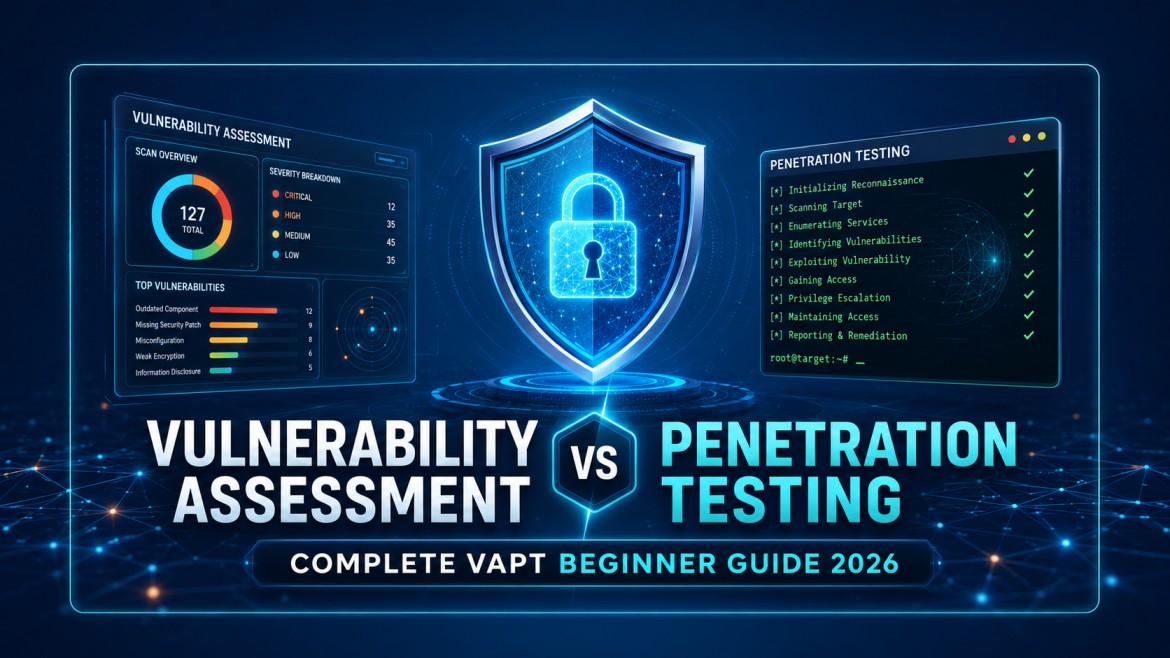
Vulnerability Assessment vs Penetration Testing: Complete VAPT Beginner Guide 2026
Vulnerability Management & VAPT
Vulnerability assessment and penetration testing are closely related cybersecurity activities, but they do not serve exactly the same purpose. A vulnerability assessment focuses on discovering, classifying and prioritizing weaknesses across systems, applications and infrastructure. A penetration test goes further by safely validating whether selected weaknesses can be exploited and what business impact an attacker could achieve.
Together, these activities are commonly described as VAPT: Vulnerability Assessment and Penetration Testing. VAPT helps organizations identify security gaps before criminals exploit them, validate whether controls work as intended and give technical teams clear remediation priorities.
What Is VAPT?
VAPT stands for Vulnerability Assessment and Penetration Testing. It combines broad vulnerability discovery with controlled security validation.
- A vulnerability assessment answers: What security weaknesses exist?
- A penetration test answers: Which weaknesses can be exploited, how far could an attacker go and what would the business impact be?
A good VAPT engagement does more than run tools. It defines a safe scope, inventories the attack surface, combines automated and manual testing, validates findings, evaluates business impact, recommends remediation and verifies fixes through retesting.
What Is a Vulnerability Assessment?
A vulnerability assessment is a systematic process for identifying, analysing and prioritising security weaknesses. It normally covers a broader set of assets than a penetration test and may be performed more frequently.
A vulnerability can be a software flaw, insecure configuration, missing patch, weak access control, exposed service, outdated protocol or design weakness that could affect confidentiality, integrity or availability.
Typical vulnerability-assessment activities
- Discovering live systems, applications and services
- Identifying operating systems and software versions
- Reviewing exposed ports and protocols
- Detecting missing security patches
- Checking insecure TLS and cryptographic configurations
- Reviewing cloud and identity configurations
- Mapping findings to CVEs and vendor advisories
- Assigning technical severity and business priority
- Recommending remediation and tracking closure
Is vulnerability assessment completely automated?
No. Automated scanners are useful for speed and coverage, but their results require human review. A scanner may report a vulnerability because it identified a software version associated with a CVE, even though the organisation has applied a backported fix or compensating control.
Scanners can also miss business-logic problems, complex authorisation weaknesses and vulnerabilities that require an understanding of how the application is intended to work.
What Is Penetration Testing?
Penetration testing is an authorised security assessment in which testers safely attempt to validate vulnerabilities and demonstrate realistic attack paths. It is more focused, hypothesis-driven and manually intensive than a typical vulnerability assessment.
The objective is not to attack everything possible. The objective is to answer specific risk questions without causing unnecessary disruption.
- Can an external attacker gain access to a customer portal?
- Can one authenticated user access another user’s records?
- Can an exposed service provide a route to an internal system?
- Can a low-privilege account obtain administrator access?
- Can cloud misconfigurations expose sensitive storage?
Penetration testing is not uncontrolled hacking
A professional penetration test operates under signed rules of engagement. The agreement defines authorised systems, testing dates, permitted techniques, data-handling requirements, emergency contacts, production-safety limitations and stop conditions.
Destructive actions, denial-of-service testing, unrestricted data extraction and persistence are normally prohibited unless separately authorised and carefully controlled.
Vulnerability Assessment vs Penetration Testing
Wide coverage
Discovers and prioritises potential weaknesses across many assets, usually with significant scanner support and manual validation.
Deep validation
Safely demonstrates which selected weaknesses are exploitable, how controls can fail and what impact could follow.
| Area | Vulnerability assessment | Penetration testing |
|---|---|---|
| Objective | Discover and prioritise weaknesses | Validate exploitability and business impact |
| Scope | Broad coverage across many assets | Focused systems or attack objectives |
| Automation | Significant automation with manual validation | Tools plus substantial manual reasoning |
| Exploitation | Usually limited to safe verification | Controlled exploitation within the approved scope |
| Frequency | Monthly, quarterly or continuous | Periodic, annual or after major changes |
| Output | Prioritised vulnerability inventory | Validated findings, attack paths and impact |
| Operational risk | Generally lower | Higher because validation can affect systems |
A scanner may report that an internet-facing server runs vulnerable software. During an authorised penetration test, the tester manually confirms the affected version, safely validates the weakness and evaluates whether it could expose data or provide access to another system.
Complete VAPT Lifecycle
1. Define the business objective
Testing begins with a clear business question. A financial application, student portal, cloud environment and corporate network present different risks and require different testing methods.
2. Establish scope and rules of engagement
The team identifies authorised assets, excluded assets, testing windows, production constraints and emergency contacts. Hostnames and IP addresses must be verified before testing begins.
3. Discover and classify assets
Asset discovery establishes what is exposed. Testers may identify hosts, services, applications, APIs, login portals, cloud storage, DNS records and technology components. Each asset should be mapped to an owner and business purpose.
4. Perform information gathering and threat modelling
Threat modelling considers critical data, trust boundaries, user roles, authentication flows, external integrations, likely attacker objectives and existing security controls.
5. Identify vulnerabilities
The team combines automated scanning, manual testing, configuration review and security knowledge. Depending on scope, this can include patch exposure, access control, authentication, input validation, encryption, cloud permissions and business logic.
6. Validate findings
Each significant finding is checked for accuracy. Validation confirms the affected asset, exact condition, supporting evidence and realistic preconditions.
7. Perform controlled exploitation where authorised
The tester uses the least invasive method capable of proving risk. If an authorisation weakness is suspected, two approved test accounts and non-sensitive test records can demonstrate the problem without accessing real customer data.
8. Evaluate attack paths and business impact
Individual weaknesses can combine into a serious attack path. The report should explain required access, attack difficulty, failed controls, affected systems, likely detection and business consequences.
9. Report findings and recommendations
Management needs overall risk and priority actions. Engineers need accurate evidence, root-cause analysis and practical corrective steps.
10. Remediate and retest
Retesting confirms that the original vulnerability is no longer reproducible, the fix covers the affected scope and no new weakness was introduced.
Black-Box, Grey-Box and White-Box Testing
| Approach | Information provided | Best suited for |
|---|---|---|
| Black box | Minimal knowledge | External attacker simulation |
| Grey box | Selected accounts and documentation | Balanced realism and coverage |
| White box | Extensive technical information | Deep and comprehensive assessment |
Grey-box testing is often the most efficient business approach because the tester can spend more time evaluating important controls while still examining realistic user-level attack paths.
Different Types of VAPT
Network VAPT
Assesses exposed services, network devices, operating systems, segmentation, remote access and security configurations.
Web application VAPT
Evaluates authentication, authorisation, sessions, input handling, file operations, business logic and sensitive-data exposure.
API security testing
Examines object-level and function-level authorisation, authentication tokens, rate limiting, input validation and data exposure.
Mobile application testing
Covers local storage, permissions, transport security, authentication, platform interaction and backend APIs.
Cloud-security assessment
Reviews identity and access management, public exposure, storage permissions, network controls, logging, key management and workload configuration.
Red teaming
Red teaming is broader than a standard penetration test. It evaluates detection and response against an adversary objective and may combine technical, physical and social-engineering methods under specialised authorisation.
Common VAPT Tools
Tools assist an assessment, but they do not replace methodology, authorisation, technical reasoning or reporting skills.
| Tool | Common purpose | Important limitation |
|---|---|---|
| Nmap | Host, port and service discovery | Results require asset and business validation |
| Nessus | Commercial vulnerability scanning | Findings may require credentials and manual validation |
| OpenVAS/Greenbone | Vulnerability assessment | Coverage depends on feeds and configuration |
| Burp Suite | Web and API security testing | Requires HTTP and application-logic knowledge |
| OWASP ZAP | Web proxy and scanning | Automation cannot replace manual authorisation testing |
| Wireshark | Authorised network-protocol analysis | Packet data may contain sensitive information |
| Metasploit | Controlled validation in authorised environments | Modules can disrupt systems |
Practical VAPT Example
Consider an organisation with an online student portal. A vulnerability assessment identifies an outdated component, missing security headers, an exposed administration page and weak TLS configuration.
Using two authorised test accounts, a penetration tester then observes that one account can request a non-sensitive test record created for the other account by changing a record identifier. The tester stops after proving the authorisation failure.
This controlled validation demonstrates broken access control and a realistic risk of unauthorised student-information access.
Recommended remediation
- Enforce server-side authorisation for every record request
- Verify that the authenticated user can access the requested object
- Use centralised authorisation middleware where possible
- Add negative authorisation tests to the development pipeline
- Review other endpoints using similar identifiers
- Log repeated unauthorised object requests
What Does a Professional VAPT Report Contain?
The executive summary explains the objective, overall security posture, major attack paths, business impact and priority actions in non-technical language.
Each technical finding should contain a clear title, affected asset, severity, evidence, preconditions, business impact, root cause, remediation, references and retesting status.
| Finding | Broken access control permits cross-user record access |
|---|---|
| Severity | High |
| Precondition | Authenticated low-privilege test account |
| Evidence | Test account A accessed a non-sensitive test record assigned to account B |
| Recommendation | Enforce server-side object authorisation and add negative tests |
What should not appear in the report?
- Unverified scanner output presented as confirmed vulnerabilities
- Real passwords, tokens or unnecessary personal information
- Generic recommendations such as “apply security”
- Severity ratings with no explanation
- Claims of compromise unsupported by evidence
CVSS and Risk Prioritisation
The Common Vulnerability Scoring System provides a standard way to communicate technical severity. CVSS v4.0 includes Base, Threat, Environmental and Supplemental metric groups.
A CVSS score ranges from 0 to 10, but technical severity is not the same as organisational risk. Prioritisation must also consider exposure, active exploitation, asset criticality, data sensitivity, business impact, privileges and compensating controls.
A medium-severity issue on an internet-facing identity system may deserve faster remediation than a technically critical issue isolated in a non-production lab.
Common VAPT Mistakes
- Treating every scanner result as confirmed
- Testing without complete written authorisation
- Using aggressive settings in production
- Focusing only on CVSS scores
- Ignoring business logic
- Writing reports without actionable remediation
- Skipping retesting
- Confusing penetration testing with red teaming
VAPT Career Roles and Required Skills
Common roles
- Vulnerability Management Analyst
- VAPT Associate
- Penetration Tester
- Application Security Analyst
- Cloud Security Analyst
- Security Consultant
- Product Security Analyst
- Red Team Operator
Technical skills
- TCP/IP, DNS, HTTP, TLS and common network protocols
- Linux and Windows fundamentals
- Web architecture and API concepts
- Authentication, sessions and authorisation
- OWASP risks and testing methodology
- Cloud and identity fundamentals
- Basic scripting with Python, PowerShell or Bash
- CVSS, evidence handling and report writing
12-week learning roadmap
- Weeks 1–2: Networking, Linux and Windows foundations
- Weeks 3–4: HTTP, APIs, authentication and OWASP risks
- Weeks 5–6: Nmap and vulnerability-scanning labs
- Weeks 7–8: Burp Suite or OWASP ZAP in authorised labs
- Weeks 9–10: Reporting, CVSS and remediation
- Weeks 11–12: Complete a scoped lab assessment and retest
A sanitised professional report can demonstrate more ability than a list of tools on a resume.
VAPT Interview Questions
What is the main difference between vulnerability assessment and penetration testing?
Vulnerability assessment focuses on discovery and prioritisation. Penetration testing validates exploitability, attack paths and business impact within an authorised scope.
Can an automated scanner replace a penetration tester?
No. Scanners improve speed and coverage but cannot reliably understand business logic, complex authorisation, chained attack paths or organisational context.
What is a false positive?
A false positive is a reported vulnerability that is not present or exploitable under the tested conditions.
Why is CVSS not the same as risk?
CVSS describes technical severity. Organisational risk also depends on exposure, asset value, threat activity, data sensitivity and compensating controls.
What should a tester do after proving a vulnerability?
Stop after collecting the minimum evidence required, avoid unnecessary access, protect the evidence and continue only when further validation is authorised.
Frequently Asked Questions
Is VAPT the same as ethical hacking?
Ethical hacking is a broad term for authorised security testing. VAPT is a structured combination of vulnerability assessment and penetration testing with defined scope, evidence, reporting and remediation.
How often should VAPT be performed?
Frequency depends on risk and rate of change. Vulnerability assessment may be continuous or monthly or quarterly. Penetration testing is commonly performed periodically, after major changes or before important releases.
Can VAPT guarantee that a system is secure?
No. VAPT provides evidence based on the agreed scope, time and techniques. New vulnerabilities, configuration changes and untested systems can still create risk.
Do beginners need programming skills?
Advanced programming is not required at the beginning, but basic scripting and the ability to read application code become increasingly valuable.
How can a fresher get practical experience?
Build an isolated lab, use intentionally vulnerable applications, practise within written authorisation, write professional reports and document remediation and retesting.
Official References
Career-focused learning
Build Practical VAPT Skills
CyberSecurityTRAIN provides mentor-led VAPT and ethical-hacking training with practical labs, vulnerability assessment, web application testing, reporting, remediation and career guidance.
Training modes: Online, hybrid and classroom training from Kukatpally, Hyderabad.
Explore VAPT training Explore internship
Call or WhatsApp: +91 98857 89887