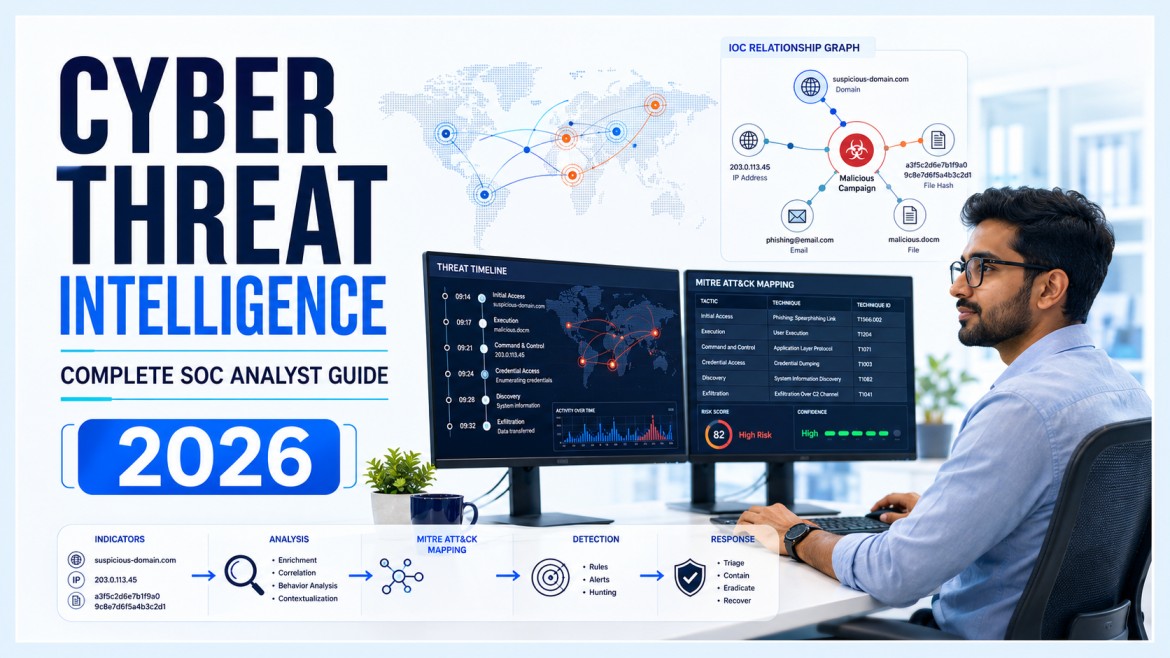
Cyber Threat Intelligence: Turn Threat Data into Action
Learn how analysts collect, validate, enrich and communicate intelligence—and then convert it into detections, hunts, blocks, investigations and better security decisions.
A threat feed may tell you that an IP address was reported as malicious. Intelligence explains who reported it, when it was observed, what activity was associated with it, whether it is relevant to your environment, how confident you should be, and what action your team should take. That difference—between receiving data and creating decision-ready insight—is the foundation of effective CTI.
This guide is designed for cybersecurity beginners, SOC analysts, incident responders and students building practical portfolios. It covers concepts, frameworks and tools, but its primary focus is the working method an analyst follows from the first question to the final recommendation.
What Is Cyber Threat Intelligence?
Cyber threat intelligence is the result of collecting relevant threat information, evaluating its reliability, analyzing it in context and communicating conclusions that support a decision. NIST describes cyber threat information broadly as information that can help organizations identify, assess, monitor and respond to threats. This can include indicators, adversary tactics and procedures, defensive recommendations and lessons from incidents.
Useful intelligence normally answers at least one meaningful question:
- Which threats are most relevant to our organization, sector, technology or geography?
- What is the adversary trying to achieve?
- Which systems, identities or business processes are exposed?
- What evidence would reveal the activity in our environment?
- What should the SOC, incident response team or leadership do next?
- How confident are we, and what important information is still missing?
Threat Data vs Information vs Intelligence
| Stage | Example | What Is Missing? | Analyst Value |
|---|---|---|---|
| Raw data | 203.0.113.77 |
Context, source, time and meaning | Very limited |
| Information | The address appeared in outbound proxy logs from one endpoint. | Reputation, purpose and relationship to other activity | Useful for triage |
| Analyzed information | The endpoint contacted the address every 60 seconds after a suspicious script executed. | Confidence, scope and recommended action | Supports investigation |
| Intelligence | Correlated endpoint, DNS and proxy evidence suggests command-and-control beaconing with high confidence; isolate the host, hunt for the behavior and block the validated infrastructure. | Continuous feedback and new evidence | Decision-ready |
Notice that the analyst did not create intelligence simply by adding more data. The value came from correlation, interpretation, confidence and an action tied to the organization’s environment.
Why Cyber Threat Intelligence Matters to a SOC
1. Faster and More Accurate Alert Triage
CTI can enrich a SIEM or EDR alert with domain age, passive DNS, certificate information, malware relationships, prior sightings and known behaviors. This helps an analyst distinguish a weak reputation match from a meaningful sign of compromise.
2. Better Detection Engineering
Threat reports can reveal behaviors that become detection opportunities: a particular command pattern, scheduled-task method, authentication sequence, network artifact or cloud API action. Behavior-based analytics generally remain useful longer than a single file hash.
3. Focused Threat Hunting
Intelligence helps hunters form relevant hypotheses. Instead of searching randomly, a team might ask: “Are exposed accounts being targeted by password spraying followed by unusual mailbox access?” The hypothesis identifies required logs, time range and investigation logic.
4. Improved Incident Response
During an incident, CTI helps analysts expand scope. A domain found on one device may lead to related IP addresses, certificates, files, phishing senders or ATT&CK techniques. Those relationships support retrospective searches across the environment.
5. Risk and Leadership Decisions
Strategic intelligence can explain why a threat matters to the business, which capabilities require investment and where exposure should be reduced. Leadership usually needs likelihood, potential impact, trend and options—not a long IOC spreadsheet.
The Four Levels of Cyber Threat Intelligence
| Level | Primary Consumer | Main Question | Typical Output |
|---|---|---|---|
| Strategic | Executives, CISO, risk leaders | How is the threat landscape changing our business risk? | Executive brief, trend assessment, investment recommendation |
| Operational | SOC managers, incident response and CTI teams | What campaign or adversary activity may affect us? | Campaign profile, targeting assessment, response preparation |
| Tactical | Threat hunters, detection engineers, blue teams | How does the adversary behave? | TTP analysis, ATT&CK mapping, hunt hypotheses |
| Technical | SOC analysts and security tools | Which specific artifacts can we search, alert on or block? | Hashes, IPs, domains, URLs, rules and signatures |
These levels overlap. A strong campaign report may give leaders a concise risk summary, provide responders with likely targets, offer hunters behavior to search for and supply the SOC with time-bound indicators. The presentation changes according to the audience.
Begin with Intelligence Requirements
Many weak CTI programs begin by purchasing feeds and collecting everything. Strong programs begin with decisions. An intelligence requirement states what a consumer needs to know and why it matters.
Example Priority Intelligence Requirements
- Which adversary behaviors are most likely to target our remote-access and identity services?
- Are threat actors exploiting vulnerabilities in technologies present on our internet-facing assets?
- Which phishing themes, brands and delivery methods are targeting employees in our sector?
- Is observed ransomware activity likely to affect our business-critical systems?
- What cloud account compromise techniques should our SOC be prepared to detect?
Make a Requirement Actionable
A useful requirement has a consumer, scope, timeframe, decision and delivery format. Compare these examples:
| Weak Request | Improved Requirement |
|---|---|
| Tell us about ransomware. | Identify ransomware initial-access and lateral-movement behaviors observed against Indian technology companies during the last 90 days so the SOC can validate logging and detection coverage. |
| Find malicious IPs. | Identify and validate infrastructure associated with the phishing campaign seen in our email gateway this week so responders can scope exposure and apply time-bound controls. |
The Cyber Threat Intelligence Lifecycle
The CTI lifecycle is iterative. Feedback can refine the original question, expose collection gaps or trigger new analysis.
- Planning and direction: Define the consumer, decision, intelligence requirement, priority, scope, deadline and handling restrictions.
- Collection: Gather relevant internal telemetry and external reporting. Collect only what supports the requirement and document provenance.
- Processing: Normalize formats, remove duplicates, extract observables, translate timestamps, tag data and prepare it for analysis.
- Analysis and production: Correlate evidence, assess reliability, test competing explanations, map relationships, state confidence and develop conclusions.
- Dissemination: Deliver the right product to the right audience through a report, ticket, dashboard, SIEM rule, briefing or threat-intelligence platform.
- Feedback and evaluation: Ask whether the product answered the question, led to action, created false positives or revealed a new requirement.
Internal and External Intelligence Sources
Internal Sources
Internal data shows what is relevant to your environment and often provides the most valuable context:
External Sources
- Government alerts and advisories
- Vendor and security-research reports
- Sector information-sharing communities
- Open-source intelligence, including passive DNS and certificate data
- Malware repositories and sandbox reports
- Commercial or community threat feeds
- Vulnerability and exploit information
- Trusted peer organizations and incident-response partners
How to Evaluate a Source
Do not treat all sources equally. Record the following:
- Provenance: Who created the information, and how close were they to the original observation?
- Reliability: Has this source been accurate and transparent in the past?
- Recency: When was the artifact first and last observed?
- Corroboration: Do independent sources or internal logs support the claim?
- Relevance: Does it apply to your sector, technology, geography or assets?
- Bias and limitations: What might the source not see, or what incentive may influence its reporting?
A source can be reliable while a specific claim remains uncertain. Keep source reliability separate from confidence in the analytical conclusion.
Observables, Indicators of Compromise and TTPs
Observable
An observable is a measurable fact, such as an IP address, domain, file hash, registry path, process name or user-agent string. It becomes an IOC when analysis indicates that it may represent malicious or compromised activity.
Common IOC Types
| IOC Type | Example Use | Important Context | Common Limitation |
|---|---|---|---|
| File hash | Find a known file across endpoints | Algorithm, file name, malware family, first/last seen | A minor file change produces a new cryptographic hash |
| IP address | Search proxy, firewall or EDR connections | Port, protocol, direction, time, hosting and shared use | Cloud and shared infrastructure can create false positives |
| Domain or URL | Investigate DNS and web activity | Registration, resolution history, path, redirect chain, TLS data | Domains and paths can change rapidly |
| Email artifact | Scope a phishing campaign | Sender, reply-to, subject, headers, attachment and recipient set | Display names and sending infrastructure can be spoofed or reused |
| Host artifact | Hunt for persistence or execution | Path, command line, parent process, user and timestamp | A legitimate administration pattern may look similar |
| Behavior or TTP | Detect how an adversary operates | Required telemetry, sequence, conditions and exceptions | Needs careful analytics and validation |
IOC Quality Checklist
- What exactly was observed?
- Who observed it, and can the report be traced to an original source?
- When was it first and last seen?
- What malicious behavior was associated with it?
- Is the infrastructure dedicated, compromised, shared or a public service?
- How confident are we, and what evidence supports that confidence?
- Should the control be alert-only, block, quarantine or monitor?
- When should the indicator expire or be reviewed?
The Pyramid of Pain: Prioritize Durable Intelligence
The Pyramid of Pain explains that different indicator types impose different levels of effort on an adversary when defenders detect or deny them. Hashes are precise but easy to change. IP addresses and domains may also rotate. Host and network artifacts can require more work to alter. Tools and TTPs are usually more costly for an adversary to replace.
| Indicator Level | Example | Durability | Defender Use |
|---|---|---|---|
| Hash | SHA-256 of one malicious file | Low | High-confidence search for that exact file |
| IP address | Command infrastructure address | Low to medium | Short-term search, correlation or block after validation |
| Domain | Phishing or command domain | Medium | DNS, proxy, email and certificate investigation |
| Host/network artifact | Distinct URI, service name or registry pattern | Medium to high | Behavioral analytics and hunts |
| Tool | Recognizable malware capability or protocol | High | Family detection, signatures and emulation |
| TTP | Password spraying followed by valid-account use | Higher | Behavior-focused detection and threat hunting |
The practical lesson is not to ignore hashes or IP addresses. Use them quickly, but also look for behavior that remains detectable after the adversary changes infrastructure.
Threat Intelligence Frameworks Analysts Should Know
MITRE ATT&CK
MITRE ATT&CK is a publicly available knowledge base of adversary tactics and techniques based on real-world observations. It helps teams describe behavior consistently, map incidents, build detections and create threat-hunting hypotheses.
In CTI, use ATT&CK to convert a narrative report into behaviors. If a report describes a malicious attachment launching PowerShell, creating a scheduled task and communicating over HTTPS, an analyst can map the observed actions to relevant techniques and identify required telemetry.
Read CybersecurityTRAIN’s detailed MITRE ATT&CK beginner guide for tactic-by-tactic examples and detection mapping.
Cyber Kill Chain
The Cyber Kill Chain presents an intrusion as broad phases, such as reconnaissance, delivery, exploitation, installation, command and control, and actions on objectives. It is useful for understanding attack progression and identifying opportunities to interrupt an operation. Real incidents may not follow a perfectly linear sequence.
Diamond Model
The Diamond Model examines relationships among four core features: adversary, capability, infrastructure and victim. It encourages analysts to pivot. If you discover infrastructure, what capability used it? Which victims were targeted? What other infrastructure is connected? Record how each relationship was established and avoid treating an assumption as a fact.
Framework Comparison
| Framework | Best Used For | Core View |
|---|---|---|
| MITRE ATT&CK | Behavior mapping, detection and hunting | Tactics, techniques, sub-techniques and procedures |
| Cyber Kill Chain | High-level attack progression | Phases of an intrusion |
| Diamond Model | Relationship analysis and pivoting | Adversary, capability, infrastructure and victim |
| Pyramid of Pain | Prioritizing indicator durability | Cost imposed on adversaries by detection and denial |
STIX, TAXII, MISP and TLP Explained
STIX
Structured Threat Information Expression is a language and serialization format for representing cyber threat and observable information. It can describe objects such as indicators, malware, campaigns, threat actors, attack patterns and relationships in a machine-readable form.
TAXII
Trusted Automated eXchange of Intelligence Information is an application-layer protocol for communicating CTI. A simple memory aid is: STIX structures the intelligence; TAXII transports it.
MISP
MISP is an open-source platform used to collect, correlate, share and operationalize threat information. Analysts can organize events, attributes, objects, tags, taxonomies and relationships, then distribute appropriate information to trusted communities or security tools.
Traffic Light Protocol
TLP communicates sharing boundaries. FIRST TLP 2.0 uses four labels:
| Label | Practical Meaning |
|---|---|
| TLP:RED | Restricted to the individual recipients; do not share further. |
| TLP:AMBER | Limited sharing on a need-to-know basis within the permitted community or organization. |
| TLP:GREEN | May be shared within a defined community, but not through public channels. |
| TLP:CLEAR | May be distributed without TLP-based sharing restrictions, subject to normal copyright and legal requirements. |
Useful Cyber Threat Intelligence Tools for Beginners
| Tool or Resource | Typical Use | Beginner Learning Goal |
|---|---|---|
| VirusTotal | Relationships and detections associated with files, URLs, domains and IP addresses | Interpret results without treating detection counts as a verdict |
| WHOIS/RDAP | Registration and allocation information | Identify registrar, dates and ownership context while recognizing privacy limitations |
| Passive DNS | Historical relationships between domains and IP addresses | Build an infrastructure timeline and identify pivots |
| Certificate transparency search | Certificates and related hostnames | Discover connected subdomains and infrastructure |
| MITRE ATT&CK Navigator | Visualize adversary behavior or detection coverage | Create an evidence-based technique layer |
| MISP | Manage, correlate and share threat intelligence | Create an event with attributes, context, tags and handling rules |
| SIEM and EDR | Search internal telemetry and validate relevance | Convert an external indicator into an internal scoped investigation |
| CyberChef | Decode, transform and inspect data | Safely decode common encodings without executing content |
Practical CTI Investigation: From Suspicious Domain to SOC Action
Scenario
An endpoint alert shows a script interpreter connecting to billing-update.example, which resolves to 203.0.113.77. The connection repeats every 60 seconds. The user recently received a message about an overdue invoice.
The domain and IP address in this exercise are reserved for documentation and do not represent live malicious infrastructure.
Step 1: Define the Investigation Question
Do not begin with “Is this IP malicious?” A better requirement is:
Step 2: Preserve the Original Evidence
- Alert ID and original alert fields
- Endpoint name, user, IP address and asset criticality
- Process name, full command line, parent process and file hash
- Destination domain, resolved IP, port, protocol and timestamps
- DNS, proxy, firewall and EDR events around the same period
- Email message trace, sender, reply-to, URL and attachment metadata
Step 3: Validate Each Observable
| Observable | Validation Questions | Possible Pivots |
|---|---|---|
| Domain | When was it registered? What did it resolve to? Does it imitate a known brand? | Subdomains, name servers, certificates, historical IP addresses |
| IP address | Who owns the network? Is it shared? When was suspicious activity observed? | Other domains, ports, certificates, internal connection history |
| File hash | Was the exact file seen elsewhere? What type is it? Is it signed? | File names, family, behavior, dropped files, contacted domains |
| Did authentication pass? Who received it? Was the URL clicked? | Related senders, subjects, attachments, recipients and campaigns |
Step 4: Search Internal Telemetry
The goal is to establish scope. Search the domain and IP across DNS, proxy, firewall and endpoint telemetry. Search the file hash across endpoints. Look for the same parent-child process pattern and identify additional recipients of the email.
A Microsoft Sentinel learning query could begin like this, but table names must match your environment:
// Training example: replace tables and fields with your data model
let SuspectDomain = "billing-update.example";
let SuspectIP = "203.0.113.77";
union isfuzzy=true
(
    DnsEvents
    | where Name =~ SuspectDomain
    | project TimeGenerated, DeviceName, Evidence=Name, Source="DNS"
),
(
    DeviceNetworkEvents
    | where RemoteUrl =~ SuspectDomain or RemoteIP == SuspectIP
    | project TimeGenerated, DeviceName, InitiatingProcessFileName,
              Evidence=coalesce(RemoteUrl, RemoteIP), Source="Endpoint"
)
| order by TimeGenerated asc
For additional detection examples, use the 25 KQL queries for SOC analysts and the SIEM tools beginner guide.
Step 5: Build a Timeline
- 09:12: The email gateway delivers an invoice-themed message.
- 09:18: The user opens a link or attachment.
- 09:19: A document application launches a script interpreter.
- 09:20: The endpoint resolves the suspicious domain.
- 09:20 onward: Repeated outbound connections occur at regular intervals.
- 09:27: The endpoint attempts to access a credential-related resource.
A timeline helps distinguish isolated reputation data from a coherent behavior chain. Exact causation still requires supporting evidence.
Step 6: Map Observed Behavior to ATT&CK
| Observed Evidence | Possible ATT&CK Area | Confidence |
|---|---|---|
| Invoice-themed malicious delivery | Initial Access — Phishing | High |
| User opens the content | Execution — User Execution | Medium |
| Script interpreter starts with suspicious arguments | Execution — Command and Scripting Interpreter | High |
| Periodic outbound connections | Command and Control — application-layer protocol or web service | Medium |
| Credential-related access | Credential Access | Low pending validation |
Map what the evidence supports. Do not add techniques simply because they are common in similar campaigns.
Step 7: State an Analytical Judgment
Step 8: Recommend Actions
- Isolate the confirmed endpoint and preserve required forensic evidence.
- Disable or reset affected credentials according to the incident-response playbook.
- Block validated infrastructure with a documented expiry and review date.
- Search all telemetry for the domain, IP, file hash and behavioral sequence.
- Find and quarantine related messages; identify users who clicked or opened content.
- Create or tune behavioral detections for the process and communication pattern.
- Monitor for related activity after containment.
- Update the incident record with evidence, confidence, limitations and ownership.
See the full phishing email investigation guide for header, sender, URL and attachment analysis.
How to Operationalize Threat Intelligence in a SOC
1. Intake and Triage
Accept intelligence through defined channels. Record source, time, handling rules, confidence, related campaign and indicator expiry. Reject malformed or context-free submissions rather than silently adding them to production controls.
2. Enrichment
Add internal sightings, asset context, identity information and relevant external relationships. Automation can collect facts, but an analyst should review decisions that may disrupt business.
3. Match Intelligence to Controls
| Intelligence Output | Possible SOC Action | Validation Needed |
|---|---|---|
| High-confidence malicious file hash | EDR search, quarantine or prevention rule | File identity, source, recency and business exceptions |
| Domain tied to an active phishing campaign | Email, DNS and proxy search; time-bound block | Shared-service risk, current resolution and internal sightings |
| Password-spraying behavior | Identity analytic and threat hunt | Failure pattern, targeted users, source and follow-on success |
| Relevant vulnerability exploitation | Prioritized exposure review, mitigation and monitoring | Asset presence, exposure, exploit conditions and control coverage |
| Adversary TTPs | ATT&CK-mapped detections and purple-team validation | Required telemetry and realistic test procedure |
4. Expiration and Review
Indicators decay. Define a time-to-live based on type, source and context. Expiration does not necessarily mean deletion: keep historical intelligence for retrospective analysis while removing outdated automatic enforcement.
5. Feedback
Record whether an indicator matched, produced false positives, found an incident or led to a useful detection. This feedback improves scoring, collection and source evaluation.
6. Integrate CTI with Core SOC Processes
- Alert triage: enrich alerts and prioritize meaningful matches.
- Detection engineering: convert reports into tested analytics.
- Threat hunting: derive hypotheses from adversary behavior.
- Incident response: expand scope and anticipate likely next actions.
- Vulnerability management: prioritize exploitable and actively targeted weaknesses relevant to assets.
- Security architecture: identify telemetry and control gaps exposed by realistic threats.
How to Write an Actionable Threat Intelligence Report
A report should make the important conclusion easy to find. Use a structure such as:
- Title and date: clearly identify the topic and reporting period.
- Executive summary: explain what happened, why it matters and the recommended decision.
- Intelligence requirement: state the question the report answers.
- Key judgments: present conclusions with confidence levels.
- Scope and impact: identify affected or potentially affected assets, users and business functions.
- Evidence and analysis: show the facts, relationships, timeline and reasoning.
- ATT&CK mapping: include only evidence-supported behaviors.
- IOCs: provide type, value, first/last seen, source, confidence, context and expiry.
- Recommendations: specify actions, owners, urgency and validation criteria.
- Limitations: state collection gaps, assumptions and alternative explanations.
- Handling: apply the correct TLP or organizational classification.
Use Calibrated Confidence
Explain what confidence means in your team. For example:
- High confidence: supported by strong, consistent evidence from reliable and independent sources; important gaps are limited.
- Moderate confidence: the conclusion is credible, but evidence has gaps, ambiguity or limited corroboration.
- Low confidence: the conclusion is plausible but based on incomplete, indirect or weakly corroborated information.
Confidence is not probability and should not hide uncertainty. A low-confidence warning about a high-impact scenario can still deserve collection or monitoring.
Common CTI Mistakes and How to Avoid Them
| Mistake | Why It Fails | Better Practice |
|---|---|---|
| Collecting every available feed | Creates duplicates, noise and maintenance effort | Collect against defined intelligence requirements |
| Confusing reputation with proof | Shared infrastructure and stale reports cause false positives | Correlate time, context and internal evidence |
| Blocking without expiry | Controls become stale and may disrupt legitimate activity | Use confidence, ownership, expiry and review criteria |
| Overstating attribution | Different actors can reuse tools, infrastructure and techniques | Separate observed facts, analytical judgments and unknowns |
| Listing ATT&CK techniques without evidence | Produces misleading coverage and incident records | Map only observed or strongly supported behavior |
| Sending the same report to everyone | Executives get excessive detail while analysts lack artifacts | Tailor the product to each consumer and decision |
| Ignoring internal telemetry | External intelligence remains disconnected from actual risk | Validate relevance against assets, identities and logs |
| Measuring feed volume | Large numbers do not prove security value | Measure decisions, detections, findings and reduced investigation time |
Six Beginner CTI Portfolio Projects
1. Phishing Campaign Intelligence Report
Use a safe sample or simulation. Document message characteristics, infrastructure, likely behavior, ATT&CK mapping, defensive searches and an executive summary.
2. Threat Actor Profile with Confidence Assessment
Use multiple authoritative reports. Separate confirmed behavior from claims, map TTPs, identify targeted sectors and explain collection gaps. Do not present uncertain attribution as fact.
3. IOC Enrichment Workbook
Create a structured table containing observable type, value, source, first and last seen, internal sightings, confidence, context, action, owner and expiry.
4. ATT&CK Navigator Layer
Select one public campaign report and map only supported techniques. Add comments showing the cited evidence and propose telemetry needed for detection.
5. Intelligence-Led Threat Hunt
Turn one behavior into a hypothesis, identify data requirements, write a safe query, record results and propose a detection with false-positive considerations.
6. Weekly Strategic Threat Brief
Write one page for a fictional organization. Cover relevant developments, business exposure, confidence, recommended decisions and items to monitor. Avoid copying headlines without analysis.
30-Day Cyber Threat Intelligence Learning Roadmap
Days 22–26: Production
- Write one technical IOC note.
- Create one ATT&CK-mapped threat report.
- Write one intelligence-led hunt hypothesis and query.
- Produce one one-page executive brief.
Days 27–30: Portfolio and Interview Preparation
- Review your evidence and remove unsupported claims.
- Add confidence, limitations, handling and expiry.
- Explain your analysis aloud in five minutes.
- Publish only sanitized work that contains no sensitive or unauthorized data.
If you want guided practice across monitoring, SIEM, incident investigation and threat hunting, explore the SOC Analyst training program, SOC training in Hyderabad or the cybersecurity internship in Hyderabad.
Cyber Threat Intelligence Interview Questions
| Question | Strong Beginner Answer |
|---|---|
| What is cyber threat intelligence? | Analyzed and contextualized threat information that supports a security decision. |
| How is threat data different from intelligence? | Data is a fact or observation; intelligence adds relevance, analysis, confidence and recommended action for a consumer. |
| What are the four CTI levels? | Strategic, operational, tactical and technical intelligence. |
| What is an intelligence requirement? | A defined question tied to a consumer, scope, timeframe and decision. |
| What are the CTI lifecycle stages? | Planning, collection, processing, analysis, dissemination and feedback. |
| What is the difference between an observable and an IOC? | An observable is a measurable fact. An IOC is an observable assessed as potentially connected to malicious or compromised activity. |
| Why are TTPs valuable? | They describe adversary behavior and are generally harder to change than one hash or IP address. |
| How does MITRE ATT&CK support CTI? | It provides a shared language to map and communicate observed adversary behavior and create detections or hunts. |
| What is STIX vs TAXII? | STIX represents structured threat information; TAXII is a protocol for exchanging it. |
| How do you prevent false positives from threat feeds? | Validate source, recency, context, shared infrastructure, internal sightings, confidence and business impact before enforcement. |
| What makes an intelligence report actionable? | A clear requirement, key judgment, evidence, confidence, relevance, limitations and specific recommendations with owners. |
| How should CTI value be measured? | By decisions supported, investigations accelerated, incidents found, detections improved and false positives reduced—not feed volume. |
Frequently Asked Questions
Is cyber threat intelligence suitable for beginners?
Yes. Beginners can start with networking, operating-system basics, logs and the intelligence lifecycle, then practice safe IOC enrichment, ATT&CK mapping and report writing. Deep malware reverse engineering is not required for every entry-level CTI task.
Does a threat intelligence analyst need programming?
Programming is helpful but not mandatory at the beginning. Spreadsheet skills, research discipline, writing and log analysis come first. Python, APIs and query languages become valuable when normalizing feeds, automating enrichment and analyzing larger datasets.
What is the difference between CTI and threat hunting?
CTI develops knowledge about relevant threats and their behavior. Threat hunting proactively searches an environment using a hypothesis. Intelligence can guide the hunt, and hunt results can create new intelligence.
What is the difference between CTI and OSINT?
OSINT refers to information collected from publicly available sources. CTI is the broader analytical product and can combine OSINT with commercial reporting, trusted sharing and internal security telemetry.
Can an IOC prove that a device is compromised?
Not always. An IOC match is a lead that must be validated using time, process, network, identity, asset and source context. Some high-confidence file hashes may be highly specific, while shared IP addresses can be ambiguous.
How long should an IOC remain blocked?
There is no universal duration. Define expiry based on indicator type, source, confidence, activity and business risk. Review enforcement while retaining historical data for retrospective investigations.
Which skills matter most for a CTI career?
Analytical reasoning, research, source evaluation, concise writing, networking, logs, SIEM, OSINT, ATT&CK, incident response and communication with technical and business audiences are all important.
What should a beginner include in a CTI portfolio?
Include a sanitized investigation, IOC workbook, ATT&CK layer, intelligence-led hunt, technical report and executive brief. Show requirements, evidence, confidence, limitations and actions.
Official and Authoritative References
- NIST SP 800-150: Guide to Cyber Threat Information Sharing
- CISA Automated Indicator Sharing
- MITRE ATT&CK
- MITRE ATT&CK Navigator
- OASIS STIX Version 2.1
- OASIS TAXII Version 2.1
- MISP Documentation
- FIRST Traffic Light Protocol 2.0
- The Original Pyramid of Pain
Build Practical SOC and Threat Intelligence Skills
Move from reading threat reports to investigating evidence, writing detections and communicating decisions through mentor-led cybersecurity training and practical labs.
Explore SOC Analyst Training Explore the Internship Get Free Career Counseling