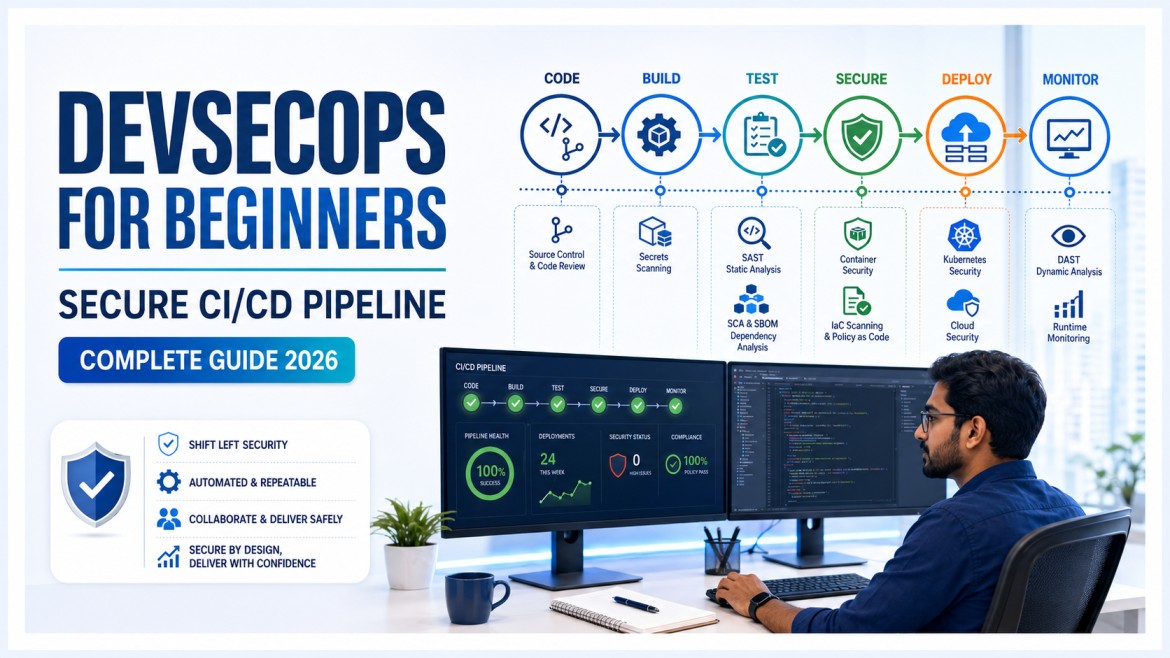
DevSecOps: Build Security into Every Software Change
Learn how development, security and operations teams design secure software, automate useful checks and protect the path from source code to production—without turning security into a last-minute release obstacle.
A vulnerable application is rarely created by one careless developer. Risk emerges from design assumptions, weak access control, unsafe dependencies, exposed credentials, permissive build systems, misconfigured cloud resources, untrusted artifacts and production changes that nobody monitors. DevSecOps addresses the complete delivery system rather than relying on a penetration test at the end.
This beginner guide explains the mindset, lifecycle, pipeline controls and practical skills needed to start with DevSecOps. It is written for students, developers, cloud and platform engineers, SOC analysts, VAPT professionals and career changers who want to understand how modern software security works in practice.
What Is DevSecOps?
DevSecOps combines development, security and operations practices so that security becomes part of everyday software delivery. The objective is not to place a security tool inside a pipeline and call the problem solved. The objective is to help the people with the best context make safe decisions at the right time, supported by automation, standards and specialist guidance.
A mature DevSecOps approach covers:
- Business and security requirements
- Secure architecture and threat modeling
- Developer training and secure coding standards
- Source-code and repository protection
- Automated testing of code, dependencies and configuration
- Build-system and artifact integrity
- Controlled, least-privilege deployment
- Runtime hardening, logging, detection and response
- Vulnerability remediation and feedback
NIST’s Secure Software Development Framework organizes high-level secure-development practices into four groups: prepare the organization, protect the software, produce well-secured software, and respond to vulnerabilities. DevSecOps provides an operating model for implementing many of those practices continuously.
DevOps vs DevSecOps vs Application Security
| Area | Primary Focus | Typical Activities | Relationship |
|---|---|---|---|
| DevOps | Fast, reliable software delivery and operations | Version control, automation, testing, CI/CD, observability and collaboration | Provides the delivery practices and platform that DevSecOps extends |
| DevSecOps | Integrating risk management throughout delivery and operations | Threat modeling, automated checks, policy, secure builds, least privilege and feedback | Connects engineering, security and operations responsibilities |
| Application Security | Protecting applications and their data | Secure design, code review, testing, penetration testing and vulnerability management | Supplies specialist practices that DevSecOps operationalizes at scale |
DevSecOps does not replace application-security experts or penetration testing. Automation finds repeatable patterns quickly, while specialists investigate complex authorization, business logic, architecture and chained attack paths. Read the VAPT beginner guide to understand how continuous testing and authorized manual validation complement each other.
Why DevSecOps Matters
Modern Software Changes Constantly
Teams may merge code and deploy infrastructure many times per day. A security review performed once before launch cannot evaluate every later code change, dependency update, container image and cloud configuration.
Applications Depend on a Software Supply Chain
A release may include source code, open-source libraries, package registries, build runners, third-party actions, container base images, artifact repositories and deployment credentials. Compromise anywhere along this path can affect the final product.
Cloud Infrastructure Is Software-Defined
Infrastructure-as-Code templates, Kubernetes manifests and policy files are reviewed and deployed like application code. This creates an opportunity to identify risky settings before provisioning—but also means repository or pipeline compromise can change production infrastructure.
Late Findings Are Expensive and Disruptive
A design-level authorization flaw discovered after release may require architecture, code, tests, data migration and emergency operational changes. Earlier feedback is easier to act on, but security must also shift right: teams need runtime visibility and incident learning after deployment.
Customers Expect Secure Products
CISA’s Secure by Design guidance emphasizes that software manufacturers should take ownership of customer security outcomes. Good defaults, strong authentication, useful logging, safe update mechanisms and transparent vulnerability handling belong in product decisions—not optional customer workarounds.
Core DevSecOps Principles
1. Security Is a Shared Engineering Responsibility
Define ownership explicitly. Developers correct code defects, service owners accept or remediate risk, platform teams harden shared delivery systems, security specialists define requirements and high-risk review, and leadership resolves priority conflicts.
2. Build Secure by Design, Not Only Shift Left
Shift-left testing is useful, but design determines trust boundaries, identity flows, authorization and data exposure. A scanner cannot repair an architecture that grants every service administrator access.
3. Automate Repeatable Checks
Automate high-signal controls that can produce fast, understandable feedback. Human review remains essential for context, exceptions and complex risks.
4. Use Risk-Based Gates
Blocking every warning causes teams to bypass security. Allowing every finding creates false assurance. Gate releases using severity, exploitability, exposure, asset sensitivity, fix availability, compensating controls and policy.
5. Make the Secure Path the Easy Path
Offer approved templates, hardened base images, reusable workflows, standard logging, secrets management and paved-road infrastructure. Developers should not need to become cryptographers or cloud-security architects to make a safe default choice.
6. Protect the Delivery System
A pipeline has authority to build and deploy trusted software. Treat it as production infrastructure: apply least privilege, isolation, audit logging, protected branches, trusted dependencies and short-lived credentials.
7. Learn from Production
Runtime events, vulnerabilities, incidents, near misses and false positives should update tests, architecture standards and developer guidance.
The Secure Software-Development Lifecycle
- Plan: Classify data, define security and privacy requirements, identify compliance obligations and establish acceptance criteria.
- Design: Model assets, trust boundaries, identities, abuse cases, external dependencies and failure modes. Select secure architecture patterns.
- Develop: Apply secure coding standards, peer review, protected branches, secrets management and approved dependencies.
- Build: Use controlled build environments, verify inputs, generate traceable artifacts and protect signing or publishing authority.
- Test: Combine unit and integration tests with SAST, SCA, secrets, IaC, container, API and dynamic security testing.
- Release: Produce an inventory, evidence, SBOM and approvals. Sign or attest artifacts when appropriate and verify provenance.
- Deploy: Use least-privilege workload identity, policy checks, environment protection, separation of duties and safe rollout methods.
- Operate: Monitor logs, vulnerabilities, configuration drift, abuse and performance. Maintain playbooks and response ownership.
- Improve: Feed incidents, vulnerabilities, user reports and operational evidence back into design, code, tests and controls.
Secure CI/CD Pipeline Stages
| Stage | Security Activities | Example Evidence |
|---|---|---|
| Pre-commit | Local linting, unit tests, secrets detection and developer guidance | Developer test results and blocked secret |
| Pull request | Peer review, SAST, SCA, IaC checks, branch protection and change approval | Review, scan reports and policy decision |
| Build | Trusted builder, pinned inputs, isolated job, minimal permissions and artifact integrity | Build log, immutable artifact digest and provenance |
| Test | Integration, API, DAST, container and policy testing in an isolated environment | Test outcomes, validated findings and coverage |
| Release | SBOM, signatures or attestations, vulnerability decision and approval | Release record, SBOM and accepted exceptions |
| Deploy | Short-lived identity, environment controls, verified artifact and policy enforcement | Deployment identity, artifact digest and change record |
| Runtime | Logging, detection, configuration monitoring, vulnerability tracking and incident response | Telemetry, alerts, incidents and remediation status |
Threat Modeling and Security Requirements
Threat modeling is a structured way to ask what can go wrong before building or changing a system. It is most valuable during design and whenever trust boundaries, sensitive data, identities or external integrations change.
A Beginner Threat-Modeling Workflow
- Define the objective and scope: What feature or service are you reviewing?
- Identify assets: Which data, credentials, functions and business processes need protection?
- Map components and data flows: Include clients, APIs, services, databases, third parties and administrative paths.
- Mark trust boundaries: Where does data or identity cross between different trust levels?
- Identify abuse cases: How could an unauthorized user misuse an intended feature?
- Define controls: Authentication, authorization, validation, encryption, rate limits, logging and recovery.
- Create testable requirements: Convert important risks into acceptance criteria and automated or manual tests.
Weak vs Testable Security Requirements
| Weak Statement | Improved Requirement |
|---|---|
| The API must be secure. | Every record request must enforce server-side authorization using the authenticated user and requested object; negative tests must prove that users cannot access another user’s records. |
| Protect sensitive data. | Classified personal data must be encrypted in transit and at rest, excluded from application logs and accessible only to approved service identities. |
| Use strong authentication. | Administrative access must require phishing-resistant MFA where supported, use short session lifetimes and generate auditable sign-in events. |
Repository and Secrets Security
Source-control systems hold code, pipeline definitions, infrastructure templates and review history. A compromised maintainer or token can change all of them.
Repository Baseline
- Require multifactor authentication and organization-managed identities.
- Protect important branches and require reviewed pull requests.
- Restrict force pushes and direct changes to release branches.
- Use CODEOWNERS or equivalent review ownership for sensitive paths.
- Separate read, write, release and administration permissions.
- Review inactive users, deploy keys, service accounts and third-party integrations.
- Enable audit logging and alert on important permission or protection changes.
- Verify commits or release artifacts when the assurance level requires it.
Secrets Management
Passwords, API keys, private keys and cloud credentials should not be stored in source code, pipeline files, container images or build logs.
- Use an approved secrets manager or workload-identity mechanism.
- Prefer short-lived, scoped credentials over long-lived secrets.
- Scan local changes, commits, pull requests and repository history.
- Mask secret values in logs and prevent debug output from exposing them.
- Rotate and revoke a credential immediately when exposure is suspected.
- Remove the secret from history only after revocation; deleting a commit does not make the credential safe.
Static Application Security Testing and Secure Coding
SAST examines source code or compiled artifacts without executing the complete application. It can identify patterns such as unsafe input handling, weak cryptography, injection risks, insecure APIs and exposed error information.
Where SAST Helps
- Fast feedback on changed code
- Consistent detection of known coding patterns
- Developer education with line-level guidance
- Trend analysis across repositories
- Support for secure-code review
SAST Limitations
SAST may produce false positives, miss framework-specific behavior and struggle with runtime context. It usually cannot understand complex business logic or prove whether a vulnerability is exploitable in production.
Practical Adoption
- Start with rules appropriate to the language and framework.
- Run fast checks on pull requests and deeper analysis separately.
- Prioritize new findings rather than blocking releases for the entire historical backlog.
- Provide a documented suppression process with reason, reviewer and expiry.
- Track confirmed defect classes and update coding guidance.
Software Composition Analysis, Dependencies and SBOMs
Modern applications use open-source and third-party components. Software Composition Analysis identifies dependencies and may associate them with known vulnerabilities, licenses and maintenance information.
Dependency Security Questions
- Which direct and transitive dependencies are included?
- Are versions locked and resolved deterministically?
- Is the package from the expected registry and maintainer?
- Is the component maintained and appropriate for production use?
- Does a reported vulnerability affect the function actually used?
- Is a fixed version available, and will the upgrade cause compatibility risk?
- Are licenses compatible with the organization’s obligations?
What Is an SBOM?
A Software Bill of Materials is a structured inventory of software components and their supply-chain relationships. It helps organizations understand what a release contains, investigate exposure and communicate component information.
An SBOM improves visibility; it does not prove that a product is secure. Quality depends on completeness, accurate versions, dependency relationships, identifiers, generation point and connection to the released artifact.
SBOM Workflow
- Generate the SBOM from the final build or artifact where practical.
- Associate it with an immutable release identifier or digest.
- Store and protect it as release evidence.
- Monitor newly disclosed vulnerabilities affecting listed components.
- Evaluate actual reachability, exploit conditions and business exposure.
- Update the SBOM when the artifact changes.
Dynamic Application Security Testing
DAST examines a running application from the outside, commonly through its web or API interface. It can identify observable behavior such as insecure headers, weak transport settings, injection opportunities, authentication problems and information exposure.
Safe DAST Practices
- Scan an isolated, representative test environment by default.
- Obtain explicit authorization and define allowed targets.
- Use dedicated test accounts and non-sensitive data.
- Start with passive or low-impact checks.
- Control scan rate, test types and stop conditions.
- Store reports securely because findings may contain sensitive details.
- Validate important results manually before escalation.
DAST does not see source code and may miss unlinked endpoints, complex authorization and logic flaws. Combine it with SAST, API specifications, manual testing and runtime evidence.
Infrastructure-as-Code Security
Infrastructure-as-Code defines cloud resources, networks, identity policies and services through versioned configuration. Security teams can review proposed infrastructure before deployment and detect drift afterward.
Common IaC Risks
Policy-as-Code Workflow
- Define policies for mandatory and prohibited configurations.
- Test templates during pull requests.
- Return precise feedback showing the resource, rule and remediation.
- Block high-confidence prohibited configurations.
- Allow controlled exceptions with owner, reason and expiry.
- Evaluate deployed resources for drift from approved configuration.
Learn the networking foundations behind subnets, routing, firewalls and segmentation in the networking fundamentals for cybersecurity guide.
Container and Kubernetes Security
Secure the Container Image
- Use a minimal, approved and maintained base image.
- Pin base images using an appropriate immutable reference.
- Remove package managers, compilers and temporary files when not required at runtime.
- Run as a non-root user where possible.
- Do not bake credentials or sensitive configuration into image layers.
- Scan operating-system packages and application dependencies.
- Generate an SBOM and associate it with the image digest.
- Promote the same tested image through environments rather than rebuilding it differently.
Secure the Kubernetes Workload
- Apply least-privilege service accounts and RBAC.
- Enforce suitable Pod Security Standards.
- Set security contexts, run as non-root and prevent privilege escalation where feasible.
- Use read-only filesystems and drop unnecessary Linux capabilities.
- Apply network policies and namespace separation.
- Protect secrets and avoid exposing them through environment dumps or logs.
- Set resource limits and monitor abnormal runtime behavior.
- Keep cluster components and workloads supported and patched.
Protecting the CI/CD Pipeline
The delivery pipeline is a high-value target because it can alter trusted software and reach production. Protect it as a privileged system.
| Risk | Example | Control |
|---|---|---|
| Excessive job permissions | Every workflow can write repository contents or deploy | Default to read-only and grant permissions per job |
| Long-lived cloud credentials | Static access key stored as a repository secret | Use workload identity or OIDC with scoped, short-lived tokens |
| Untrusted pipeline component | Third-party action referenced only by a moving tag | Review and pin trusted actions to immutable versions or commit digests |
| Untrusted code execution | Pull-request content runs with secrets or deployment authority | Separate untrusted tests from privileged jobs and protect triggers |
| Shared runner contamination | One job leaves tools, files or credentials for another | Use isolated, ephemeral runners for sensitive builds |
| Artifact substitution | Deployment uses a different image from the tested image | Promote and verify the immutable digest that passed testing |
| Log exposure | Command output prints token or customer data | Mask secrets, minimize debug output and control log access |
Why OIDC Helps
Where supported, OpenID Connect lets a workflow exchange a verifiable identity token for short-lived cloud access instead of storing a permanent credential. Security still depends on carefully restricting which repository, branch, environment and workflow can receive which role.
Software Supply-Chain Security
A software supply chain includes sources, dependencies, build services, tools, packages, artifacts and distribution systems. A trustworthy release needs evidence that the expected source produced the expected artifact through an approved process.
Key Supply-Chain Controls
- Protect source repositories and maintainer accounts.
- Review dependency origin, maintenance and update risk.
- Lock dependencies and verify integrity where the ecosystem supports it.
- Separate and harden build infrastructure.
- Produce build provenance and an SBOM.
- Sign or attest artifacts according to the required assurance level.
- Verify identity, provenance and artifact digest before deployment.
- Secure registries and restrict who can publish or overwrite releases.
SLSA in Simple Language
Supply-chain Levels for Software Artifacts is an incrementally adoptable framework for improving artifact integrity and build assurance. It is not one product. Teams use its requirements to strengthen how artifacts are produced and how provenance is generated and verified.
The current SLSA specification should be checked before designing a formal compliance target because versions and track requirements evolve. Beginners should first understand three questions:
- Can we identify the source and build process for this artifact?
- Can unauthorized users tamper with that process or its output?
- Does deployment verify that the artifact is the one we intended to trust?
Practical Secure Pipeline Design
Beginner Project Scenario
A small team maintains a containerized web API and deploys it to a controlled test environment. The objective is to build a safe learning pipeline that checks code, dependencies, secrets, infrastructure and the final image, then produces release evidence.
Use only your own repository and isolated lab resources. Replace every placeholder with an organization-approved tool and configuration before real use.
Pipeline Flow
- Pull request opens: Validate formatting, unit tests, secrets, SAST, dependencies and IaC.
- Peer review completes: Require an authorized reviewer and resolve blocking findings.
- Trusted build starts: Build in an isolated runner with read-only source permissions.
- Artifact is created: Assign an immutable digest and generate an SBOM.
- Artifact checks run: Scan the final image and verify policy.
- Test deployment occurs: Use short-lived identity and an approved test environment.
- Dynamic tests run: Perform authorized low-impact DAST and API security tests.
- Release evidence is stored: Preserve scan results, SBOM, approvals, exceptions and artifact digest.
Illustrative GitHub Actions Structure
# Educational structure—not a production-ready workflow.
# Replace placeholders with reviewed, approved and pinned tools.
name: secure-ci

on:
  pull_request:
  push:
    branches: [main]

permissions:
  contents: read

jobs:
  verify-source:
    runs-on: ubuntu-latest
    steps:
      - uses: actions/checkout@<PINNED_FULL_COMMIT_SHA>
      - name: Unit tests
        run: ./scripts/test.sh
      - name: Secrets scan
        run: ./scripts/scan-secrets.sh
      - name: Static analysis
        run: ./scripts/run-sast.sh
      - name: Dependency and license review
        run: ./scripts/run-sca.sh
      - name: IaC policy checks
        run: ./scripts/scan-iac.sh

  build-and-assess:
    needs: verify-source
    if: github.ref == 'refs/heads/main'
    runs-on: ubuntu-latest
    permissions:
      contents: read
      packages: write
    steps:
      - uses: actions/checkout@<PINNED_FULL_COMMIT_SHA>
      - name: Build artifact once
        run: ./scripts/build.sh
      - name: Generate SBOM
        run: ./scripts/generate-sbom.sh
      - name: Scan final artifact
        run: ./scripts/scan-artifact.sh
      - name: Publish immutable artifact
        run: ./scripts/publish-by-digest.sh

  deploy-test:
    needs: build-and-assess
    environment: test
    permissions:
      contents: read
      id-token: write
    steps:
      - name: Obtain short-lived deployment identity
        run: ./scripts/authenticate-with-oidc.sh
      - name: Verify and deploy approved digest
        run: ./scripts/deploy-approved-digest.sh
      - name: Run authorized dynamic tests
        run: ./scripts/run-safe-dast.sh
Why This Structure Is Safer
- Repository permissions default to read-only.
- Deployment identity is unavailable to pull-request validation.
- The artifact is built once and promoted by immutable digest.
- Security outputs become release evidence.
- Third-party actions must be reviewed and pinned.
- Dynamic testing occurs only after deployment to an authorized environment.
Security Gates and Vulnerability Prioritization
A security gate decides whether a change can proceed. Good gates are transparent, risk-based, fast and owned. They protect the organization without teaching teams to ignore or bypass security.
| Finding | Illustrative Decision | Reasoning |
|---|---|---|
| Verified live production secret in a commit | BLOCK | Revoke immediately, investigate access and remove exposure safely |
| Critical reachable vulnerability in an internet-facing component with a fix | BLOCK | High exposure and actionable remediation |
| High-severity dependency issue in an unused build-time path | REVIEW | Validate reachability, environment and compensating controls |
| New public storage resource containing sensitive data | BLOCK | Violates a clear policy requirement |
| Low-confidence style warning with no security impact | ALLOW | Track or suppress without delaying delivery |
Risk Factors Beyond Severity
- Internet exposure and attack path
- Exploit availability or known exploitation
- Reachability of the vulnerable function
- Privileges required and user interaction
- Data sensitivity and asset criticality
- Runtime environment and compensating controls
- Fix availability, regression risk and operational urgency
Exception Process
An exception should identify the finding, affected component, business reason, risk owner, compensating controls, expiration date and remediation plan. Permanent, ownerless suppressions hide risk.
DevSecOps Metrics That Support Improvement
| Metric | Useful Question | Avoid |
|---|---|---|
| Time to remediate by risk class | Are important weaknesses corrected at an appropriate speed? | One average that hides critical outliers |
| New vs inherited findings | Are teams preventing new debt while reducing the backlog? | Blocking every change because old debt exists |
| False-positive and suppression rate | Are checks producing trusted feedback? | Rewarding high finding volume |
| Security check execution and reliability | Do important pipelines consistently run required controls? | Counting a disabled or failing scan as coverage |
| Exception age | Are accepted risks reviewed and closed? | Exceptions without owners or expiry |
| Escaped defects and incidents | What reached production and how should controls improve? | Using incidents only to blame individuals |
| Developer feedback time | Can developers act while the change is still fresh? | Slow scans that teams routinely skip |
Combine security metrics with delivery outcomes such as lead time, deployment frequency, change-failure rate and recovery time. A program that reduces releases to a crawl may shift risk rather than manage it.
DevSecOps Tool Categories
| Category | Purpose | Key Evaluation Question |
|---|---|---|
| Secrets scanning | Detect credentials and sensitive patterns | Can it prevent exposure early and support rapid revocation workflows? |
| SAST | Analyze code for security weaknesses | Does it understand the team’s languages and produce actionable results? |
| SCA | Inventory dependencies, vulnerabilities and licenses | Can it resolve transitive dependencies and support prioritization? |
| DAST/API testing | Test running applications and interfaces | Can it operate safely and authenticate to cover important paths? |
| IaC scanning | Evaluate infrastructure configuration before deployment | Are rules aligned with actual cloud architecture and policy? |
| Container scanning | Assess images, packages and configuration | Does it scan the final artifact and deployed inventory? |
| Policy as code | Apply consistent guardrails to changes and deployments | Can teams understand, test and safely override policy? |
| SBOM and provenance | Describe composition and build origin | Is evidence tied to the exact immutable artifact? |
| Runtime security | Detect workload, identity and configuration threats | Does runtime feedback reach engineering and incident response? |
Do not select tools only from feature lists. Run a proof of value using your languages, repositories, risk policies, developer workflows and support capacity. Assess accuracy, feedback speed, integration security, data handling, reporting and total operational effort.
Complete Beginner DevSecOps Portfolio Project
Project: Secure a Demo API from Commit to Test Deployment
Use a simple application that you created or an intentionally educational project. Do not test public systems or deploy vulnerable applications to an exposed environment.
Project Deliverables
- Architecture diagram: Show client, API, database, build platform, registry and test environment.
- Threat model: Document assets, trust boundaries, five abuse cases and mitigations.
- Repository baseline: Protected branch, review ownership and least-privilege workflow permissions.
- Security pipeline: Unit tests, secrets, SAST, SCA, IaC and final-image checks.
- SBOM: Generate and associate it with the final artifact digest.
- Safe deployment: Use an isolated test environment and short-lived identity.
- DAST: Run authorized low-impact tests and manually validate one safe finding.
- Risk decision: Demonstrate one blocking rule and one controlled exception.
- Remediation: Fix a test weakness and show the successful retest.
- Final report: Explain design, evidence, limitations and improvements.
What Recruiters Should See
- Why each control exists
- How you reduced false positives
- How identity and permissions were restricted
- How the tested artifact was connected to the deployed artifact
- How you handled exceptions and sensitive outputs
- What the automation could not evaluate
Explore additional ideas in 15 cybersecurity projects for beginners.
DevSecOps Roles, Skills and 12-Week Roadmap
Common Roles
- DevSecOps Engineer
- Application Security Engineer
- Product Security Engineer
- Cloud Security Engineer
- Platform Security Engineer
- Software Supply-Chain Security Engineer
- Security Automation Engineer
- Container or Kubernetes Security Engineer
Foundational Skills
12-Week Learning Plan
- Weeks 1–2: Git, Linux, networking, HTTP, APIs and basic scripting.
- Weeks 3–4: DevOps concepts, CI/CD, build artifacts, test environments and observability.
- Weeks 5–6: Secure coding, threat modeling, SAST, SCA, secrets and vulnerability triage.
- Weeks 7–8: Cloud IAM, IaC, containers, registries and Kubernetes fundamentals.
- Weeks 9–10: SBOMs, provenance, supply-chain risks, policy as code and runtime feedback.
- Weeks 11–12: Complete the portfolio project, document tradeoffs and practice interviews.
The Cloud Security Career Roadmap 2026 provides an adjacent path covering cloud platforms, IAM, Zero Trust, DevSecOps skills and certifications.
DevSecOps Interview Questions and Answers
| Question | Strong Beginner Answer |
|---|---|
| What is DevSecOps? | It integrates security responsibilities and feedback throughout software planning, development, delivery and operations. |
| Is DevSecOps only shift left? | No. Earlier feedback matters, but secure design, pipeline protection, runtime visibility and incident learning are equally important. |
| What is SAST? | Analysis of source code or compiled artifacts without executing the complete application to identify security patterns. |
| What is DAST? | Security testing of a running application through observable interfaces such as web or API endpoints. |
| What is SCA? | Software Composition Analysis inventories third-party dependencies and evaluates vulnerabilities, versions and licenses. |
| What is an SBOM? | A structured inventory describing software components and their supply-chain relationships for a specific artifact or release. |
| Why should pipelines use OIDC? | It can replace stored long-lived cloud credentials with scoped, short-lived access based on verified workflow identity. |
| Why pin pipeline dependencies? | Immutable references reduce the risk that a moving tag or upstream change silently alters trusted pipeline code. |
| How should security gates work? | They should be fast, transparent and risk-based, with clear ownership and a controlled, expiring exception process. |
| Can scanners replace penetration testing? | No. Scanners provide repeatable coverage, while authorized specialists evaluate complex logic, exploitability, architecture and attack paths. |
| What is artifact provenance? | Verifiable information describing where and how an artifact was produced. |
| How do you measure DevSecOps success? | Use outcomes such as important risks remediated faster, fewer escaped defects, reliable control execution, reduced false positives and safer delivery. |
Frequently Asked Questions
Is DevSecOps suitable for cybersecurity beginners?
Yes, but beginners should first learn Git, Linux, networking, application basics and CI/CD. DevSecOps connects software, cloud, security and operations, so foundations make the tools easier to understand.
Does a DevSecOps engineer need to be a developer?
You do not need to be a senior application developer, but you should be able to read code, understand build processes, write scripts, review configuration and communicate practical fixes with engineering teams.
Which security scan should run first?
Fast, high-signal checks such as secrets, linting and targeted code or dependency analysis should give early feedback. Deeper tests can run after basic verification or on a scheduled basis. The exact order depends on architecture and risk.
Should every vulnerability block a release?
No. Blocking should consider severity, exploitability, reachability, exposure, asset criticality, compensating controls and policy. Verified secrets and prohibited high-risk configurations usually require immediate action, while ambiguous findings need review.
Is an SBOM the same as a vulnerability report?
No. An SBOM inventories components and relationships. A vulnerability report evaluates known weaknesses and context. An SBOM can support vulnerability analysis but does not prove whether a component is exploitable.
What is the difference between DevSecOps and cloud security?
DevSecOps focuses on securely delivering and operating software. Cloud security covers the broader protection of cloud identities, networks, data, services, configurations and workloads. The domains overlap heavily through IaC, containers and deployment identity.
Can DevSecOps eliminate all software vulnerabilities?
No. It reduces risk through better design, earlier feedback, controlled delivery, runtime monitoring and faster response. Tools, people and processes all have limitations, and new vulnerabilities continue to emerge.
What is the best first DevSecOps project?
Secure a small application you own: create a threat model, add secrets/SAST/SCA/IaC checks, build one container, generate an SBOM, deploy it to an isolated test environment and document one remediation and retest.
Official and Authoritative References
- NIST SP 800-218: Secure Software Development Framework Version 1.1
- NIST SP 800-218 Revision 1 Initial Public Draft
- CISA Secure by Design
- OWASP DevSecOps Guideline
- SLSA Specification Version 1.2
- OpenSSF Scorecard
- NTIA Minimum Elements for an SBOM
- GitHub Actions Secure Use Reference
- Kubernetes Security Checklist
- Kubernetes Application Security Checklist
Build Practical Cloud, VAPT and DevSecOps Foundations
Strengthen the networking, cloud, application-security and hands-on project skills that support a DevSecOps career through mentor-led training and practical learning.
Explore VAPT Training Explore the Internship Get Free Career Counseling