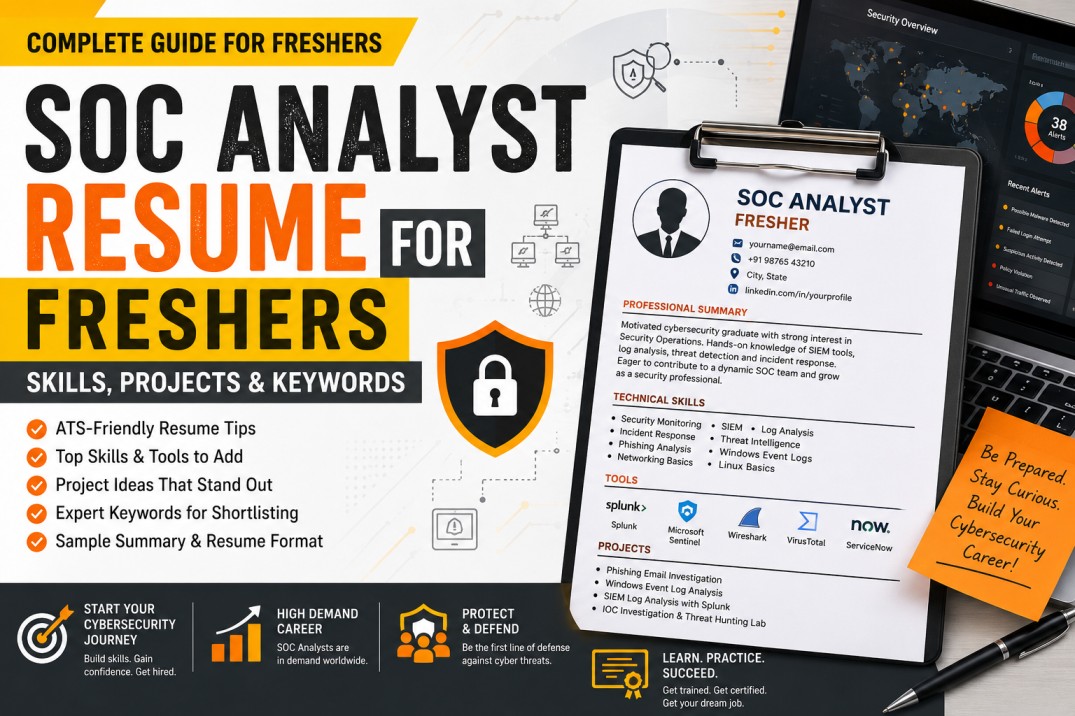
SOC Analyst Resume for Freshers: Skills, Projects and Keywords
If you want to start your cybersecurity career as a SOC Analyst, your resume must do one important job: convince recruiters that even if you are a fresher, you understand security basics, can think like an analyst, and are serious about learning real-world SOC operations.
Many freshers complete a cybersecurity course, add a few tools to their resume, and start applying. But most resumes still get ignored. Why? Because they do not clearly show skills, practical exposure, project work, tools, investigation mindset, and job relevance.
The good news is that a fresher can still create a strong SOC Analyst resume. You do not need years of experience to make a recruiter notice you. What you need is a clean resume structure, the right cybersecurity keywords, relevant projects, tool awareness, and a professional summary that clearly shows your direction.
Main idea: A good SOC Analyst fresher resume should not try to look “overloaded.” It should look focused, practical, clean, and job-ready.
In this guide, you will learn exactly how to build a strong SOC Analyst resume for freshers, including what to write, what to avoid, what skills to include, what projects to add, and how to make your resume more ATS-friendly.
Why Most SOC Analyst Fresher Resumes Fail
Common Problems
- Too generic profile summary
- No SOC-specific projects
- Only course names, no practical skills
- No SIEM, phishing, alert handling or log analysis mention
- Too much theory and no job relevance
- Weak formatting and no focus
What Recruiters Want
- Clear interest in SOC and Blue Team work
- Basic knowledge of incident handling
- Hands-on awareness of SIEM or log analysis
- Security projects or lab work
- Understanding of phishing, malware, alerts or event logs
- Professional and ATS-friendly format
Important: A fresher resume does not need fake experience. It needs credible evidence of readiness.
What Recruiters Look for in a Fresher SOC Analyst Resume
If you are applying for L1 SOC Analyst, Junior SOC Analyst, Security Operations Analyst, or Cybersecurity Analyst entry-level roles, recruiters usually look for a mix of the following:
- Basic understanding of cybersecurity concepts
- Knowledge of alerts, incidents, logs and monitoring
- Awareness of SIEM platforms such as Splunk, QRadar, Sentinel or Elastic
- Understanding of phishing analysis, malware basics, Windows Event IDs or IOC-based investigation
- Incident response awareness
- Hands-on labs, mini-projects or internship exposure
- Communication and documentation ability
- A clear career focus toward security operations
Recruiter mindset: “This candidate may be a fresher, but do they understand the role and can they be trained quickly?”
Best Resume Format for SOC Analyst Freshers
For freshers, the best approach is a clean one-page or two-page resume with clear sections. Do not make it overdesigned. Keep it simple and readable.
| Section | What to Include | Priority |
|---|---|---|
| Header | Name, mobile number, email, city, LinkedIn, GitHub or portfolio if relevant | High |
| Professional Summary | 2–4 lines focused on SOC role, skills and direction | High |
| Technical Skills | SOC, SIEM, Windows logs, phishing, incident response, networking basics, Linux basics | High |
| Tools | Splunk, Wireshark, VirusTotal, Any.Run, Microsoft Sentinel, QRadar, Elastic, ServiceNow, etc. | High |
| Projects / Labs | 2–4 strong practical SOC-related projects | Very High |
| Education | Degree, college, year, percentage/CGPA if good | Medium |
| Certifications / Training | SOC training, Security+, CEH basics, internship, online labs | High |
| Soft Skills | Analytical thinking, communication, documentation, teamwork | Medium |
Best Headline and Profile Summary Examples
Resume Headline Examples
Profile Summary Example 1
Cybersecurity fresher with strong interest in Security Operations Center activities, including log analysis, phishing email investigation, SIEM monitoring and incident response basics. Trained in SOC concepts, Windows Event IDs, Splunk fundamentals, and security alert triage. Looking for an entry-level SOC Analyst role to apply practical knowledge and continue learning in a real-world security operations environment.
Profile Summary Example 2
Detail-oriented cybersecurity learner with hands-on exposure to SIEM, phishing analysis, incident handling workflow and basic threat detection concepts. Completed practical SOC training with project experience in alert analysis, IOC investigation and Windows security log review. Eager to begin a career as an L1 SOC Analyst and contribute to monitoring and incident response processes.
Tip: Your summary should answer 3 things quickly: Who are you? What do you know? What role are you targeting?
Technical Skills to Add in a SOC Analyst Resume
Security Basics
- CIA Triad
- Threats & Vulnerabilities
- Attack Vectors
- IOC Basics
- MITRE ATT&CK Awareness
SOC Skills
- Alert Triage
- Log Analysis
- Phishing Investigation
- Incident Escalation
- Security Monitoring
Platform Basics
- Windows Security Logs
- Linux Basics
- Networking Fundamentals
- TCP/IP Basics
- DNS / HTTP / HTTPS Basics
Best Skill Categories to Mention
- Security monitoring and alert triage
- SIEM fundamentals
- Phishing email analysis
- Windows Event ID analysis
- Basic incident response process
- Threat intelligence basics
- IOC and URL/file hash analysis
- Basic networking and packet understanding
- Documentation and ticket handling
Tools to Mention in a SOC Resume
You should only mention tools that you can explain confidently in an interview. Even basic exposure is okay if you are honest.
| Tool Category | Examples | How to Mention on Resume |
|---|---|---|
| SIEM | Splunk, QRadar, Microsoft Sentinel, Elastic | Used for log analysis, alert review and basic detection understanding |
| Threat Intel | VirusTotal, AbuseIPDB, OTX | Used for IOC enrichment and suspicious artifact validation |
| Packet / Traffic Analysis | Wireshark | Used to inspect packets and understand suspicious traffic patterns |
| Sandbox / Malware Analysis | Any.Run, Hybrid Analysis | Used to inspect suspicious file or URL behavior |
| Ticketing / Workflow | ServiceNow, Jira | Used for incident tracking, documentation and escalation workflows |
| OS / Logs | Windows Event Viewer, Linux terminal | Used to review logs and basic system activity |
Best Projects to Add in a SOC Analyst Fresher Resume
If you are a fresher, projects can act like mini-experience. Good projects show your practical interest in SOC operations.
Project 1: Phishing Email Investigation
Analyze a suspicious email using headers, links, URLs, attachments and threat intelligence sources like VirusTotal. Document findings and classification.
Project 2: Windows Event Log Analysis
Review Windows Event IDs related to login attempts, account lockouts or process creation. Identify suspicious activity patterns.
Project 3: SIEM Log Analysis Lab
Use Splunk or another SIEM lab environment to search logs, filter events and understand basic detection and alert review workflow.
Project 4: IOC Investigation
Investigate malicious IPs, hashes or domains using public threat intelligence tools and document findings in analyst format.
Project 5: Brute Force Detection Scenario
Analyze login failure events and identify suspicious repeated authentication attempts from a source system or IP.
Project 6: Incident Escalation Simulation
Create a sample SOC workflow showing alert intake, validation, severity assessment, escalation and incident documentation.
Best practice: For each project, mention objective, tools used, what you analyzed, and what conclusion you reached.
How to Write Project Points on Resume
Can Freshers Add Internship or Training Experience?
Yes, definitely. If you have done SOC training, internship, project-based training or lab-based hands-on practice, mention it properly.
Example
Cybersecurity Training Program – SOC Analyst Track
CybersecurityTRAIN.com | 2026
- Completed training in SIEM basics, phishing analysis, Windows Event IDs, incident response workflow and threat detection fundamentals.
- Performed lab exercises on alert review, IOC analysis and basic security log investigation.
- Built hands-on projects aligned with junior SOC Analyst responsibilities.
ATS Keywords for SOC Analyst Resume
ATS means Applicant Tracking System. Many companies use ATS to scan resumes before a recruiter sees them. So your resume should naturally include role-relevant keywords.
Strong SOC Resume Keywords
- SOC Analyst
- Security Operations Center
- SIEM
- Log Analysis
- Alert Triage
- Incident Response
- Phishing Analysis
- Threat Intelligence
- Windows Event Logs
- Blue Team
- IOC Analysis
- Security Monitoring
- Splunk
- QRadar
- Microsoft Sentinel
- MITRE ATT&CK
- Malware Analysis Basics
- Ticketing
- Incident Documentation
- Cybersecurity Analyst
Use these keywords naturally. Do not stuff them randomly.
Sample SOC Analyst Fresher Resume Structure
Common Mistakes to Avoid
Mistake 1: Generic Objective
Do not write: “Looking for a challenging role in a reputed organization.” Make it SOC-specific.
Mistake 2: Mentioning Too Many Tools
Only mention tools you can explain. Interviewers can quickly catch fake claims.
Mistake 3: No Projects
Without projects, your resume may look too theoretical. Projects add practical value.
Mistake 4: Weak Formatting
Messy formatting reduces readability and professionalism. Use clean headings and spacing.
Mistake 5: Too Much Irrelevant Content
Remove unrelated school achievements or outdated content unless directly useful.
Mistake 6: No SOC Focus
Your resume should clearly show that you want a SOC Analyst role, not a random IT job.
Final Resume Checklist Before Applying
- Is your resume targeted specifically to SOC Analyst roles?
- Have you added a strong cybersecurity-focused summary?
- Have you included SOC-related skills and tools?
- Have you added 2–4 practical projects?
- Have you used role-specific ATS keywords naturally?
- Is your formatting clean and professional?
- Can you explain everything written on the resume?
- Have you checked spelling, grammar and contact details?
Golden rule: If you write it on your resume, be ready to explain it confidently in the interview.
Useful Related Guides
Want Help Building a SOC Analyst Career?
At CybersecurityTRAIN.com, we help freshers and career starters learn SOC concepts step by step with practical training in SIEM, phishing analysis, incident response, Windows logs, investigation workflow and job-oriented preparation.
If you want to build a strong SOC Analyst profile, prepare for interviews and gain practical exposure, explore our SOC training program.
Explore SOC Analyst Training Read SOC Career RoadmapCall or WhatsApp: +91 98857 89887
Frequently Asked Questions
1. Can a fresher become a SOC Analyst?
Yes. Many companies hire freshers for entry-level SOC roles if they have the right basic skills, practical projects, security awareness and a focused resume.
2. What should a fresher include in a SOC Analyst resume?
A fresher should include a strong summary, technical skills, tools, projects, training, certifications, education and role-specific keywords relevant to SOC operations.
3. Which projects are best for a SOC Analyst fresher resume?
Good projects include phishing email analysis, Windows Event ID analysis, SIEM log investigation, IOC analysis and basic alert triage simulations.
4. Is internship mandatory for a SOC resume?
No. Internship is helpful, but not mandatory. Strong training projects and lab-based practical work can also strengthen your resume.
5. Which tools should I mention as a fresher?
You can mention SIEM tools such as Splunk, QRadar, Microsoft Sentinel or Elastic, along with tools like Wireshark, VirusTotal, Any.Run, Windows Event Viewer and ServiceNow, if you have genuine exposure.
6. How long should a fresher SOC Analyst resume be?
Usually one page is enough, but two pages are acceptable if your projects and skills are relevant and well-presented.
7. What are the best ATS keywords for a SOC Analyst resume?
Useful ATS keywords include SOC Analyst, SIEM, alert triage, log analysis, phishing analysis, incident response, Windows Event Logs, threat intelligence, IOC analysis and security monitoring.
8. Should I add soft skills in a SOC resume?
Yes. Analytical thinking, communication, documentation, teamwork and attention to detail are valuable for SOC Analyst roles.
9. Can I add online labs and self-practice projects?
Yes. If the labs are relevant and you can explain what you did, they are useful additions to a fresher SOC resume.
10. What is the biggest mistake freshers make in SOC resumes?
The biggest mistake is making the resume too generic. A SOC resume should clearly show security operations focus, relevant tools, practical exposure and job-readiness.